
View full specs
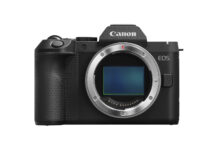
In this Canon R8 review, the real question is whether Canon’s lightest full-frame mirrorless body gives you enough camera without forcing too many compromises. The short answer: the R8 is a strong full-frame upgrade for travel, portraits, family work, and hybrid shooting. It is not a tiny R6 Mark II.
Should you buy the Canon R8 before the R8 Mark II?
Canon has not officially announced an EOS R8 Mark II, but current reporting points to a possible September 15 announcement. If you do not need a camera immediately, wait for confirmed specifications and pricing. Our Canon EOS R8 Mark II tracker separates official information from unconfirmed claims and compares the expected upgrade with the discounted R8.
Who the Canon R8 is really for
This Canon R8 review is mainly for photographers who want full-frame image quality without carrying a large body. If you are moving up from APS-C, an older Rebel DSLR, an EOS RP, or a compact travel camera, the R8 gives you a meaningful jump in autofocus, low-light flexibility, depth of field control, and video quality.
I see the R8 as a camera for people, travel, street, lifestyle, family, lightweight event work, and everyday full-frame photography. It is also a smart second body for Canon RF shooters who want something smaller than an R6-series camera. What it is not is a rugged workhorse with every professional safety feature.
If you are still deciding between full frame and a smaller APS-C Canon body, our Canon R50 review is useful context. As a system, the R50 is cheaper and lighter. Choose the R8 when full-frame image quality and shallow depth of field matter more.
Canon R8 specs that matter
Canon’s official EOS R8 product page lists the essentials: a 24.2MP full-frame CMOS sensor, Dual Pixel CMOS AF II, 4K video up to 60 fps, and high-speed electronic shooting. The important practical detail is simple. The R8 borrows heavily from the R6 Mark II’s imaging pipeline while keeping a much smaller, simpler body.
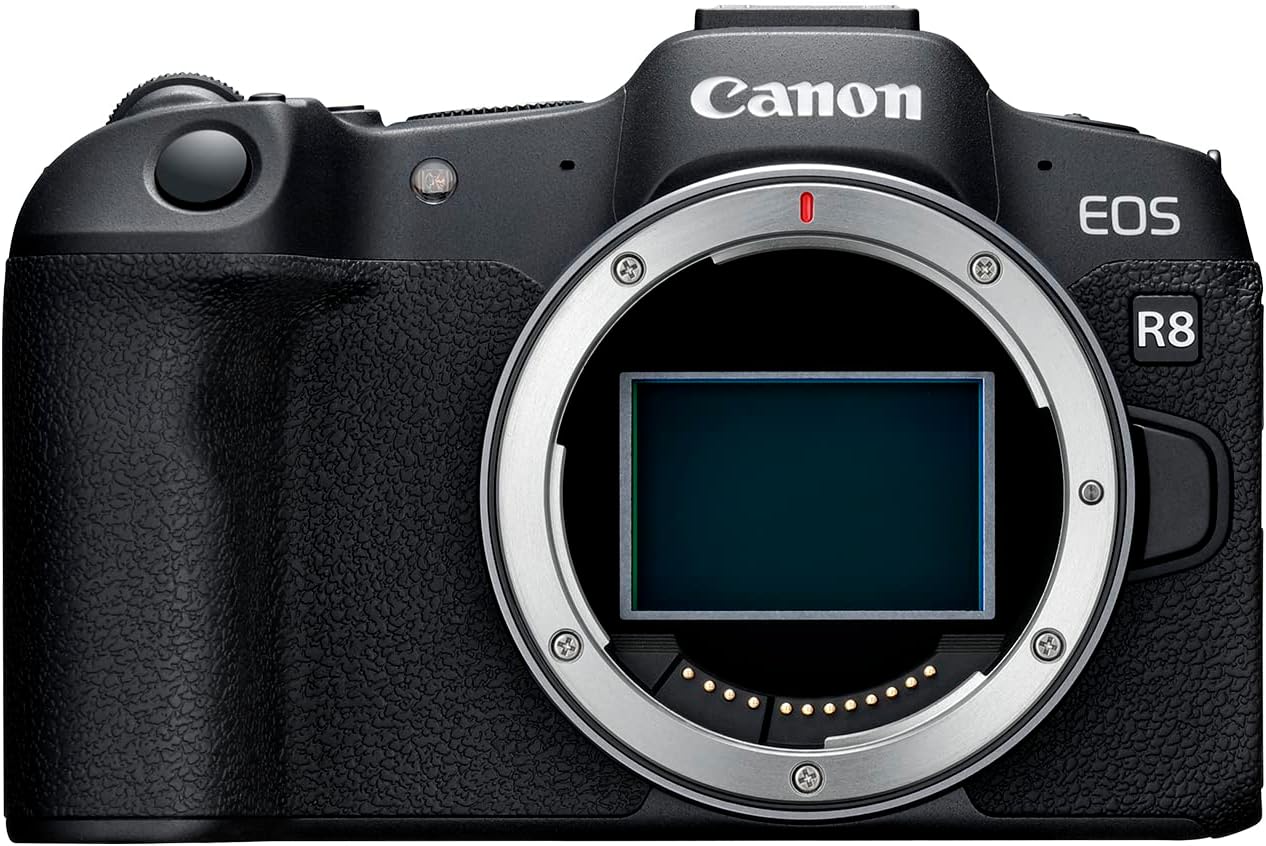
You get the Canon RF mount, a 2.36M-dot OLED EVF, a fully articulating 3-inch touchscreen, a single UHS-II SD card slot, LP-E17 battery power, USB-C charging support, microphone and headphone ports, and a body weight of about 461g with battery and card. That is a lot of full-frame camera in a very small package.
Missing features define the camera just as much as the spec sheet. There is no in-body image stabilization, no dual card slots, no AF joystick, and no fully mechanical shutter. Instead, the R8 uses electronic first-curtain shutter plus electronic shutter. For many photographers that is fine, but it matters for some flash, fast-action, and professional backup workflows.
Handling and build
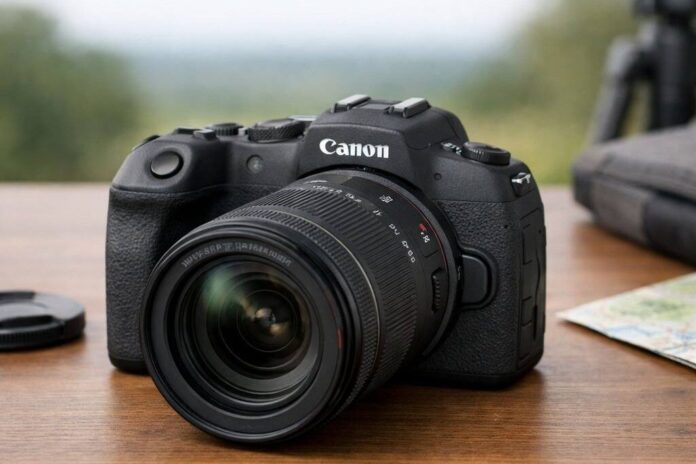
Pick up the Canon R8 and it feels almost surprisingly light. With compact RF primes, it is exactly the kind of full-frame body you can carry all day. Pair it with the RF 35mm f/1.8, RF 50mm f/1.8, or RF 24-50mm kit zoom and the camera feels like a genuine travel companion.
With large RF glass, the small body is less convincing. Mount an RF 24-70mm f/2.8L or RF 70-200mm and the lens starts to dominate the setup. That does not make the camera unusable, but it changes the appeal. The R8 is at its best when you build around its lightness. Do not pretend it is an R6 Mark II in a smaller shell.
Controls are simple and approachable. Canon’s menus remain easy to understand, and the photo/video switch is practical for hybrid users. The tradeoff is that you lose some direct control. There is no joystick, and there are fewer custom buttons. You also get less of the fast tactile handling found on higher bodies. For casual and enthusiast shooting, that is acceptable. For fast event work, it can slow you down.
Image quality
Image quality is the R8’s biggest reason to exist. The 24.2MP full-frame sensor gives you clean files and attractive Canon color. It also offers enough resolution for portraits, travel, family work, and moderate cropping. It is not a high-megapixel landscape specialist, but it is a very balanced sensor.
Compared with APS-C bodies, the R8 gives you better high ISO flexibility and easier shallow depth of field. You see that difference indoors, at evening events, and anytime you want portraits with natural subject separation. If you are coming from an older Rebel, EOS M, or entry APS-C mirrorless camera, the files will feel noticeably more flexible.
Dynamic range is strong for the class. You can recover shadows in RAW without files falling apart too quickly, and highlights are manageable if you expose carefully. Canon JPEGs are pleasing, especially for skin tones, but the R8 deserves to be shot in RAW if you want to get the most from it.
Autofocus and burst shooting
Autofocus is one of the R8’s standout features in this Canon R8 review. Dual Pixel CMOS AF II brings people, animal, and vehicle detection into a small entry full-frame body, and that changes the experience dramatically if you are coming from older cameras. Face and eye detection are confident, and tracking feels far more modern than the EOS RP or older DSLRs.
For everyday action, children, pets, street scenes, and casual sports, the R8 is excellent. It can shoot up to 40 fps with the electronic shutter, which sounds almost absurd in a body this small. The important caution is rolling shutter. Electronic shutter can distort fast movement, and the single card slot limits professional redundancy.
Electronic first-curtain shutter is slower at around 6 fps, but it avoids some electronic-shutter artifacts. In practical use, I would use electronic shutter for quiet moments, expressions, and moderate action, but I would be cautious with very fast lateral movement or critical paid sports work.
Video and hybrid shooting
For video, the Canon R8 is one of the better lightweight full-frame bodies for the price. It records oversampled 4K up to 60p from 6K sensor data, includes Canon Log 3, and gives you both microphone and headphone ports. For interviews, travel films, YouTube, family video, and hybrid creator work, the footage can look excellent.
There are limits. The R8 has no in-body stabilization. Handheld video therefore depends on lens IS, digital stabilization, rigging, or careful technique. Battery life is also a weak point because the LP-E17 is small. Long 4K sessions need spare batteries and realistic heat expectations.
Canon says the R8 can record 4K or Full HD for extended clips under the right conditions, but I would not treat it like a fan-cooled cinema body. For short and medium clips, it is strong. For long ceremonies, lectures, or paid video jobs where the camera must roll continuously, I would step up to a more robust body or use external planning.
Lenses and system value
Lens choice matters because the R8 works best with compact RF lenses. Canon’s RF 24-50mm kit lens is small and convenient, though optically modest. The RF 24-105mm f/4-7.1 IS STM is a better everyday zoom for many people. The RF 35mm f/1.8 and RF 50mm f/1.8 are the lenses that make the R8 feel like a lightweight full-frame camera rather than a budget body.
If you want higher optical quality, Canon’s RF L lenses are excellent, but they change the balance and cost of the setup. That is where the R8 becomes a strategic purchase. Save money and weight on the body, then spend carefully on lenses that match your work.
Adapted EF lenses also make sense if you already own Canon DSLR glass. The EF-to-RF adapter works well. It can make the R8 a very affordable full-frame migration path. For new buyers, though, I would focus on RF lenses unless there is a clear used EF bargain.
Canon R8 vs EOS RP, R7, and R6 Mark II
Canon’s EOS RP is cheaper, but the R8 is a much stronger camera. Autofocus, video, burst speed, sensor performance, and overall responsiveness are all better. I would only choose the RP if budget is extremely tight and your subjects are mostly static.
The Canon R7 is different rather than worse. It is APS-C, has in-body stabilization, dual card slots, and better reach for wildlife and sports. The R8 is full frame, so it is better for low light and shallow depth of field. It is also more appealing for portraits, travel, and event-style work. Our Canon R7 review is the natural comparison if you are choosing between reach and full-frame rendering.
The R6 Mark II is the camera the R8 borrows from, but it is also the camera that shows the R8’s limits. The R6 Mark II gives you IBIS, dual card slots, a better battery, stronger controls, and a more professional body. If you shoot paid weddings, events, or demanding hybrid work, the R6 Mark II is safer. If you want much of the image quality in a lighter, cheaper package, the R8 is the value play.
Final verdict
The Canon R8 is one of the smartest entry full-frame cameras in Canon’s lineup, and that is the bottom line of this Canon R8 review. It gives you excellent image quality, modern autofocus, strong 4K video, and a body light enough to carry everywhere. For travel, portraits, family, lifestyle, and enthusiast full-frame shooting, it is easy to recommend.
The limitations are real: no IBIS, one card slot, modest battery life, simplified controls, and a small body that does not love big lenses. But those compromises are easy to understand. This camera is not trying to be a pro body. It is trying to make full-frame Canon RF photography lighter and more affordable, and it does that very well.
Canon EOS R8 alternatives
The main alternatives to the Canon EOS R8 are Canon EOS RP, Canon R7, Canon R6 Mark II, Nikon Z5, Sony a7C II. Compare autofocus, stabilization, video limits, lens choice and current price before deciding which camera fits you best.
Frequently asked questions
Is the Canon R8 good for beginners?
Yes, the Canon R8 can work well for committed beginners who want to start with full frame. It is easy to use, but the cost of full-frame RF lenses means casual beginners may be better served by a cheaper APS-C body.
Does the Canon R8 have in-body stabilization?
No. The Canon R8 does not have in-body image stabilization. For stills and video, stabilization depends on lens IS, digital video stabilization, support gear, or careful handheld technique.
Is the Canon R8 good for professional work?
The Canon R8 can produce professional image quality, but it lacks dual card slots, a larger battery, IBIS, and rugged pro controls. It is better as a lightweight professional backup or enthusiast body than as a primary high-pressure wedding or event camera.
Is the Canon R8 better than the EOS RP?
Yes, for most buyers. The Canon R8 has much better autofocus, video, burst shooting, and sensor performance. The EOS RP only makes sense if budget is the deciding factor.
What lenses pair best with the Canon R8?
Compact RF lenses make the most sense. The RF 35mm f/1.8, RF 50mm f/1.8, RF 24-105mm f/4-7.1, and RF 24-50mm kit zoom all preserve the R8’s lightweight appeal.
Travel, portraits, family, lifestyle, and photographers upgrading to lightweight full-frame Canon RF.
You need IBIS, dual card slots, long battery life, pro controls, or a body balanced for large lenses.
Low to medium; Canon menus are friendly, but full-frame lens cost is the real learning curve.
Canon R6 Mark II for IBIS, dual slots, and pro handling; Canon R5-series bodies for higher resolution.
Excellent 4K quality for short and medium clips, but no IBIS, small battery, and heat planning matter.
Yes, if you want full-frame Canon image quality in the smallest practical RF body.