
View full specs
This Canon R3 review is really about one question: does Canon’s first serious pro mirrorless action body still make sense now that newer bodies like the EOS R1 and EOS R5 Mark II exist? For sports, wildlife, news, and event photographers, the answer can still be yes, but only if you understand what the R3 is built to do. It is not the Canon body for maximum resolution, small travel kits, or casual full-frame shooting. It is a fast, rugged, integrated-grip camera for photographers who care more about getting the frame than about winning a spec-sheet argument.
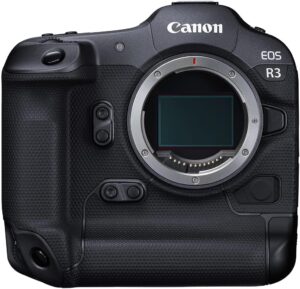
The EOS R3 uses a 24.1MP full-frame stacked back-illuminated CMOS sensor, Canon’s RF mount, Dual Pixel CMOS AF II, Eye Control AF, a blackout-free 5.76M-dot EVF, 30 fps electronic shooting, and internal 6K RAW video. Canon’s own EOS R3 specifications confirm the key numbers, but the important part is how those numbers work together. The R3 is a camera designed for pressure: sideline assignments, wildlife bursts, breaking news, indoor action, and long days where the body has to disappear in your hands.
Canon EOS R3 at a glance
- 24.1MP full-frame stacked BSI CMOS sensor
- Canon RF mount, with EF lens support through Canon EF-EOS R adapters
- 30 fps electronic shutter and 12 fps mechanical shutter with AF/AE tracking
- Dual Pixel CMOS AF II with people, animal, and vehicle detection
- Eye Control AF for selecting focus by looking through the viewfinder
- 5.76M-dot blackout-free OLED EVF with 120 fps refresh option
- 3.2-inch vari-angle touchscreen, approximately 4.15 million dots
- 5-axis in-body stabilization, rated up to 8 stops with compatible lenses
- 6K 60p RAW internal video and 4K up to 120p
- Dual card slots: one CFexpress Type B and one SD UHS-II
- LP-E19 battery, integrated vertical grip, and pro weather-resistant body
Who the Canon R3 is really for
The Canon R3 is for photographers who repeatedly shoot things that move and cannot be repeated. That means sports, wildlife, press work, weddings with heavy action, motorsport, equestrian events, and documentary assignments where responsiveness matters more than compactness. If I were packing for a casual trip, I would not choose an R3 first. If I were standing on a sideline with a 400mm lens, bad light, and one chance to catch the decisive moment, the R3 starts to make a lot more sense.
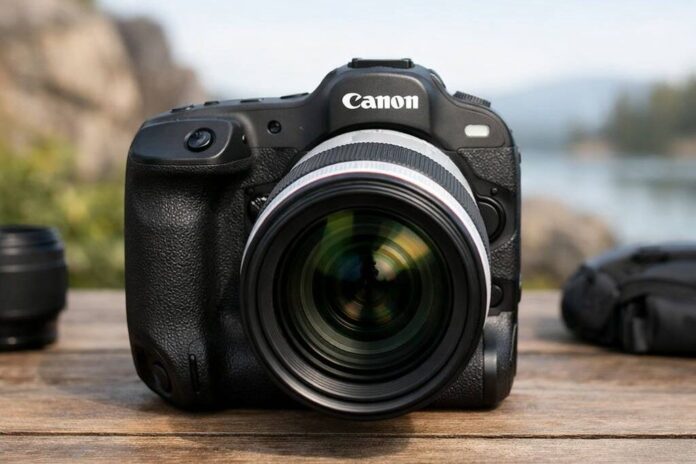
The built-in grip is part of that story. Some photographers see it as bulk, but for long-lens work it is balance. A smaller body can feel attractive in a product photo, then become awkward once a large RF telephoto is mounted. The R3’s shape gives your right hand more purchase, keeps vertical shooting natural, and spreads the weight in a way that feels familiar if you came from Canon’s 1D-series DSLRs.
The trade-off is obvious: this is a big and expensive body for a very specific kind of photographer. If you shoot family travel, occasional portraits, or slow landscape work, a Canon EOS R6 Mark II, EOS R8, or even a higher-resolution R5-series camera may be easier to justify. The R3 earns its keep when the pace is high and missed focus costs you more than the camera’s extra size.
Design, handling, and field usability
Canon understands professional ergonomics, and the R3 shows it. The grip is deep, the buttons are placed where working photographers expect them, and the vertical controls do not feel like an afterthought. The body is large, but it is not clumsy. With heavier RF lenses, the size becomes part of the camera’s stability rather than just weight to carry.
The controls also matter because action photography rarely gives you time to browse menus. Exposure mode, AF area, drive settings, ISO, and back-button focus behavior need to be available without breaking concentration. The R3 gives you enough customizable controls to build a serious workflow around the way you shoot. That is the kind of thing that sounds boring until you are working fast and realize the camera is not fighting you.
The EVF is another strength. A 5.76M-dot finder is not unusual anymore, but the R3’s blackout-free shooting experience is still one of the reasons to buy it. When you are following a runner, bird, cyclist, or player cutting across a field, the difference between a stable live view and a choppy interrupted view is not theoretical. It affects timing, framing, and confidence.
Autofocus and Eye Control AF
The Canon R3 autofocus system is built around Dual Pixel CMOS AF II with subject detection for people, animals, and vehicles. In practical terms, this is the camera’s center of gravity. The R3 is not trying to out-resolve an R5; it is trying to keep the subject sharp through a sequence where other cameras may hesitate, jump to the background, or lose the subject when the frame gets messy.
Eye Control AF is the unusual feature. It lets you select or guide the focus point by looking through the viewfinder after calibration. I would not describe it as magic, and I would not rely on it blindly for every assignment. It takes setup, practice, and some photographers will like it more than others. But in the right situation, especially when you need to jump quickly between subjects, it can feel like Canon found a more direct way to tell the camera what matters.
The safer way to think about Eye Control AF is as an extra layer, not as a replacement for normal AF control. I would still want the joystick, AF-ON button, and a familiar subject-detection setup ready. But when Eye Control AF works for your eye and your shooting style, it gives the R3 a distinct handling advantage that few cameras can copy.
Speed and burst shooting
The EOS R3 shoots up to 30 fps with the electronic shutter and 12 fps with the mechanical shutter, both with autofocus and auto exposure tracking. That speed is not only about having more frames. It is about choosing the exact body position, wing angle, gesture, or contact moment after the sequence. For sports and wildlife, those small differences are often the difference between a usable frame and the frame you actually want to publish.
Because the sensor is stacked, electronic shutter distortion is better controlled than on slower-readout cameras. It is not a global shutter camera like the Sony a9 III, so it is not the final answer to every rolling-shutter problem. But for many real sports and wildlife situations, the R3 is fast enough that the electronic shutter becomes a practical everyday tool rather than a mode you only use cautiously.
If you are comparing pro action systems, our Sony a9 III vs Canon EOS R3 comparison goes deeper into that exact trade-off: Sony’s global shutter advantage versus Canon’s integrated pro body, RF system, and familiar control logic.
Image quality and the 24MP question
The R3’s 24.1MP resolution is both its strength and its limitation. It keeps files manageable, helps workflow speed, supports fast bursts, and gives enough resolution for news, sports, events, web use, magazines, and a lot of professional print work. If your income depends on fast turnaround, 24MP can be more practical than 45MP or 61MP files that slow every part of the process.
At the same time, 24MP is not ideal for every photographer. Wildlife shooters who crop heavily may prefer more pixels. Landscape and commercial shooters may want the detail of an R5-series body. If you often rescue compositions by cropping deeply, the R3 leaves less room than high-resolution alternatives.
Where the R3 makes a better argument is in difficult light. The files are clean, Canon color is easy to work with, and the sensor handles high ISO work well for the audiences this camera serves. For indoor sports, evening events, and press work under poor lighting, I would rather have reliable autofocus and clean enough files than a higher-resolution body that slows the entire job down.
Video performance
The Canon R3 is primarily a stills action camera, but its video feature set is serious. Internal 6K 60p RAW, 4K up to 120p, Canon Log options, strong autofocus, a vari-angle screen, headphone monitoring, and a rugged body make it useful for hybrid assignments. It is not the small creator body I would hand to a casual vlogger, but for a photographer who needs to deliver clips alongside stills, it is far more capable than its stills-first identity suggests.
The full-width 6K RAW mode is the headline, but most working hybrid shooters will care just as much about dependable 4K, autofocus behavior, battery life, and heat management. A camera like this is often used in fragments: a ceremony moment, a sideline clip, a short interview, a behind-the-scenes sequence, then back to stills. In that mixed workflow, the R3 feels like a professional camera that happens to shoot strong video rather than a video camera with stills added on.
Battery, cards, and workflow
The LP-E19 battery is one of the quiet reasons the R3 works as a professional body. CIPA ratings never tell the whole story for burst-heavy shooting, but the larger battery gives the R3 the endurance expected from an integrated-grip camera. For all-day event or sports use, that matters more than shaving a few hundred grams from the bag.
The card setup is more controversial. One CFexpress Type B slot and one SD UHS-II slot gives you flexibility, but not perfect symmetry. CFexpress is the card you want for the fastest bursts and the heaviest video modes. SD UHS-II is convenient and widely available, but it is the slower side of the pair. For critical assignments, I would plan card strategy deliberately instead of assuming both slots behave the same way under every workload.
The R3 also includes the kind of connectivity working shooters care about: USB-C, Wi-Fi, Bluetooth, and wired LAN. Those features are not glamorous, but they matter for agency, event, and sports workflows where moving files quickly can be part of the job.
Canon R3 vs Canon R1 and R5 Mark II
The EOS R1 now sits above the R3 as Canon’s flagship pro action body. That does not make the R3 irrelevant. It changes the buying question. A new R1 is the cleaner choice for Canon shooters who want the newest flagship and have the budget. A discounted or used R3 becomes interesting when you want a pro integrated-grip action body but do not want to pay flagship launch money.
The R5 Mark II is a different kind of temptation. It gives you much more resolution and a more flexible all-rounder profile, while still being fast enough for many photographers. If your work includes landscapes, portraits, commercial shooting, and hybrid video as much as sport, read our Canon R5 Mark II review before assuming the R3 is the better professional choice.
In simple terms, choose the R3 when speed, handling, battery life, and viewfinder experience matter most. Choose the R5 Mark II when resolution and versatility matter more. Choose the R1 when you want Canon’s latest no-compromise action flagship and the price does not force the decision.
Lens pairing and system cost
The R3 is only as practical as the lens system you build around it. For sports and wildlife, that usually means serious RF telephoto glass, and those lenses are not cheap. The good news is that Canon’s RF system is strong at the professional end, and EF lenses can still be used through Canon adapters if you already own DSLR glass.
If you are planning an R3 kit from scratch, start with the work you actually shoot. A sideline sports photographer, a bird photographer, and a wedding shooter can all justify the body for different reasons, but they should not build the same kit. Our Canon RF lens guide is a better place to think through the lens side before committing the full budget to the body alone.
Canon R3 pros and cons
What the R3 does well
- Excellent action autofocus and subject tracking
- Fast 30 fps electronic shooting with a strong blackout-free viewfinder experience
- Professional integrated-grip handling for long assignments and big lenses
- Clean, manageable 24MP files for sports, news, and events
- Strong high-ISO usability for indoor and low-light work
- Serious hybrid video tools, including 6K RAW and 4K 120p
- Large LP-E19 battery and pro connectivity options
Where the R3 is weaker
- 24MP leaves less cropping room than high-resolution bodies
- The integrated grip makes it large for travel or casual shooting
- One CFexpress Type B slot plus one SD UHS-II slot is not as clean as dual CFexpress
- Eye Control AF is powerful but may not suit every eye or workflow
- The EOS R1 and R5 Mark II make the used price more important than ever
Should you buy the Canon R3 now?
You should buy the Canon R3 if you are a Canon shooter who wants a proven pro action body and can get it at the right price. It still makes the most sense for sports, wildlife, press, events, and demanding field work where autofocus confidence, blackout-free shooting, battery life, and rugged handling matter every time you pick up the camera.
You should skip it if you mainly want a compact full-frame camera, maximum resolution, or the best value for general photography. In those cases, Canon has better-fitting bodies. The R3 is specialized, but that is also why it remains appealing. It does not pretend to be the sensible camera for everyone. It is the camera for photographers who know exactly why a fast integrated-grip body belongs in the bag.
Canon EOS R3 alternatives
The main alternatives to the Canon EOS R3 are Canon EOS R1, Canon EOS R5 Mark II, Nikon Z9, Sony a9 III. Compare autofocus, stabilization, video limits, lens choice and current price before deciding which camera fits you best.
Frequently asked questions
Is the Canon R3 still worth buying?
Yes, if you shoot sports, wildlife, news, or events and can buy it at a meaningful discount compared with newer flagship bodies. It is still overkill for casual photography, but it remains a serious professional action camera.
Is the Canon R3 better than the Canon R5 Mark II?
It depends on the job. The R3 is better for integrated-grip handling, battery life, and action-focused shooting. The R5 Mark II is better if you need higher resolution and a more flexible all-rounder body.
Does the Canon R3 have enough resolution?
For sports, news, events, and most wildlife work, 24.1MP is enough. Photographers who crop heavily or make very large fine-art prints may prefer a higher-resolution Canon body.
What memory cards does the Canon R3 use?
The Canon R3 uses one CFexpress Type B card slot and one SD UHS-II card slot. CFexpress is the better choice for the heaviest burst and video workloads, while SD UHS-II is useful for convenience and backup.
What battery does the Canon R3 use?
The Canon R3 uses Canon’s LP-E19 battery, the same pro battery family associated with Canon’s integrated-grip professional bodies.
Sports, wildlife, news, and event shooters who need speed, rugged controls, and Canon RF autofocus.
You want a small camera, maximum resolution, or a lower-cost full-frame body.
High; it is a professional body with professional size, controls, and lens costs.
EOS R1 for Canon flagship action, or EOS R5 Mark II if resolution matters more than integrated-grip handling.
Strong 6K/4K tools, but the body is still action-first rather than a small creator camera.
Yes for action shooters when priced well below newer flagship bodies; overkill for casual use.