
Choosing between the Sony a7c vs a7 III is not as simple as comparing specs on a sheet. I have found that size, handling, autofocus behavior. Lens balance matter just as much as image quality when you actually shoot in the field.
| Decision point | Sony a7C | Sony a7 III |
|---|---|---|
| Sensor | 24MP full-frame BSI CMOS | 24MP full-frame BSI CMOS |
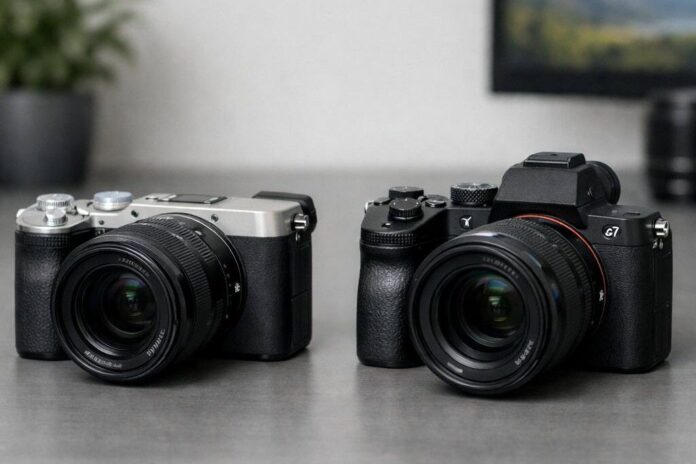
| Body style | Compact rangefinder-style body | Larger SLR-style body with deeper grip |
| Screen and EVF | Vari-angle screen, smaller side EVF | Tilting screen, larger central EVF |
| Cards | Single SD UHS-II slot | Dual SD slots, one UHS-II |
| Buy it if | You want the smallest full-frame Sony kit | You prefer stronger controls, grip, and backup storage |
What really separates these two cameras
When photographers weigh the Sony a7c vs a7 III, the conversation often starts with sensor specs and ends with a tie. Both models feature a 24MP full-frame sensor, similar BIONZ X processing, and comparable native ISO ranges. On paper, their still image potential is almost identical. In real-world use, the differences in final files are rarely deal-breakers for most genres.
If your decision is leaning toward ergonomics, reliability, and how the camera behaves over long shoots, a closer look at the Sony A7 III review can add useful context. It helps clarify why many photographers still prefer its handling and control layout despite the a7c’s smaller footprint.
The real separation comes from how these cameras fit into your daily workflow. The Sony a7c is built around portability and discretion, borrowing the compact style of Sony’s popular APS-C line to deliver a full-frame sensor in an impressively small body. Meanwhile, the Sony a7 III is the classic workhorse, maintaining a more traditional DSLR-like body with a deeper grip, larger viewfinder. A physical control layout that suits event shooters and those using bigger lenses.
What this means in real use
Another key difference lies in feature priorities. The a7c leans into creator-friendly convenience – smaller size, flip-out screen, and a focus on travel and vlogging. The a7 III, on the other hand, was designed as a do-everything hybrid, offering dual card slots, a beefier battery. A more robust set of manual controls. If you shoot fast-paced events, weddings, or need redundancy, these distinctions matter far more than a minor spec advantage in dynamic range or burst speed.
Ultimately, the choice is less about outright image quality and more about how each camera supports your shooting style. For some, the a7c’s lightness and compactness will be a revelation. For others, the a7 III’s confidence-inspiring grip and dual slots make it the natural pick for demanding assignments. As with many Sony full-frame comparison debates, it comes down to which compromises you are willing to live with in everyday use.
Design, size, and everyday handling

How the grip, EVF, and controls change the shooting experience
If you are moving from a DSLR or a larger mirrorless camera, the first thing you notice about the Sony a7c is its size. It is significantly shorter and thinner than the a7 III, and weighs about 120 grams less. For travel, street, or casual shooting, this difference is massive. You can easily slip the a7c into a small bag or even a jacket pocket with a pancake lens attached. Sony a7c size reminds me of those classic compact digital cameras that are making a comeback in 2026, but with full-frame power inside.
However, that portability comes with some trade-offs. The grip on the a7c is shallow. While it is comfortable for short sessions or with lighter primes, it can feel cramped with larger zooms or long telephotos. The a7 III, by contrast, has a chunkier grip that fills the hand and balances better with heavier lenses. If you routinely use lenses like the Sony 24-70mm f/2.8 or 70-200mm f/4, the a7 III feels better. The ergonomic advantage becomes obvious after an hour.
Controls, screen, and comfort in practice
The electronic viewfinder (EVF) also differs. The a7c’s EVF is small and offset to the left, reminiscent of a rangefinder. This appeals to some street shooters, but the size and resolution (2.36M dots) can feel limiting in bright light or for critical manual focus. The a7 III’s centrally mounted, higher-magnification EVF offers a more immersive experience, making it easier to judge focus and exposure. If you rely heavily on the EVF, especially for action or low-light shooting, the a7 III simply provides a more traditional and confidence-inspiring view.
Control layout is another major factor. The a7 III offers three customizable dials, a dedicated joystick for focus point selection. A more robust set of buttons. This speeds up adjustments, especially when shooting fast-moving subjects or switching between modes. The a7c, in pursuit of compactness, simplifies the controls. There is no joystick, and some buttons are smaller or less tactile. While you can customize the a7c’s buttons and use the touchscreen, it never feels quite as direct as the a7 III when you need to react quickly. For casual shooting, the a7c’s interface is quick and approachable. For high-pressure situations, the a7 III’s handling stands out.
Image quality and autofocus in real shooting

Portraits, travel, and low-light performance
On the image quality front, the differences between the Sony a7c and a7 III are subtle. Both use the same 24.2MP Exmor R sensor and deliver excellent dynamic range, sharpness, and low noise up to ISO 6400. If you shoot RAW and process files, you will rarely see a difference between them, whether you are capturing landscapes, portraits, or city scenes at night. For most photographers, the question is not about which camera produces better files. Which one helps you get the shot more reliably in your preferred style of shooting.
For portraits, both cameras deliver beautiful files with pleasing color, great skin tones. Enough resolution for prints and professional use. The a7c’s compact form makes it less intimidating for candid or street-style portraits. This I found especially helpful when working with camera-shy subjects. The a7 III is easier to handle with heavier portrait lenses and allows for quicker setting adjustments. Its physical joystick is a real asset when tracking a moving subject or reframing on the fly.
Where image quality differences matter
In travel and low-light scenarios, the story is much the same. Both cameras handle high ISO gracefully, with minimal color shift or banding. Their 5-axis stabilization systems are nearly identical and good for a solid three to four stops of shake reduction. However, the a7c’s lighter build means you are more likely to have it with you at all times. This can make the difference between getting the shot and missing it entirely. For low-light urban scenes or handheld night portraits, either camera will deliver professional results. But the a7 III’s larger grip can help steady heavier lenses and reduce fatigue during longer sessions.
Autofocus is an area where both cameras excel, but with slight nuance. Both models offer Real-time Eye AF for humans and animals. Both are quick to lock on and track moving subjects. In my experience, the a7c’s autofocus feels a touch snappier in continuous mode, likely due to firmware improvements and a more refined user interface. However, the a7 III’s physical controls and focus joystick make it easier to override focus points quickly. This can be crucial when working with unpredictable subjects. For most genres, including portraits, travel, and even sports, both cameras are highly reliable. But your preference may come down to how you like to select and adjust your focus points.
Video features and creator-friendly tools
Flip screen vs dual card slots for different workflows
For hybrid creators, video features and workflow tools often tip the balance in the Sony a7c vs a7 III debate. Both cameras shoot 4K video up to 30p with full pixel readout and no pixel binning, delivering sharp, detailed footage with good dynamic range. Color profiles like S-Log2 and HLG are available on both, allowing for flexible grading in post-production. In practical terms, video image quality is nearly identical between the two, but usability factors create a real divide.
The a7c introduces a fully articulating flip screen, a significant advantage for vloggers, solo shooters, and anyone capturing themselves on camera. This feature also makes it easier to compose from tricky angles, such as low to the ground or above crowds. The a7 III, by contrast, only offers a tilting screen, which is less useful for self-recording or vertical shooting. For content creators who value versatility and quick setup, the a7c’s flip screen is hard to beat.
On the other hand, the a7 III stands out with dual SD card slots. This is a key feature for professional video work, allowing for instant backup or overflow recording. If you shoot long events, weddings, or anything where card failure would be catastrophic, dual slots provide peace of mind that the a7c cannot match. The a7 III also has a slightly larger battery, which can make a difference during long video sessions.
Practical buying takeaway
Other creator-friendly tools include microphone and headphone jacks on both models, as well as support for external recorders via HDMI. Autofocus in video is fast and reliable on both cameras, with accurate face and eye detection. However, the a7c’s newer interface and firmware refinements make touchscreen focus pulls a bit smoother, a detail that matters for cinematic shooting styles.
In summary, the a7c has a clear advantage for solo content creation and handheld video. Its flip screen and compact body make the workflow easier. If you need maximum reliability or instant in-camera backups, the a7 III is safer. Its dual card slots and larger body may be worth the extra weight.
Battery life, storage, and reliability on longer shoots
Both the Sony a7c and a7 III use the NP-FZ100 battery. This is a major advantage for anyone planning extended sessions or travel days. In real-world use, the Sony a7c battery life is very close to the a7 III’s. Expect roughly 600-700 shots per charge if you shoot a mix of stills and moderate video. If you are conservative with LCD and playback, you can stretch well beyond that figure.
However, the a7 III has a clear edge when it comes to storage and workflow security. It features dual card slots, which is invaluable on professional or once-in-a-lifetime shoots. You can set the slots for backup, overflow, or splitting RAW and JPEG files. This is not just a “pro” feature – it is peace of mind. If you have ever lost images to a corrupted card, you know the anxiety that a single slot can bring.
The a7c, by contrast, has only one SD card slot. For most hobbyists, travelers, or street photographers, this will not be a deal-breaker. But for event, wedding, or sports shooters, this single slot can feel like a risk. I have shot a full wedding season with a single-slot camera and. While I never lost files, I always felt that background worry.
Storage, backup, and long-session confidence
On the reliability front, both cameras are weather-sealed and have proven robust in the field. Neither is a tank, but I have used both in light rain, dusty streets, and packed bags without issue. The a7 III is marginally more substantial in build. But the difference is subtle unless you are particularly rough on your gear.
For long video shoots, heat management is good on both, though the a7c’s smaller body means it gets warm faster if you shoot 4K for extended periods. I have never had a forced shutdown in normal conditions. If you are pushing record limits outdoors in summer, the a7 III has a slight advantage.
In summary, if you need maximum reliability and redundancy, the a7 III’s dual slots and slightly larger body give you confidence. If your shoots are casual or travel-focused, the a7c’s battery life and compactness are more than enough for a full day with a spare in your pocket.
Lens pairing and who each body suits best
Best lens types for compact travel kits and balanced setups
The lens you mount changes the entire feel of both the a7c and a7 III. For the a7c, compact primes and travel zooms shine. The best lenses for Sony a7c keep the setup light and balanced. Good examples include the Sony 28mm f/2, Tamron 28-75mm f/2.8 G2, and tiny Sony 40mm f/2.5 G. With these, the a7c feels like a premium point-and-shoot, perfect for street, documentary, or travel work.
If you try to use fast telephoto zooms or big f/1.4 primes, the a7c becomes front-heavy. That does not mean you cannot use something like the 85mm f/1.8 or 70-200mm f/4, but handling is less comfortable compared to the a7 III. For long days or rapid shooting, that balance matters.
The a7 III, with its deeper grip and more traditional body, feels natural even with heavier glass. The best lenses for Sony a7 III include the 24-70mm f/2.8 GM, 135mm f/1.8, or even manual focus classics with adapters. For portrait sessions, studio work, or situations where you want to mount a battery grip or flash, the a7 III is simply more versatile.
Lens balance and kit-building advice
The real question is about your shooting style. If you are a city explorer or a parent documenting family trips, the a7c is ideal. Pair it with a compact lens and it slips into a small bag easily. If you regularly shoot events, work with flash, or need to swap between wide, tele. Specialty lenses, the a7 III is built for that kind of flexibility.
- Sony a7c: Best with compact primes, travel zooms, pancake lenses. Ideal for lightweight everyday kits.
- Sony a7 III: Best with pro zooms, fast primes, adapted lenses. Ideal for demanding, mixed-genre work.
This is why I often suggest that the body you choose should match the lenses you actually want to use most. The wrong body-lens combo can make even the best camera feel like a chore.
Pros, cons, and my honest buying advice
After using both cameras in the field and on paid assignments, I would not call either objectively better. They have different identities and suit different photographers.
Sony a7c pros and cons:
- Extremely compact and light – great for travel, street, or anyone who hates carrying a heavy bag
- Flip-out screen is a blessing for vlogging, selfies, and low/high-angle shooting
- Same image quality as a7 III in a smaller shell
- Single card slot limits professional or critical use
- Grip is shallow, not ideal for big lenses or all-day shoots
- Fewer direct controls than the a7 III, especially for those who rely on custom buttons
Sony a7 III pros and cons:
- Dual card slots offer real backup and workflow flexibility
- Deeper grip is more comfortable with heavy or long lenses
- More direct access to controls, making it faster in high-pressure moments
- No flip-out screen, so vlogging and selfie work is awkward
- Heavier and bulkier, which is noticeable for all-day carry or travel
- Now starts to feel “classic” in layout, which some may find dated compared to newer models
My honest advice: if you are a photographer who values portability, discretion, and a small kit, the a7c is a joy. For travel, daily life, and compact digital camera fans (and yes, compact digital cameras are making a comeback in 2026), the a7c slots in perfectly. If you are a hybrid shooter, event pro, or someone who changes lenses often and needs backup and robust handling, the a7 III remains a smart, reliable workhorse. Think carefully about your lens plans and shooting habits. That will tell you which camera will actually make you want to pick it up every day.
Frequently asked questions
Is the Sony a7C better than the a7 III for photography?
Not in pure image quality. For travel, street, and compact lens setups, the Sony a7C is easier to carry and less conspicuous. For demanding paid work, the Sony a7 III still has the edge. This is. This is because Of its grip, controls, and dual card slots.
Does the Sony a7 III still make sense to buy today?
Yes, especially used or discounted. The Sony a7 III remains a reliable full-frame body with good files, dependable autofocus. Better controls than the a7C. It is less modern, but it is not obsolete.
Which camera is better for travel and street photography?
The Sony a7C is usually the better travel and street camera. Its smaller body, flip screen, and ability to pair well with compact primes make it easier to carry all day.
Is the flip screen on the a7C more useful than dual card slots on the a7 III?
It depends on the job. For vlogging, self-recording, and awkward angles, the a7C screen is more useful. For weddings, events, and work where backup matters, the a7 III dual card slots are more important.
Key takeaways for lensandshutter.com readers
- The Sony a7c is the better fit if you value portability, a flip screen, and a lighter everyday kit.
- The Sony a7 III feels more comfortable with larger lenses and offers stronger workflow confidence with dual card slots.
- Image quality is very close, so handling, video needs, and lens choices should drive the final decision.
- For lensandshutter.com readers, the smartest choice often comes down to how the body balances with the lenses you actually plan to use.