

View full specs
This Ricoh GR IIIx review starts with the lens, because that is the whole reason this camera exists. The GR IIIx takes the pocketable GR formula and replaces the classic 28mm view with a tighter 40mm-equivalent f/2.8 lens. That small change makes it feel like a different camera in the street.
- Best for: street details, travel, everyday carry, documentary portraits, watch/product details, and photographers who see in a normal-ish field of view.
- Skip if: you want wide environmental scenes, strong video, a viewfinder, weather sealing, or a camera that forgives sloppy framing.
- Price discipline: compare against remaining GR IIIx stock, the GR IIIx HDF, and the newer GR IV ecosystem before overpaying.
- Main appeal: APS-C image quality and a 40mm lens in a camera that still disappears into a pocket.
Why the Ricoh GR IIIx is not just a GR III with a crop
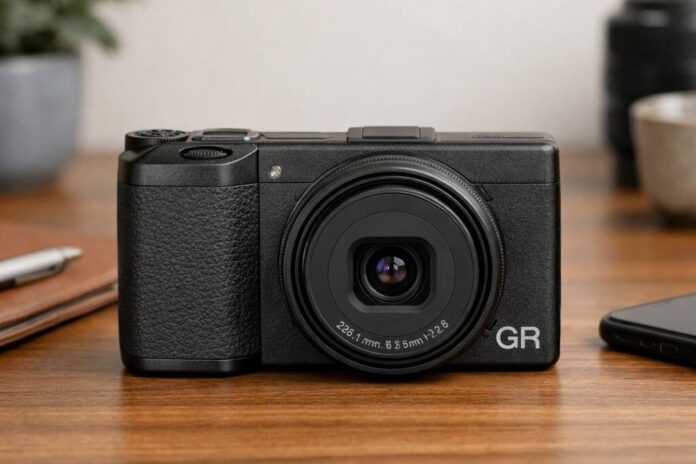
The Ricoh GR IIIx uses the same basic idea as the GR III: a 24.24MP APS-C sensor, a fixed f/2.8 prime lens, 3-axis Shake Reduction, a rear touchscreen, USB-C charging, and a compact magnesium-alloy body. Ricoh’s official GR IIIx page describes the 26.1mm lens as a 40mm-equivalent view, and that is the key distinction.
Forty millimeters feels less dramatic than 28mm and less formal than 50mm. It is a human, observant focal length. You can photograph a person across a table without stretching their face. You can isolate a storefront sign, a hand on a coffee cup, or a face in a crowd without needing to be aggressively close.
This makes the GR IIIx more comfortable for many photographers than the original Ricoh GR III. It is less about wide street layers and more about noticing. I find the IIIx better when the scene is already busy and I want to simplify rather than include everything.
Design and handling: the same pocket discipline
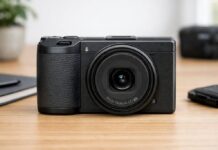
The GR IIIx remains genuinely pocketable. It is slightly deeper and heavier than the GR III, but not in a way that changes the daily-carry appeal. This is still a camera you can carry without a strap, without a bag, and without feeling like you have made photography the main event of the day.
Controls are small but efficient. The best experience comes after customization: set up Snap Focus, assign the buttons you actually use, save a few My Settings presets, and stop treating the menu like a place to live. Once dialed in, the camera becomes very fast.
The rear screen is the only built-in way to compose. Some photographers will hate that. I understand the complaint, especially in bright light. But the missing viewfinder is also part of the camera’s honesty. The GR IIIx is not pretending to be a mini rangefinder. It is a pocket camera for fast, direct seeing.
Image quality and the 40mm lens
The GR IIIx files have the same basic strength that made the GR III famous: clean APS-C detail from a tiny body. The lens is sharp, contrasty, and more flexible for everyday subjects than its spec sheet suggests. At 40mm equivalent, it gives a natural perspective for street portraits, travel details, food, family moments, and urban fragments.
The 40mm view is also less forgiving. With the GR III, you can often make a frame work by embracing context. With the GR IIIx, you need to be more exact. Slightly wrong distance or timing can make an image feel cramped. When it works, though, the frame feels calmer and more intentional.
The built-in crop modes are useful, but I would not buy the IIIx as a fake multi-lens camera. The strength is the native 40mm lens. If you keep cropping to wider or longer views mentally, you probably bought the wrong GR.
Street photography: quieter, tighter, more selective
The GR IIIx is excellent for street photography, but not in the same way as the GR III. The wider GR III pulls you into the scene. The IIIx lets you stand back just enough to avoid exaggeration. That can be a big deal when photographing people, gestures, storefronts, or small details in crowded places.
Snap Focus remains central. Autofocus is fine for ordinary use in decent light, but the GR series becomes more interesting when you stop waiting for it. Set your distance, choose an aperture that gives you enough depth of field, and shoot by anticipation. The IIIx’s tighter view makes distance judgment a little more demanding than 28mm, but also more rewarding when you nail it.
This is not a sports camera, and it is not a low-light AF monster. The IIIx is a camera for photographers who can work with rhythm, distance, and timing. That sounds old-fashioned, but it is exactly why many people still like it.
Battery, storage, wireless, and daily practicality
The GR IIIx uses the DB-110 battery and is rated at about 200 shots per charge. That is enough for a short walk and not enough for a long day without planning. I would treat a spare battery as part of the camera, not an optional accessory.
Storage is straightforward: one SD/SDHC/SDXC UHS-I card slot and a small amount of internal memory. I like the full-size SD card choice here. It is simple, common, and easier to handle than microSD when traveling.
Wireless transfer through Ricoh Image Sync can be useful for quick sharing and location data, but I would not build an entire workflow around moving big RAW batches over Wi-Fi. For serious editing, a card reader is still cleaner. The wireless features are best treated as convenience, not the heart of the camera.
USB-C charging is genuinely useful. The camera is small enough that travel photographers will often carry it with a phone and a power bank, and being able to top it up without a dedicated charger helps.
GR IIIx vs GR III, X100VI, and phones
Choose the GR IIIx over the GR III if you prefer 40mm, tighter compositions, and a more natural perspective for people and details. Choose the GR III if you want classic wide street energy, more context, and a 28mm way of seeing.
Compared with the Fujifilm X100VI, the GR IIIx is smaller, quieter, and more pocketable. The Fuji gives you a hybrid finder, stronger controls, better video ambition, more battery confidence, and a 35mm-equivalent lens that many photographers find easier as a one-camera focal length. The Ricoh wins when carryability matters above everything.
Compared with a phone, the IIIx is less convenient but more photographic. Phones are better for instant sharing and computational night shots. The Ricoh gives you a real shutter button, RAW flexibility, a larger sensor, and a lens that does not look like software trying to fix a tiny optical system.
Who should buy the Ricoh GR IIIx?
Buy it if you want a pocket camera with a more selective view than the GR III. It is excellent for photographers who notice gestures, hands, faces, objects, and small urban scenes. It is also one of the rare compact cameras that works well as an everyday carry for people who usually shoot larger systems.
Avoid it if you need width. If you regularly photograph interiors, landscapes, tight travel scenes, or layered street compositions from close range, the GR III is more natural. Also avoid it if video, weather sealing, or a built-in viewfinder are important parts of your shooting life.
Final verdict
The Ricoh GR IIIx is one of the most interesting compact cameras because it refuses to be broadly useful. It is tiny, sharp, fast enough, and beautifully focused around a 40mm way of seeing. It has weak battery life, modest autofocus by modern standards, no built-in viewfinder, no weather sealing, and video that should not drive the purchase.
And still, it makes sense. For street, travel details, and everyday photography, the GR IIIx gives experienced photographers a rare thing: serious files from a camera that never feels like a burden. If 40mm matches your eye, this may be the best pocket camera Ricoh has made.
Ricoh GR IIIx alternatives
The main alternatives to the Ricoh GR IIIx are Ricoh GR III, Ricoh GR IV, Fujifilm X100VI, Sony RX100 VII, Leica Q series. Compare autofocus, stabilization, video limits, lens choice and current price before deciding which camera fits you best.
Frequently asked questions
Is the Ricoh GR IIIx good for street photography?
Yes, especially if you prefer tighter, cleaner street frames. The 40mm-equivalent lens is less immersive than 28mm but better for details, gestures, and environmental portraits.
What is the main difference between the Ricoh GR III and GR IIIx?
The lens. The GR III has a 28mm-equivalent lens, while the GR IIIx has a 40mm-equivalent lens. That difference changes framing, working distance, and the kind of street images each camera encourages.
Does the Ricoh GR IIIx have a viewfinder?
No built-in viewfinder. It uses the rear screen, though Ricoh offers an optional optical finder for photographers who want eye-level framing.
How long does the Ricoh GR IIIx battery last?
Ricoh rates it at about 200 shots per charge. In real daily use, carry a spare DB-110 battery if you plan to shoot for more than a short walk.
Is the Ricoh GR IIIx better than a smartphone?
For deliberate photography, RAW files, natural rendering, and tactile control, yes. For instant sharing, video convenience, and computational low-light images, a phone is easier.
Street details, daily carry, travel, documentary portraits, and photographers who like a 40mm view.
You need a wide lens, viewfinder, weather sealing, long battery life, strong video, or zoom flexibility.
Medium; the camera is simple, but the 40mm fixed view rewards precise framing.
GR III for a wider view, GR IV for the newer 28mm body, Fujifilm X100VI for finder-based 35mm shooting.
Full HD only and not a serious hybrid camera.
Yes if 40mm matches your eye and the price is sane.