
View full specs
This Ricoh GR III review is really about one question: does a tiny 28mm APS-C compact still make sense now that phones are excellent, the GR IV exists, and the GR III is often awkward to buy new? For the right photographer, yes, but only as a price-disciplined 28mm choice. If you are buying through Amazon today and you can live with the tighter view, I would push most readers toward the Ricoh GR IIIx instead.
- Best for: street, travel, documentary walks, visual notebooks, and photographers who specifically like a wide 28mm frame.
- Skip if: you need a viewfinder, weather sealing, dependable all-day battery life, strong video, or a zoom lens.
- Current-buy bias: choose the GR IIIx first if you want a Ricoh GR that is easier to buy new and you prefer a tighter 40mm view.
- Price discipline: buy the GR III only at a sensible used or remaining-new price now that the GR IV has changed the 28mm conversation.
What the Ricoh GR III is, and why photographers still care
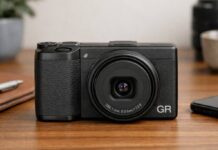
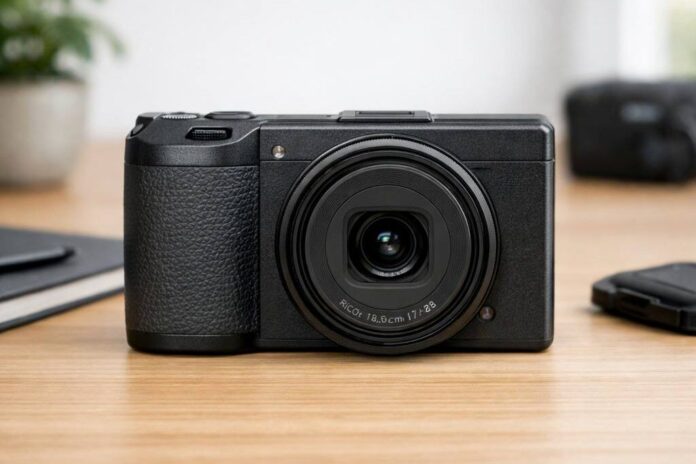
The GR III is a fixed-lens APS-C compact with a 24.24MP sensor, an 18.3mm f/2.8 lens that gives a 28mm-equivalent view, sensor-shift stabilization, a touchscreen, and Ricoh’s Snap Focus system. Ricoh’s own GR III and GR IIIx specifications are plain enough: this is not a do-everything compact. It is a stills-first camera built around speed, image quality, and pocket carry.
That is why the GR III has a strange kind of loyalty around it. It is not luxurious like a Leica Q, not nostalgic like a Fujifilm X100VI, and not versatile like a Sony RX100 VII. It is more like a well-worn notebook. You bring it because it is small, direct, and almost invisible.
The 28mm lens matters. It is wide enough to pull context into the frame: sidewalks, storefronts, subway light, hotel rooms, restaurant tables, family scenes, and layered street compositions. If you naturally move toward your subject and like environmental framing, the GR III feels alive. If you prefer tighter, cleaner compositions from a little farther back, the Ricoh GR IIIx is probably the better sibling.
Design and handling: pocket camera first, everything else second
The body is the point. The Ricoh GR III is small enough to carry when you are not officially “going photographing.” That changes behavior. A mirrorless camera asks for a bag, a strap, a lens choice, and a bit of commitment. The GR III asks for a pocket.
The grip is shallow but useful, the buttons are small but logical, and the camera is easy to operate one-handed once you set it up. The lack of a built-in viewfinder is not a small omission, especially in harsh sun, but it is part of why the camera stays so flat and pocketable. You compose from the rear screen, shoot quickly, and move on.
I would not call the GR III luxurious. The value is in the rhythm. Power on, raise, frame, shoot. The lens extends quickly, the shutter is quiet, and the camera does not announce itself. For street and daily life, that low social footprint is more important than another dial or a prettier body.
Image quality and the 28mm look
The GR III files are the reason the camera is still taken seriously. The APS-C sensor gives you far more editing room than a phone or a 1-inch compact, especially in highlights and shadows. RAW files have a clean, flexible feel at base ISO, and the lens is impressively sharp for something this small.
The 28mm-equivalent field of view is not neutral. It has a point of view. It makes you step closer, include more context, and work the edges of the frame. Used lazily, it can produce empty foregrounds and distant subjects. Used well, it gives street and travel images a physical feeling that a tighter lens often loses.
At f/2.8 you do not get dramatic full-frame blur, but you do get enough separation at close distances. The macro mode is genuinely useful for food, objects, textures, and travel details. It also turns the GR III into a surprisingly good small camera for everyday visual notes, not just street photography.
Autofocus, Snap Focus, and real street use
Autofocus is the part of the GR III that benefits most from realistic expectations. In good light, it is fine for still subjects and casual people photos. In low light or with fast movement, it can hesitate. If you expect modern mirrorless subject detection, you will be disappointed.
Snap Focus is the reason many photographers forgive that. Set a distance, work with enough depth of field, and the camera behaves almost like a digital zone-focus compact. For street work, that can be faster than waiting for AF confirmation. It rewards anticipation instead of automation.
My preferred way to think about the GR III is not as a miniature mirrorless camera. It is a digital street compact with serious image quality. Once you stop asking it to track like a sports camera, its personality makes more sense.
Battery, storage, video, and the practical annoyances
The DB-110 battery is small, and battery life is the everyday compromise. Ricoh rates the camera at about 200 shots per charge under CIPA testing. In practical use, one battery is fine for a short walk but not for a full travel day if you review images often or use wireless features. Carry a spare.
Storage is simple and photographer-friendly: one SD/SDHC/SDXC UHS-I card slot, plus a small amount of internal memory. The full-size SD slot is one of the quiet advantages over newer designs that moved to microSD. USB-C charging is also useful, especially when traveling with a small power bank.
Video is not the reason to buy this camera. Full HD recording is available, but the handling, autofocus, stabilization behavior, screen, and battery all point back to stills. If video matters, buy something else.
Dust is the other concern. The GR line has a reputation for dust anxiety because the lens retracts into a tiny body. I would not baby it, but I would avoid loose lint, sandy pockets, and wet weather. This is not a sealed travel camera.
Ricoh GR III vs GR IIIx, GR IV, and Fujifilm X100VI
The most important comparison is with the GR IIIx. The GR III is wider and more immersive. The GR IIIx is tighter, calmer, and better for details, half-body portraits, and cleaner street compositions from a bit farther away. In a vacuum, the lens decides the camera. In the real market, availability also matters, and that is where the GR IIIx is the easier recommendation for most buyers right now.
The GR IV makes the GR III harder to recommend at inflated prices. The newer model brings meaningful improvements around stabilization, autofocus, storage, battery, and general responsiveness. If you are buying a 28mm GR at near-new pricing, the GR IV deserves a hard look. If you find a clean GR III at the right price, it remains a beautiful daily camera.
Against the Fujifilm X100VI, the GR III wins on pocketability and discretion. The Fuji wins on viewfinder experience, controls, battery life, video features, and a more traditional 35mm-equivalent perspective. The GR III is the camera you carry casually. The X100VI is the camera you choose to wear.
Who should buy the Ricoh GR III now?
Buy the GR III if you specifically want the 28mm version and find one at a fair price. That is the key. I would not chase it at inflated pricing or force an unavailable Amazon listing. If you simply want a current Ricoh GR to carry every day, the GR IIIx is the cleaner recommendation unless you know 28mm is your natural view.
Avoid it if you want one compact to cover everything. No zoom, no viewfinder, no weather sealing, modest battery life, and basic video are real limitations. The GR III is not trying to solve every photographic problem. It is trying to be the camera that is actually with you.
Final verdict
The Ricoh GR III is still worth buying, but only with clear eyes. It is no longer the obvious new purchase it once was, because the GR IV exists and availability/pricing can be messy. As a used or fairly priced pocket camera, it remains special. As a simple buy-it-now recommendation, I would steer most readers to the GR IIIx first.
If you want a compact camera for deliberate everyday photography, the GR III still has real soul. Just do not buy it expecting modern hybrid-camera comfort. Buy it because you want a small, sharp, fast, slightly stubborn camera that teaches you to see wider and move closer.
Ricoh GR III alternatives
The main alternatives to the Ricoh GR III are Ricoh GR IIIx, Ricoh GR IV, Fujifilm X100VI, Sony RX100 VII, Leica Q series. Compare autofocus, stabilization, video limits, lens choice and current price before deciding which camera fits you best.
Frequently asked questions
Is the Ricoh GR III still worth buying?
Yes, if the price is sensible and you specifically want a pocketable 28mm APS-C stills camera. At inflated pricing, compare it carefully against the Ricoh GR IV.
Is the Ricoh GR III good for beginners?
It can be, but it is not the easiest beginner camera. The fixed 28mm lens teaches composition quickly, but it also punishes lazy framing. Beginners who want zoom flexibility may be happier elsewhere.
Does the Ricoh GR III have a viewfinder?
No built-in viewfinder. You compose with the rear screen, though optical accessory finders exist for photographers who like that style.
Is the Ricoh GR III better than a phone?
For RAW files, natural rendering, highlight recovery, and the physical act of shooting, yes. For instant sharing, computational night modes, and convenience, a phone still wins.
Should I buy the GR III or GR IIIx?
Choose the GR III only if you specifically want 28mm and can find a clean copy at a fair price. Choose the GR IIIx if you prefer a tighter 40mm field of view, want the more realistic current Amazon buy, or want a GR that feels better for details and everyday people photography.
Street, travel, documentary walks, daily carry, and photographers who like a wide 28mm view.
You need a viewfinder, weather sealing, long battery life, zoom, strong video, or modern subject tracking.
Medium; simple to carry, but the 28mm fixed lens requires movement and compositional discipline.
Ricoh GR IV for the newer 28mm body, GR IIIx for a tighter view, Fujifilm X100VI for finder-based shooting.
Full HD only and clearly stills-first.
Yes only at a fair used price; for a straightforward current buy, I would push most readers to the GR IIIx.