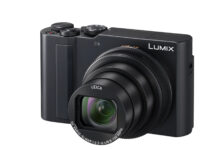

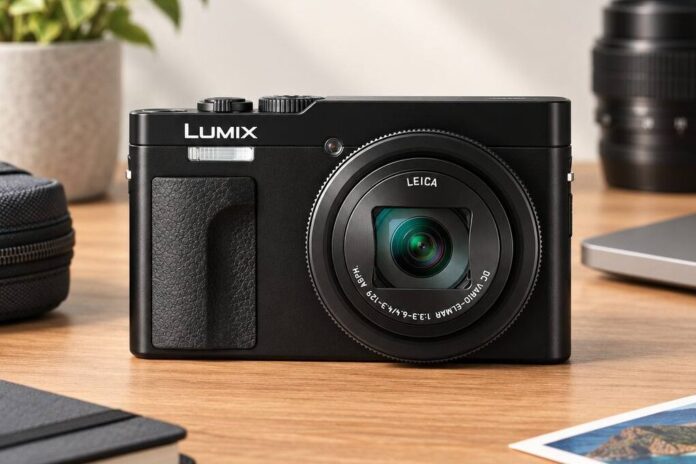

View full specs
The Panasonic ZS99 is worth considering when a pocketable 30x zoom matters more than low-light image quality. This Panasonic ZS99 review focuses on that trade: excellent framing freedom for daylight travel, but no viewfinder and little reason for satisfied ZS80 owners to upgrade. At prices well above its original $499.99 launch price, I would shop carefully.
This is a research-based review of manufacturer specifications and buying trade-offs, not a hands-on test. Inline product image: Panasonic. The featured image is illustrative. As an Amazon Associate, we earn from qualifying purchases.
The US model is the LUMIX DC-ZS99; it is called TZ99 in several other markets. Check the seller, regional warranty and included battery before ordering. This card links to the black US ZS99.
Who should buy the Panasonic ZS99?
Buy it for distant architectural details, animals standing in good light, and landscapes where you cannot walk closer. Its 24-720mm equivalent lens opens compositions that a phone's digital zoom struggles to preserve. The camera weighs approximately 322g with battery and card, so carrying that reach is unusually easy.
I would pair it with a phone rather than expect it to replace one. Use the ZS99 for distant subjects outdoors. Keep the phone handy for restaurant interiors, quick sharing and static night scenes where computational processing can help.
Skip it if your main subjects are children indoors, evening events or fast wildlife. A long focal length does not make a small camera a sports camera. Nor does a newer model number guarantee a jump in picture quality.
For a wider choice of sensor sizes and camera styles, our travel camera guide helps you decide how much reach you actually need.
Handling: useful controls, missing viewfinder
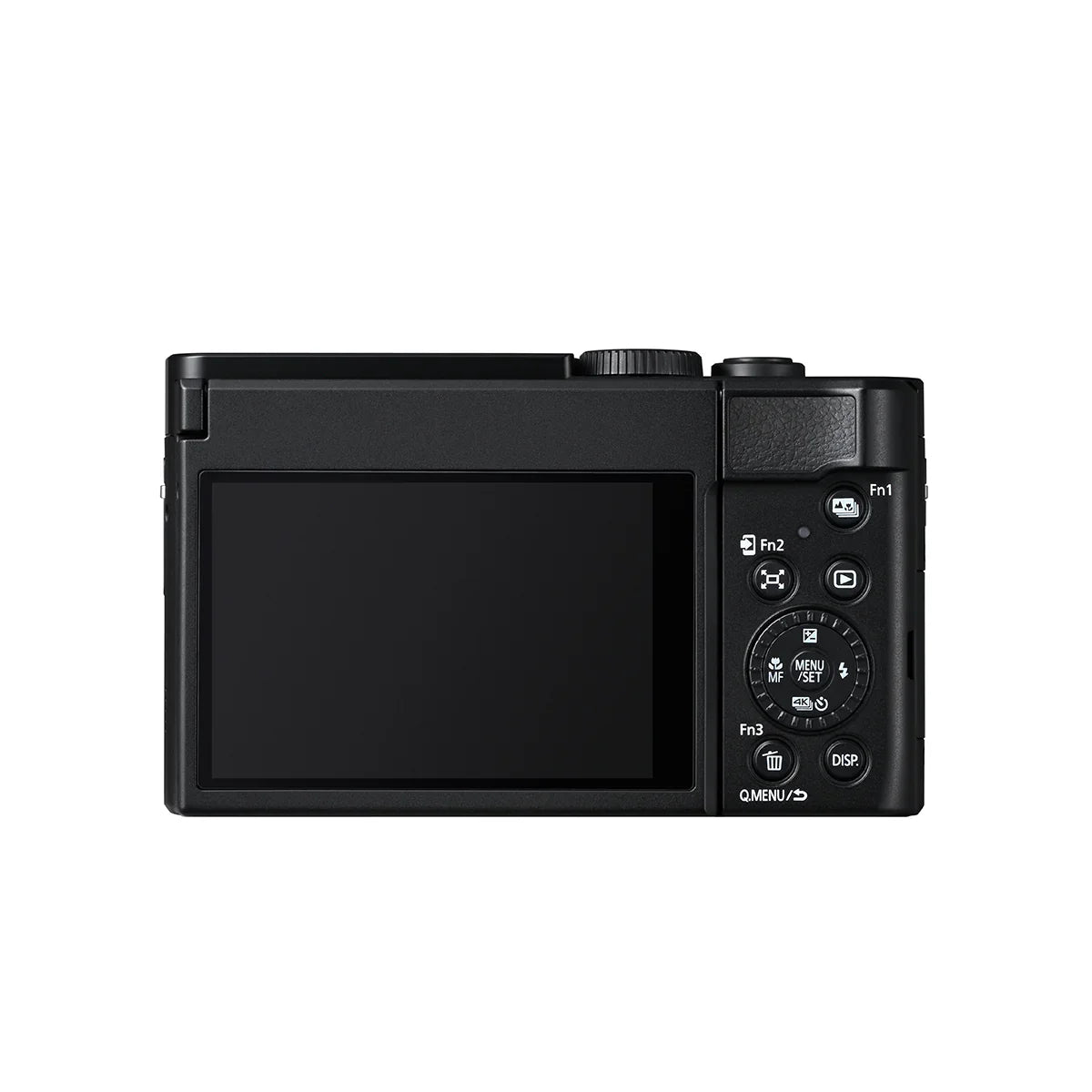
The 3-inch, 1.84-million-dot touchscreen tilts upward for selfies and low viewpoints. Physical exposure controls and RAW capture give you room to move beyond automatic shooting. I would still use a wrist strap, especially around railings or crowded viewpoints.
The missing electronic viewfinder is the biggest handling compromise. On a bright beach, judging the screen can be awkward. At long zoom settings, holding the camera at arm's length also makes steady framing harder. Try screen-only shooting outdoors before deciding this is your ideal travel companion.
At about 4.41 x 2.67 x 1.70 inches, this is a jacket-pocket camera rather than a comfortable fit for every trouser pocket. Leave room for the lens barrel to extend. Keep sand, spray and rain away: the body has no weather sealing.
Using the 30x lens without wasting its reach
The lens spans 24-720mm equivalent, with a maximum aperture of f/3.3 at wide angle and f/6.4 at full zoom. That combination favors daylight. Optical stabilization reduces camera shake; it cannot stop a bird moving or a performer turning their head.
At 720mm, I would start around 1/500 second for a relatively still animal, then inspect the result and adjust. Moving subjects may need substantially faster speeds. These are starting points, not guaranteed settings. If the camera raises ISO too far, zoom back or wait for better light.
Find the subject at a wider setting before zooming in. The Zoom Compose Assist function can help you relocate something lost outside the frame. Brace your elbows, avoid stabbing the shutter button, and take a short sequence when the moment matters.
Heat shimmer over roads and distant water can spoil detail even with perfect technique. More magnification cannot remove that atmospheric blur. For close details such as food, use the wide end's macro mode; maximum telephoto needs much more working distance.
Image quality: daylight first, RAW when useful
The 20.3MP, 1/2.3-inch sensor is the central compromise. It permits a compact long-zoom design, but offers less latitude than a larger sensor when light gets scarce. Expect the most convincing files in good light, without heavy cropping or aggressive shadow recovery.
Protect important highlights, but do not routinely underexpose everything. Brightening a dark small-sensor file can make noise more conspicuous. Check the histogram when a pale sky or sunlit building matters to the photograph.
RAW gives you control over white balance, sharpening and noise reduction. It does not rescue motion blur or turn weak light into clean detail. My preferred workflow would be RAW plus JPEG for important photographs, a few JPEG transfers to the phone, and a proper backup later.
There is also little reason to stop down aggressively for depth of field. This small sensor already gives substantial apparent depth at ordinary travel distances. I would prioritize a useful shutter speed over selecting f/8 by habit.
Autofocus, bursts and video limitations
The ZS99 offers face/eye detection and 49-area autofocus. Conventional bursts reach approximately 10fps with single autofocus or 5fps with continuous autofocus. Those headline rates do not promise reliable tracking of erratic subjects. For a distant animal, a deliberately placed focus area is often more useful than letting the camera choose the foreground.
4K Photo captures a 30fps sequence from which you select roughly 8MP JPEGs. It can help with a jump or fleeting expression, but it is not full-resolution RAW burst shooting. Choose ordinary stills when editing flexibility matters more than split-second timing.
What changes when you switch to 4K?
US 4K recording reaches 30p, with a 15-minute continuous clip limit. The view becomes tighter than for ordinary stills. Panasonic's five-axis hybrid stabilization is unavailable in 4K; optical stabilization remains available. Do not read the five-axis marketing claim as applying to every recording mode.
Full HD reaches 60p and is a sensible choice for casual movement, with a 29-minute-59-second continuous limit at that setting. There is no external microphone input, so this would not be my first choice for interviews or windy narration. At long zoom settings, I would brace the camera or use a small tripod.
Before a trip, use the Panasonic ZS99 operating instructions to check recording limits and configure the controls. Test your chosen video mode before an event you cannot repeat.
Batteries, cards and phone transfers
The US battery is the Panasonic DMW-BLG10PP, a 7.2V, 1025mAh pack. Panasonic rates still-photo endurance at approximately 380 pictures under CIPA conditions; repeated zooming, flash, cold weather and video can reduce that. USB-C charging simplifies packing, but a charged spare remains worthwhile for a full sightseeing day. An external charger is useful if you want to charge one battery while using another.
There is one SD-family slot, accepting SD, SDHC and SDXC cards with UHS-I support. Choose a reputable U3 SDHC or SDXC card for 4K and 4K Photo. Paying extra for UHS-II speed does not upgrade the camera's interface. A card reader is useful for backups and larger transfers.
Wireless sharing uses Panasonic Image App, with Wi-Fi and Bluetooth support. Pair your own phone before leaving home; do not discover app permissions or connection problems at the airport. Check Panasonic's firmware updates too: version 1.5 addresses Wi-Fi transfer performance and mode-dial stability.
Price, older models and better alternatives
The ZS99 launched in February 2025 at $499.99. At this review's November 7, 2026 check, Panasonic's US store displayed $697.99 for the black single-battery version. This is a manufacturer-store reference, not an Amazon price or a guarantee of delivery availability. That is a materially harder purchase to justify. My preferred ceiling is around $550 new; that is a value judgment, not a claim about typical selling prices.
Budget for a suitable card, spare battery and protective pouch. Accessory bundles rarely solve the camera's actual limitations. Compare the camera-only price and US warranty before paying for a box of inexpensive extras.
Keep an older ZS, or buy a larger sensor?
Already own a ZS80 or ZS80D? USB-C is convenient, but losing the viewfinder makes the ZS99 a questionable upgrade. The basic sensor-and-lens proposition is familiar. I would keep a working older model unless charging or reliability has become a real problem.
Considering used? Our Panasonic ZS70 review covers an older 30x option with a viewfinder. Check lens extension, focus across the zoom range, screen movement and battery condition. Require a useful return window; a sticky zoom mechanism can erase any savings.
Prioritize image quality? The Panasonic ZS300 has a larger 1-inch sensor and a shorter 24-360mm equivalent range. On November 7, 2026, Panasonic listed its black single-battery version at $799.99, close enough to warrant comparison if you rarely need 720mm. This is another manufacturer-store reference, not an Amazon offer. It is a different travel-zoom tier, not a direct ZS99 replacement.
Need stronger autofocus? The Sony RX100 VII combines a 1-inch sensor with phase-detection autofocus and a 24-200mm equivalent lens. Its much higher price and shorter reach make it an alternative for different priorities, not an automatic better buy.
Verdict: buy the reach, watch the price
I would choose the Panasonic ZS99 for daylight trips where distant details repeatedly defeat a phone's zoom. It packs useful manual control and real optical reach into a camera that is easy to bring along.
I would pass at an inflated price, keep a functioning ZS80, and choose a larger sensor for mostly indoor photography. Around its original price, the ZS99 makes a defensible specialist purchase. Near $700, its missing viewfinder and small sensor deserve much closer scrutiny.
Daylight travel and distant details when carrying a larger kit is impractical.
You mainly shoot indoors, need a viewfinder, or follow fast action.
Long zoom demands steady framing and a suitable shutter speed. Pair the phone app before traveling.
Keep a working ZS80. Consider the larger-sensor ZS300 if 360mm is enough; RX100 VII for stronger autofocus.
4K has a tighter view and a 15-minute clip limit. Five-axis hybrid stabilization is unavailable in 4K; no microphone input.
Yes near its launch price, for frequent daylight telephoto use. At roughly $700, compare the ZS300 before buying.