
View full specs
This Insta360 Evo review is for a small but very real group of creators who still care about VR180 3D video. The Evo is not a DSLR, not a mirrorless body, and not really a GoPro alternative. It is a little folding camera that can shoot both 360-degree video and stereoscopic VR180, and the sad part is that there still is not a clean modern successor for people who loved that idea.
- Best for: VR180 hobbyists, educators, headset owners, travel memory keepers, and creators who still want simple stereoscopic 3D capture.
- Skip if: you want a rugged action camera, waterproofing, modern low-light quality, a touchscreen, long battery life, or the easiest editing workflow.
- Buying reality: Insta360 lists the Evo as out of stock, and there is no obvious current replacement with the same friendly folding VR180/360 concept.
- Main appeal: the folding design: 360 capture when closed, stereoscopic 180-degree 3D capture when opened.
What the Insta360 Evo is
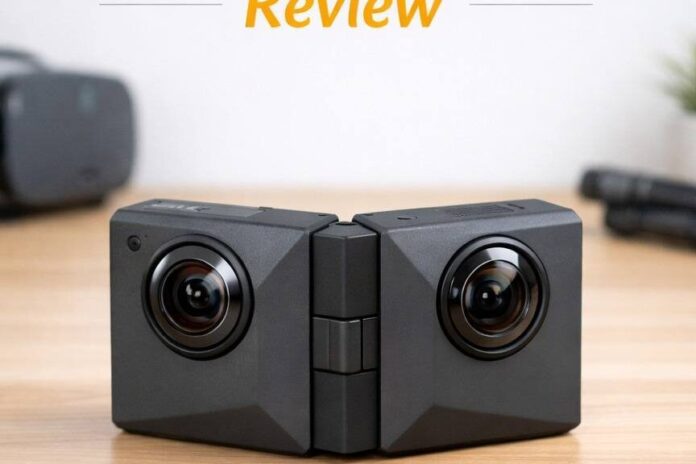
The Insta360 Evo is a compact immersive camera built around one clever trick: it folds. Closed, the two lenses face opposite directions and capture a full 360-degree scene. Opened flat, the lenses point forward together and capture VR180 in stereoscopic 3D. That is the whole magic of this camera.
Insta360’s official Evo product page lists the headline specs: 180-degree 3D, 360 capture, 5.7K video, 18MP photos, FlowState stabilization, HDR photo/video, TimeShift, and headset-ready playback. It also now shows the product as out of stock, which matters for the buying recommendation.
The Evo makes the most sense if you have a real reason to care about VR180. For normal 360-only video, newer Insta360 cameras are easier to use, sharper, more rugged, and much better supported. For VR180 memories, though, the Evo still has a charm that newer X-series cameras do not replace. That is why the camera feels a little bittersweet now: the idea was good, the niche still exists, but the product itself is no longer easy to buy.
Why VR180 is the point
Most people understand 360 video: capture everything, reframe later, make tiny planets, and hide the selfie stick. VR180 is different. It captures only what is in front of the camera, but it does so in 3D. Viewed in a headset, the image has depth. A family dinner, a small concert, a travel viewpoint, or a kid’s birthday can feel more present than a flat video clip.
This is where the Evo still earns attention. VR180 is not dead; it is just underserved. You can use the Evo for travel clips, VR headset memories, school projects, family moments, and small experiments that feel more personal than ordinary flat video. But I would not sell it as a simple influencer camera. The workflow is more specialized than that, and VR180 only makes sense if you actually plan to view or share content in a headset-friendly way.
As a photographer, I like the Evo because it makes you think less about perfect framing and more about presence. You are not chasing background blur or high ISO performance. You are asking, “Would this moment feel interesting if someone could stand here later?” That is a different creative muscle.
Design and handling
The folding design is clever and still feels special. The camera is small, light, and pocketable, but the two exposed lenses need care. This is not a throw-it-in-the-bag action camera. Fingerprints, dust, and scratches are the real enemies, so a case and microfiber cloth are not optional.
Controls are simple: power, shutter, and mode behavior tied to the physical folding position. There is no big modern touchscreen. You will use the phone app for framing, settings, previews, and transfers. That keeps the body tiny, but it also makes the Evo feel older than current 360 cameras.
The hinge is the part I would inspect carefully on any used copy. It should fold cleanly, lock positively, and not feel loose. The camera is fun because of that movement, but it is also the most obvious long-term wear point.
Image quality: good-light fun, not modern polish
The Evo shoots 5.7K video and 18MP photos, which sounds strong until you remember how immersive video works. In 360 mode, those pixels are spread across the whole sphere. In VR180, they are spread across a wide stereoscopic field. The result is usable and engaging in good light, but not as crisp as a modern 8K 360 camera or a normal camera pointed at one scene.
In daylight, colors look pleasant, depth in VR180 is convincing, and short clips can feel genuinely fresh. Indoors or at night, the small sensors show their age quickly. Noise rises, detail softens, and high-contrast scenes can look rough. I would keep this camera in bright places and treat low light as a bonus, not a strength.
Stitching is generally fine for casual 360 work, but you still need to respect the format. Keep important faces away from stitch lines, avoid placing subjects too close to the lenses, and clean both lenses constantly. VR180 avoids some 360 stitching weirdness, but it introduces its own discipline: lens alignment and distance matter more because you are creating depth.
App, editing, and sharing workflow
The Evo experience depends heavily on the Insta360 app and desktop Studio workflow. The app helps with previewing, transferring, basic edits, and sharing. Desktop software is better for more careful stitching, exporting, and headset-ready files.
This is where the Evo will either delight or frustrate a casual user. If you enjoy tinkering, exporting, watching in a headset, and trying formats, it is fun. If you expect the speed of current TikTok/Instagram camera workflows, it feels old. Large immersive files take time, phone transfers can be slow, and VR180 sharing is still less universal than ordinary video.
The friendliest way to use the Evo is to keep projects short. Capture small moments, edit simple clips, and avoid huge piles of footage. The camera is more fun as a creative toy with real VR value than as a production workhorse.
Battery, storage, and practical limits
Insta360 lists a 65-minute runtime and 90-minute charging time. In real use, especially with Wi-Fi previews and frequent mode changes, I would expect less. The battery is built in, so you cannot swap packs between scenes. That alone makes the Evo feel much older than current action and 360 cameras.
Charging uses micro-USB, another sign of its age. It works, but it is less convenient than USB-C when your phone, laptop, and newer cameras all use one cable. For a day out, bring a power bank and think of the Evo as a camera for selected moments rather than continuous filming.
Storage is microSD, and Insta360 recommends UHS-I V30 cards with exFAT formatting. The official product page lists support up to 256GB. Use a good card. Dropped frames or transfer errors are not worth saving a few dollars on storage.
The frustrating lack of a real successor
n
This is the part that makes the Evo unusual to review in 2026. Normally, an older camera is easy to place: buy the newer model, or buy the old one used if the price is right. The Evo is harder, because the obvious replacement never really arrived. Insta360 kept improving 360 cameras, but not this specific consumer-friendly VR180/360 folding concept.
n
That leaves VR180 creators in an awkward place. Newer X-series cameras are much better for 360 video, but they do not create stereoscopic VR180. Dedicated VR cameras can be expensive, less casual, or harder to recommend to someone who just wants to capture memories for a headset. The Evo sits in that gap, which is why people still search for it even though it is out of stock.
n
How it compares with newer Insta360 cameras
The obvious modern comparison is not really another VR180 camera, because that market is thin. It is newer Insta360 360 cameras such as the Insta360 X5. For normal 360 capture, the X5 is the easier recommendation: better image quality, better stabilization, better low light, stronger battery options, waterproofing, a modern touchscreen, and a cleaner app experience.
The Evo’s counterargument is simple: the X5 does not fold into a stereoscopic VR180 camera. If you do not care about VR180, skip the Evo. If VR180 is the whole reason you are shopping, the Evo still deserves a look because its main trick is still rare. That rarity is not just nostalgia; it is a real product gap.
Against GoPro-style cameras and budget action cams, the Evo is not trying to win on ruggedness. Our GoPro-like camera guide is the better place to start if you want waterproof action, helmet mounts, biking, surfing, or simple wide-angle video. The Evo is for immersive memories and VR experiments, not abuse.
Buying advice in 2026
I would only buy the Insta360 Evo in 2026 with a clear purpose. Do not buy it because it sounds like a cheap 360 camera. Buy it because you specifically want VR180 and understand the workflow. That distinction matters.
Since the official page shows it out of stock, used condition is everything. Check the hinge, lenses, microSD slot, micro-USB port, Wi-Fi connection, battery runtime, and whether the camera connects cleanly to the app. Lens scratches are especially important because immersive cameras make optical flaws hard to hide.
If you find a clean Evo at a fair used price, it can still be a delightful specialty camera. If the price is high, put the money toward a current Insta360 model unless VR180 is non-negotiable. I wish the answer were cleaner, because this niche deserves a modern consumer camera, but right now the Evo is mostly a used-market workaround.
Final verdict
The Insta360 Evo is still interesting, but not because it is the best 360 camera today. It is interesting because it does something unusual: 360 and VR180 in one folding pocket camera. The problem is that this unusual idea never received the obvious modern follow-up many VR180 fans would have liked.
For a younger or casual creator, the Evo can be genuinely fun. It lets you make immersive memories, headset-friendly clips, and playful 3D scenes without a serious rig. For most buyers, though, a newer Insta360 is easier, sharper, tougher, and more practical. Buy the Evo only if the VR180 side is the reason you want it, and understand that you are buying into a niche that camera companies have not served very well lately.
Insta360 Evo alternatives
The main alternatives to the Insta360 Evo are Insta360 X5, Insta360 X4, Insta360 X3, GoPro Max, Ricoh Theta models, used VR180 cameras. Compare autofocus, stabilization, video limits, lens choice and current price before deciding which camera fits you best.
Frequently asked questions
Is the Insta360 Evo still worth buying?
Yes, but only for a niche buyer. It is still worth considering if you specifically want VR180 plus 360 capture in one small camera. For general 360 video, newer Insta360 models make more sense.
n
Does the Insta360 Evo have a real successor?
Not really. Newer Insta360 X-series cameras are much better 360 cameras, but they do not replace the Evo’s folding VR180/360 design. That is why the Evo still matters to VR180 fans despite being out of stock.
Can the Insta360 Evo shoot both 360 and VR180?
Yes. Folded, it shoots 360-degree content. Opened flat, it shoots stereoscopic VR180 with a 3D depth effect for headset viewing.
Is the Insta360 Evo waterproof?
No. It is not a rugged waterproof action camera. Treat it carefully around rain, dust, sand, and water.
How long does the Insta360 Evo battery last?
Insta360 lists up to 65 minutes. In practical use with app previews and mixed shooting, expect less and plan around short sessions.
Should I buy the Evo or a newer Insta360 X-series camera?
Buy a newer X-series camera if you mainly want 360 video, action shooting, waterproofing, better image quality, and easier editing. Buy the Evo only if VR180 is the main attraction.
VR180 hobbyists, immersive travel memories, classroom projects, casual 360/3D experiments, and headset-focused creators.
You want rugged action-camera use, waterproofing, modern low light, quick social editing, long runtime, or a touchscreen.
Medium; easy to shoot casually, but VR180 and 360 editing require patience.
Insta360 X5/X4/X3 for better 360 video; dedicated VR180 or higher-end immersive rigs for stronger 3D quality.
Fun and immersive in good light, but dated stabilization, battery, low-light quality, and workflow show its age.
Yes only for VR180 fans who accept the used-market reality; the niche still matters, but the camera is no longer sold new.