
The best DSLR under $1,000 in 2026 is usually not the newest DSLR on a store shelf. It is a clean used or refurbished enthusiast body with a strong lens mount, good autofocus, and enough money left for glass. That is the real opportunity: Canon and Nikon have moved their marketing attention to mirrorless, but EF and F-mount DSLRs still make excellent photographs and the used lens market is unusually deep.
If you want the simplest answer, buy the Nikon D7500 if you want the best all-around DSLR value, the Nikon D500 if you shoot sports or wildlife and find one in budget, or the Canon EOS 90D if you want Canon colors, high resolution, and stronger video features. Beginners who want a lighter kit should look at the Canon Rebel SL3 or Nikon D5600, while the Pentax K-70 remains the niche pick for weather sealing and in-body stabilization.
This guide is intentionally DSLR-specific. If you are open to mirrorless, compare these bodies with our best mirrorless cameras under $1,000. If you are spending closer to a professional long-term kit, the broader best cameras under $2,000 guide gives you more current-system options.
Quick Picks: Best DSLR Under $1,000
| Pick | Best for | Why it makes sense |
|---|---|---|
| Nikon D7500 | Best overall DSLR under $1,000 | Excellent sensor, 8 fps, strong autofocus, sensible used pricing |
| Nikon D500 | Best used action DSLR | Pro-level AF, 10 fps, rugged build, ideal for wildlife and sports |
| Canon EOS 90D | Best Canon DSLR under $1,000 | 32.5MP sensor, 10 fps, uncropped 4K, huge EF/EF-S lens support |
| Canon Rebel SL3 / 250D | Best lightweight beginner DSLR | Small body, good touchscreen, simple controls, strong battery life |
| Nikon D5600 | Best cheap Nikon DSLR for learning | 24.2MP files, articulating screen, 39-point AF, long battery life |
| Canon EOS 6D | Best used full-frame DSLR | Full-frame look and strong low-light files, but slow by modern standards |
| Pentax K-70 | Best rugged alternative | Weather sealing and in-body stabilization at a budget price |
How to Buy a DSLR Under $1,000 in 2026
A $1,000 DSLR budget should be treated as a system budget, not just a body budget. A used $700-$850 body plus a sharp prime lens is usually a better photographic setup than a $999 body with only a slow kit zoom.
Buy used or refurbished when possible. DSLR pricing has stabilized because many buyers have already moved to mirrorless. That means the best values are often enthusiast bodies from 2016-2019, not brand-new entry-level kits.
Check condition before chasing the lowest price. Prioritize a clean sensor, functional buttons and dials, a healthy battery, an included charger, and a reasonable shutter count. For most consumer and enthusiast DSLRs, a shutter count under 50,000 is a comfortable target; for pro bodies like the D500, higher counts can still be acceptable if the camera is clean and priced accordingly.
Buy for the lens mount. Canon EF/EF-S and Nikon F are the strongest DSLR lens ecosystems. Pentax K is smaller but unusually good for weather-sealed outdoor kits. Avoid any DSLR body if you cannot find affordable lenses for what you actually shoot.
1. Nikon D7500: Best Overall DSLR Under $1,000
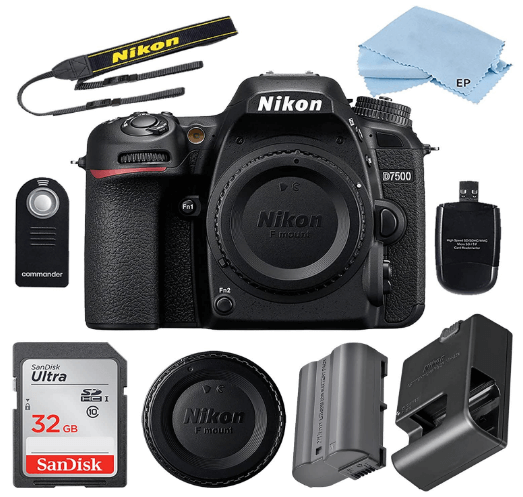
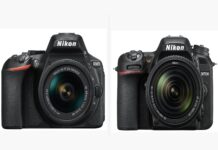
The Nikon D7500 is still the most balanced DSLR recommendation under $1,000. It uses a 20.9MP APS-C sensor related to the higher-end D500, shoots at 8 fps, has a 51-point autofocus system, and gives you the deep Nikon F-mount lens market.
The reason I like the D7500 in this price bracket is that it does not feel like a stripped beginner body. The grip is serious, the battery life is strong, the files hold up well at higher ISO settings, and the autofocus is dependable enough for events, family sports, travel, and wildlife with the right lens.
The D7500 is not the highest-resolution DSLR here. The Canon EOS 90D gives you more pixels, and the Nikon D500 gives you a more professional AF system. But the D7500 is the most sensible middle point: capable, not too heavy, not too expensive, and easy to pair with affordable DX lenses.
Buy it if: you want the best all-around DSLR value, already own Nikon F lenses, or want one body that can handle travel, portraits, wildlife, and events.
Skip it if: you need dual card slots, full-frame depth of field, or the absolute best DSLR autofocus for fast action.
2. Nikon D500: Best Used DSLR for Sports and Wildlife
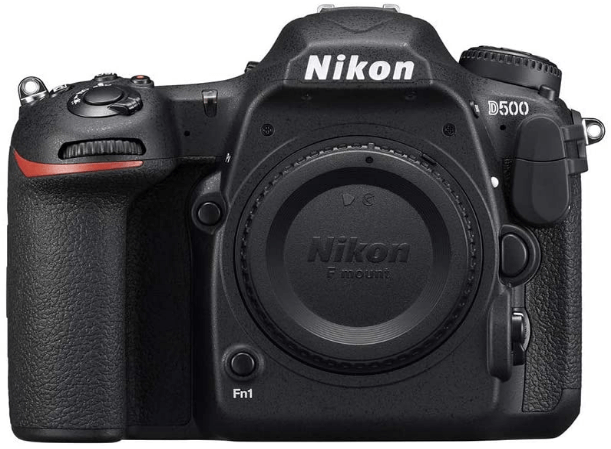
The Nikon D500 is the sleeper pick if your priority is action. It was Nikon’s flagship DX DSLR, with 10 fps burst shooting and a 153-point autofocus system. If you shoot birds, wildlife, field sports, motorsports, or fast-moving kids, the D500 is the DSLR in this guide that feels the most professional.
The catch is condition and price. Clean D500 bodies can still push above $1,000 depending on the seller, accessories, and shutter count. When you find one under budget from a reputable used dealer, it is often a better action camera than newer entry-level mirrorless bodies.
The D500 is also heavier and more specialized than the D7500. Beginners who mostly shoot travel or family photos do not need it. But for photographers who care about tracking autofocus, buffer depth, physical controls, and rugged handling, it is the strongest DSLR body here.
Buy it if: you shoot wildlife, sports, action, or already own Nikon telephoto lenses.
Skip it if: you want the lightest camera, a beginner-friendly interface, or a cheap new kit with warranty.
3. Canon EOS 90D: Best Canon DSLR Under $1,000
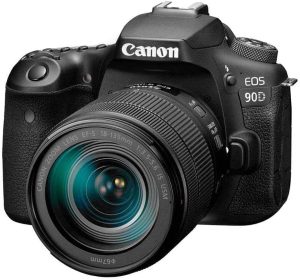
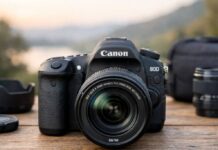
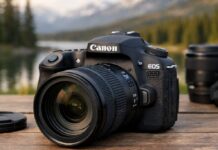
The Canon EOS 90D is the best Canon DSLR to target under $1,000 if you can find it at the right price. The 32.5MP APS-C sensor gives you more cropping room than the Nikon D7500 or D500, and the 10 fps burst rate makes it far more capable than Canon’s older Rebel bodies.
For Canon shooters, the 90D is attractive because it keeps the familiar DSLR handling while adding modern conveniences: a fully articulating touchscreen, Dual Pixel autofocus in live view, Wi-Fi/Bluetooth, and uncropped 4K video. It is a strong hybrid DSLR by DSLR standards.
The trade-off is high-ISO cleanliness. The 90D’s dense sensor rewards good lenses and good light, but it is not as forgiving in dim venues as a full-frame body. For wildlife, travel, products, landscapes, and general Canon photography, the resolution advantage is genuinely useful.
Buy it if: you want the best Canon EF/EF-S DSLR in this budget, crop heavily, or want a DSLR that also handles video reasonably well.
Skip it if: low-light events are your main work or the used price is too close to newer mirrorless options.
4. Canon Rebel SL3 / 250D: Best Lightweight Beginner DSLR
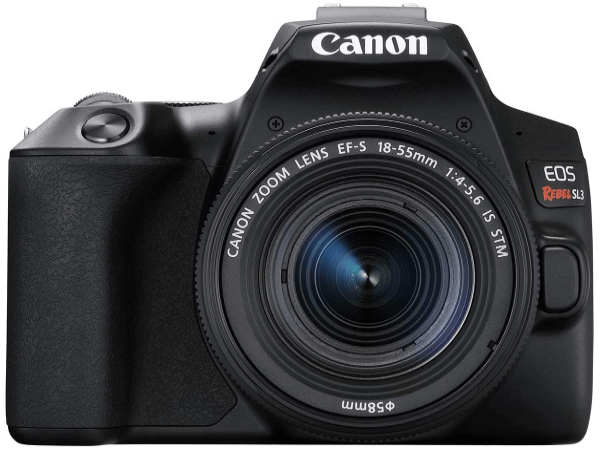
The Canon Rebel SL3, also sold as the EOS 250D, is the easiest DSLR here to recommend to a beginner who wants a small body, simple controls, and good battery life. It is much lighter than the D7500, D500, or 90D, and the fully articulating touchscreen makes low-angle photos, tripod work, and simple video much easier.
Its biggest strength is approachability. Canon’s menus are friendly, color is pleasing, and the EF-S lens ecosystem has several affordable lenses that make sense for new photographers: the EF-S 24mm f/2.8 STM, EF 50mm f/1.8 STM, and EF-S 55-250mm IS STM are all practical upgrades.
The limitation is the optical-viewfinder autofocus system. Nine AF points are fine for static subjects and basic family photography, but not ideal for action. The 4K mode is also cropped and less flexible than the spec sheet suggests.
Buy it if: you want a small DSLR for learning, travel, family photos, or casual content creation.
Skip it if: you shoot sports, birds, or anything that requires advanced tracking autofocus.
5. Nikon D5600: Best Cheap Nikon DSLR for Learning
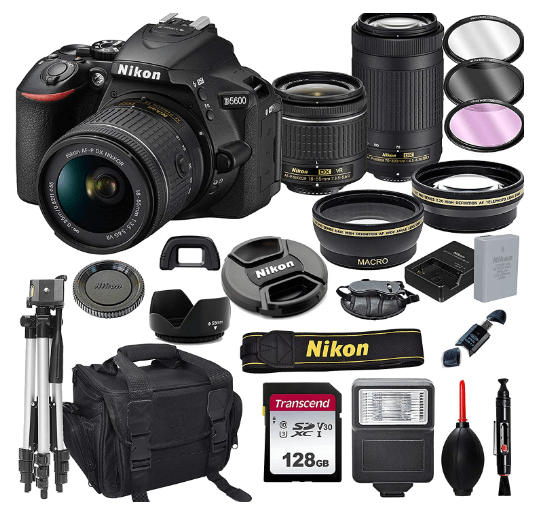
The Nikon D5600 is not the newest beginner camera, but it remains a good learning body if the price is low enough. You get a 24.2MP APS-C sensor, a 39-point autofocus system, an articulating touchscreen, and excellent battery life.
Compared with the D7500, the D5600 feels less rugged and less responsive. It is not the model I would choose for frequent action work. But for someone learning exposure, composition, RAW editing, portraits, travel, and family photography, the image quality is more than enough.
The D5600 also benefits from Nikon’s huge F-mount lens catalog. Pair it with the AF-S DX 35mm f/1.8G and it becomes a very strong low-cost photography kit.
Buy it if: you want a cheap Nikon DSLR with strong image quality and a beginner-friendly body.
Skip it if: you need 4K video, weather sealing, or fast burst shooting.
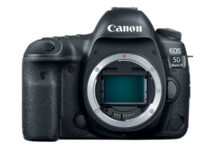
6. Canon EOS 6D: Best Used Full-Frame DSLR Under $1,000
The original Canon EOS 6D is the full-frame wildcard. It is old, slow, and not a good action camera, but the 20.2MP full-frame sensor still produces attractive files with strong high-ISO performance and shallow-depth-of-field rendering.
This is not a beginner’s best all-around DSLR in 2026. The autofocus system is basic, video is dated, and the body lacks the modern conveniences of the EOS 90D. But if you shoot portraits, available-light scenes, travel, weddings as a second body, or adapted EF primes, the 6D can still make sense.
The important buying note is lens cost. Full-frame EF lenses are usually larger and more expensive than EF-S lenses. A cheap 6D body is only a good deal if you budget for lenses like the EF 50mm f/1.8 STM, EF 85mm f/1.8, or a clean used standard zoom.
Buy it if: you specifically want full-frame Canon files and mostly shoot portraits, low light, or slower subjects.
Skip it if: you need reliable subject tracking, 4K video, or a lightweight starter kit.
7. Pentax K-70: Best Rugged DSLR Alternative
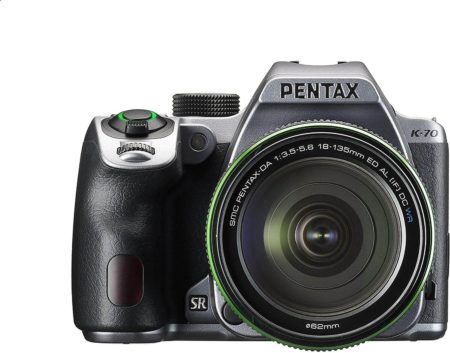
The Pentax K-70 is the left-field option, but it has real advantages. It offers weather sealing and in-body image stabilization, two features that Canon and Nikon DSLRs rarely combine at this price. For hiking, landscapes, travel in bad weather, and slow handheld shooting, the K-70 is more interesting than its age suggests.
The trade-off is ecosystem size. Pentax K-mount lenses exist and many are excellent, but the market is smaller than Canon EF or Nikon F. Autofocus is also not as strong as the Nikon D500, D7500, or Canon 90D.
Buy it if: you shoot outdoors and value weather sealing, stabilization, and a tough body more than autofocus speed.
Skip it if: you want the largest used lens market, the best action AF, or a mainstream upgrade path.
DSLRs I Would Avoid Under $1,000
Some cheap DSLRs are still usable, but they are not good buys when stronger used bodies are available.
Canon EOS 4000D / Rebel T100
The Canon 4000D / Rebel T100 does record RAW files, but that does not make it a smart buy for most people. The real problem is that it is too stripped down: old 18MP sensor, basic 9-point AF, slow shooting, fixed rear screen, very cheap body construction, and limited room to grow. It only makes sense at a very low price for absolute beginners.
Canon Rebel T6
The Rebel T6 is also too dated unless it is extremely cheap. For similar money, a Rebel SL3, Nikon D5600, or used D7500 is a better long-term purchase.
Very old beginner DSLRs
Models like the Nikon D3200, older Canon T3i/T5-era bodies, and similar early-2010s cameras can still take good photos, but they are not where I would spend a $1,000 budget. Put that money toward a cleaner, newer body and better lenses.
DSLR vs Mirrorless Under $1,000
The best DSLR argument in 2026 is not that DSLRs are newer or more advanced. They are not. The argument is value.
Choose a DSLR if:
- You want the best used body and lens value.
- You prefer an optical viewfinder and long battery life.
- You already own Canon EF/EF-S, Nikon F, or Pentax K lenses.
- You shoot stills more than video.
- You want rugged enthusiast controls at a lower price.
Choose mirrorless if:
- You need the newest subject-detection autofocus.
- You shoot video heavily.
- You want a current lens mount with long-term manufacturer investment.
- You prefer smaller bodies and electronic exposure preview.
For many buyers, the correct decision is simple: buy a DSLR only if the used/refurbished price lets you get a stronger lens kit than the mirrorless alternative. If the price gap disappears, mirrorless becomes harder to ignore.
Lens Strategy for DSLR Buyers
Lenses matter more than the body once you are buying competent DSLR cameras. A D5600 or SL3 with a good prime will often make better images than a more expensive body with a weak kit zoom.
Canon EF/EF-S lenses to consider:
- Canon EF 50mm f/1.8 STM for portraits and low light.
- Canon EF-S 24mm f/2.8 STM for a small everyday walkaround lens.
- Canon EF-S 55-250mm IS STM for wildlife, sports, and travel reach.
- Canon EF-S 10-18mm IS STM for landscapes, interiors, and vlogging-style wide shots.
Nikon F lenses to consider:
- Nikon AF-S DX 35mm f/1.8G for everyday photography.
- Nikon AF-S 50mm f/1.8G for portraits.
- Nikon AF-P DX 70-300mm VR for budget telephoto reach.
- Nikon AF-P DX 10-20mm VR for landscapes and interiors.
Pentax K lenses to consider:
- Pentax DA 35mm f/2.4 for a cheap normal prime.
- Pentax DA 50mm f/1.8 for portraits.
- Pentax DA 18-135mm WR for a weather-resistant travel zoom.
Final Verdict
For most photographers, the Nikon D7500 is the best DSLR under $1,000 because it balances image quality, autofocus, handling, battery life, lens support, and used pricing. If you shoot action, look for a clean Nikon D500. If you are a Canon shooter, the EOS 90D is the strongest APS-C DSLR target, while the Rebel SL3 is the easier beginner option.
The smartest DSLR purchase in 2026 is not the cheapest body. It is the body that leaves enough money for the right lens. Buy clean, buy from a reputable seller, and put at least part of the budget into glass.