
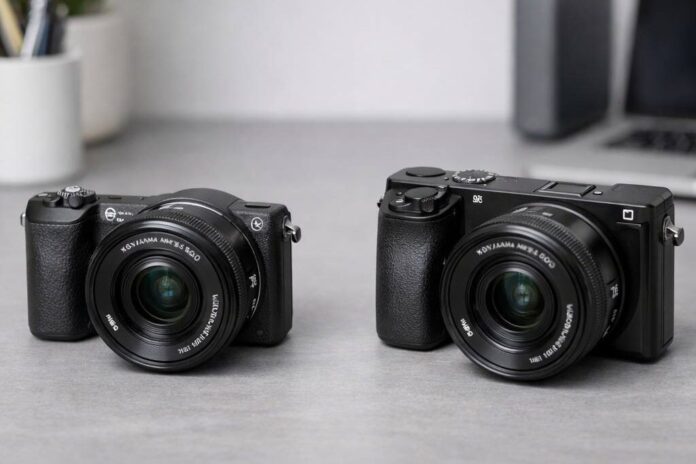
The Sony a5100 and a6000 look close on a spec sheet, but they suit different photographers. These older Sony Alpha APS-C bodies – the α5100 and α6000 – are still searched because used prices can be tempting and E-mount lenses remain useful. I’ve used both as compact APS-C bodies, and each shines for a different kind of photographer. This guide breaks down real-world handling, autofocus, image quality, and value so you can pick the one that truly suits your shooting style.
Sony a5100 quick facts
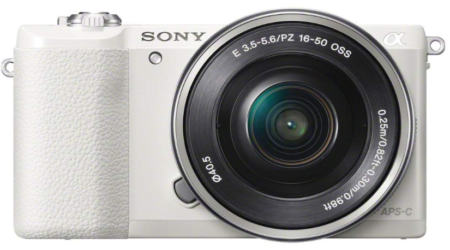
Sony a6000 quick facts
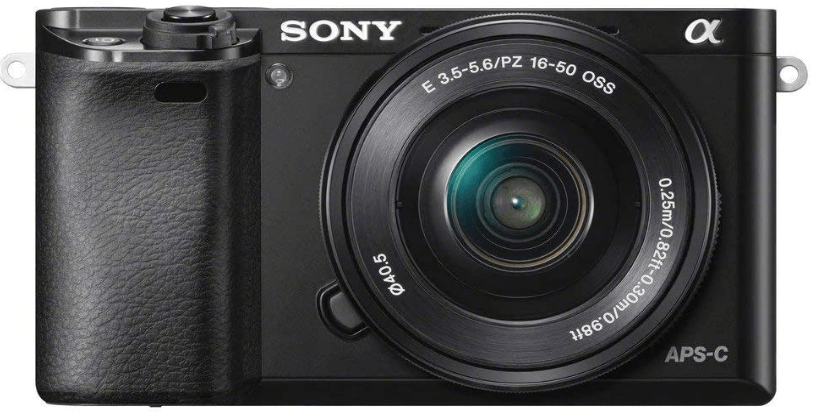
What separates the Sony a5100 and a6000 at a glance
At first glance, the Sony a5100 and a6000 seem almost like twins. Both offer a compact APS-C sensor, interchangeable lenses, and a similar megapixel count. But after spending time with each, I can say the differences go beyond the spec sheet. The experience of using these cameras and the types of photographers they suit are where the real divide emerges.
For readers leaning toward the smaller body, a closer look at the Sony a5100 review can help clarify how it feels in everyday use, especially for travel, casual shooting, and simple video setups before comparing it directly against the more control-focused a6000.
Who the a5100 is really for
The Sony a5100 is the camera I suggest for those who want a compact, no-fuss shooting experience. Its small size makes it ideal for travel, casual family moments, and street snapshots. If you prioritize a lightweight body that slips into a small bag, the a5100 delivers. The flip-up touchscreen is a huge bonus for selfies and vlogging, especially for beginners or people who want to shoot themselves without fiddling with settings. The menu layout caters to straightforward shooting, so you can focus on capturing the moment instead of getting lost in controls.
In my experience, casual shooters and those making the jump from a smartphone will find the a5100 familiar and unintimidating. It’s a camera you can hand to almost anyone and trust they’ll get good results. The lack of a viewfinder is the main tradeoff, but for many, especially in bright daylight or quick snaps, the screen is enough.
Who the a6000 makes more sense for
The Sony a6000, on the other hand, is aimed at those who want more control and room to grow. It adds an electronic viewfinder (EVF), more physical dials, and a grip that feels more secure during longer shoots. If you plan to experiment with different lenses, manual settings, or action photography, the a6000 is a better fit. Its faster burst shooting and more advanced autofocus system make it suitable for sports, wildlife, or capturing kids in motion.
For enthusiasts or those who want to learn photography, the a6000’s extra buttons and clear EVF provide a more traditional experience. Looking through a viewfinder helps you concentrate on composition, especially outdoors or when tracking moving subjects. In short, if you’re looking for a camera that can keep up as your skills and demands grow, the a6000 is the obvious choice.
Design, size, and everyday handling
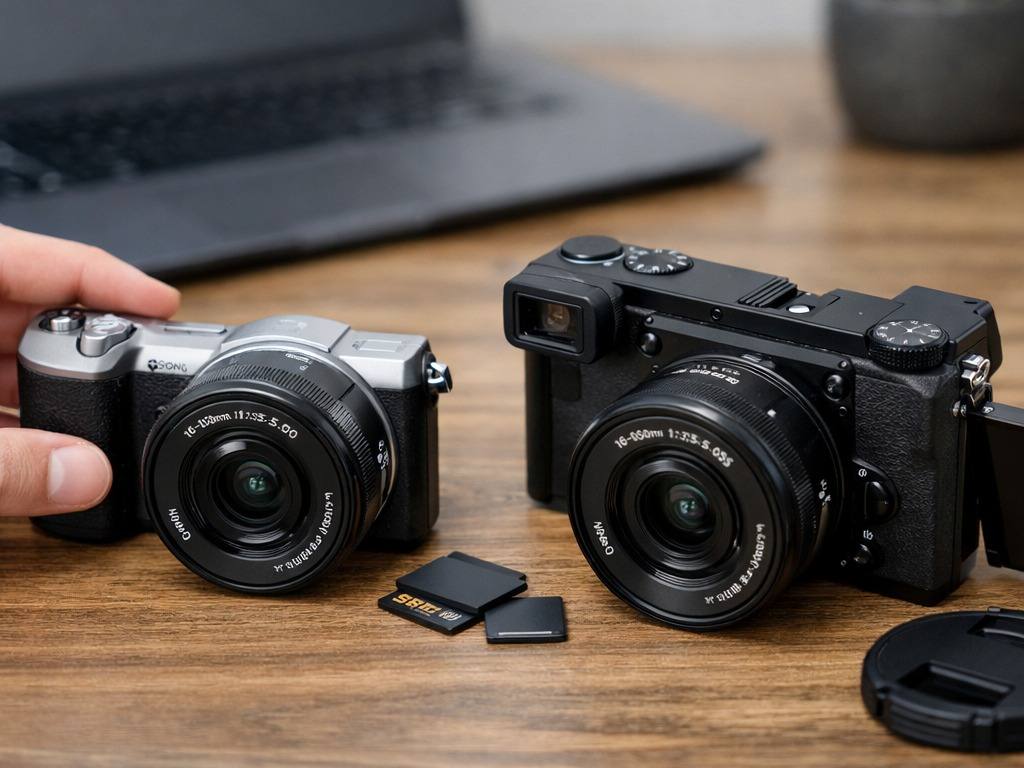
Design differences between the Sony a5100 and a6000 may seem small in photos, but they feel significant in the hand. Your priorities – whether portability, controls, or shooting style – will shape which camera feels like it was made for you.
Viewfinder, screen, and control layout
The most obvious difference is the viewfinder. The a6000 features a bright electronic viewfinder at the top left, which is absent on the a5100. This single feature changes how you shoot outdoors, especially in bright sunlight. Composing on an LCD can be a struggle when glare washes out the screen. With the a6000’s EVF, I can keep my eye on the scene, shielded from distractions and light, which also helps stabilize the camera for sharper shots.
Control layout is another area where the a6000 pulls ahead for enthusiasts. It offers two control dials and a custom function button on the back. For those who like to tweak exposure, aperture, or ISO on the fly, these dials are invaluable. The a5100, by contrast, places most controls in the touchscreen interface or on a simplified rear panel. This design makes it less intimidating for newcomers but limits fast manual adjustments.
The screens are different as well. The a5100’s rear LCD flips up 180 degrees for easy selfies or vlogging. The a6000’s screen tilts up and down, which is better for shooting at odd angles but doesn’t face forward. If you plan to shoot a lot of video of yourself, the a5100’s design wins here.
Portability for travel, family, and street photography
For size and weight, the Sony a5100 is one of the most compact interchangeable lens cameras available. It fits easily into a small purse or jacket pocket, especially with a pancake lens. For travel, family outings, or casual street shooting, the a5100 draws less attention and won’t weigh you down. Its simple grip is enough for most lenses, though heavier glass can feel unbalanced.
The a6000 is still compact compared to many DSLRs, but it is a bit wider and taller due to the EVF and bigger grip. This extra bulk makes it easier to use with longer or heavier lenses and provides more stability when shooting for extended periods. If portability is your top priority, the a5100 is the winner. For those who want a bit more substance in the hand, the a6000 feels more like a “real camera” and less like a point-and-shoot.
Autofocus and shooting speed in real use
Both cameras use Sony’s hybrid autofocus system, but there are differences in how confident and responsive they feel, especially when the action picks up.
Tracking moving subjects and keeping up with action
I’ve shot sports, wildlife, and energetic kids with both the a5100 and a6000, and the gap in autofocus performance becomes obvious in these scenarios. Both cameras use 179 phase-detection points, but the a6000 gives you the more action-friendly shooting experience because of its EVF, stronger controls, better grip, and faster burst rate. In practice, the a6000 is easier to keep on a moving subject because you can brace it to your eye and adjust settings without relying as heavily on the rear screen. Its burst shooting speed of 11 frames per second also helps nail the right moment during fast sequences.
The a5100 is quick for single shots and works well for portraits or slower scenes. However, it occasionally struggles with fast-moving subjects or in lower light, hunting for focus instead of snapping instantly. Its maximum burst rate is slightly lower, and the buffer fills more quickly, meaning you can’t shoot long action sequences before the camera pauses to write files to the card.
For everyday use – street, travel, or family events – the difference may be subtle. But if you routinely shoot sports, birds, or kids running at the park, the a6000’s autofocus and burst speed give you a noticeable edge in keepers.
Image quality and low-light performance
Both the Sony a5100 and a6000 use a 24-megapixel APS-C sensor, and their image quality is nearly identical in most conditions. This is excellent news, as it means you aren’t sacrificing detail or dynamic range by choosing the more affordable or compact camera. Both produce crisp, vibrant photos that hold up for large prints and cropping.
Where you may notice a difference is in low-light shooting. The a6000’s EVF makes it easier to compose in dark environments, and its slightly faster autofocus system copes better when light is limited. However, in terms of actual image noise and detail retention at high ISOs, both cameras perform very similarly. With a good lens, you can confidently shoot at ISO 3200 or even 6400 and still get usable results, though noise and color shifts do appear if you push the limits.
If you plan to shoot a lot indoors, at night, or in dimly lit venues, both cameras are strong contenders in the APS-C low light camera class. Your choice should come down more to handling and features than pure image quality, as neither body holds a decisive edge here.
Overall, the Sony a5100 vs a6000 debate centers less on sensor performance and more on which body matches your shooting habits, preferred lenses, and everyday needs. The next sections will dig into video features, lens options, and which model I’d pick for different scenarios.
Video features and vlogging practicality
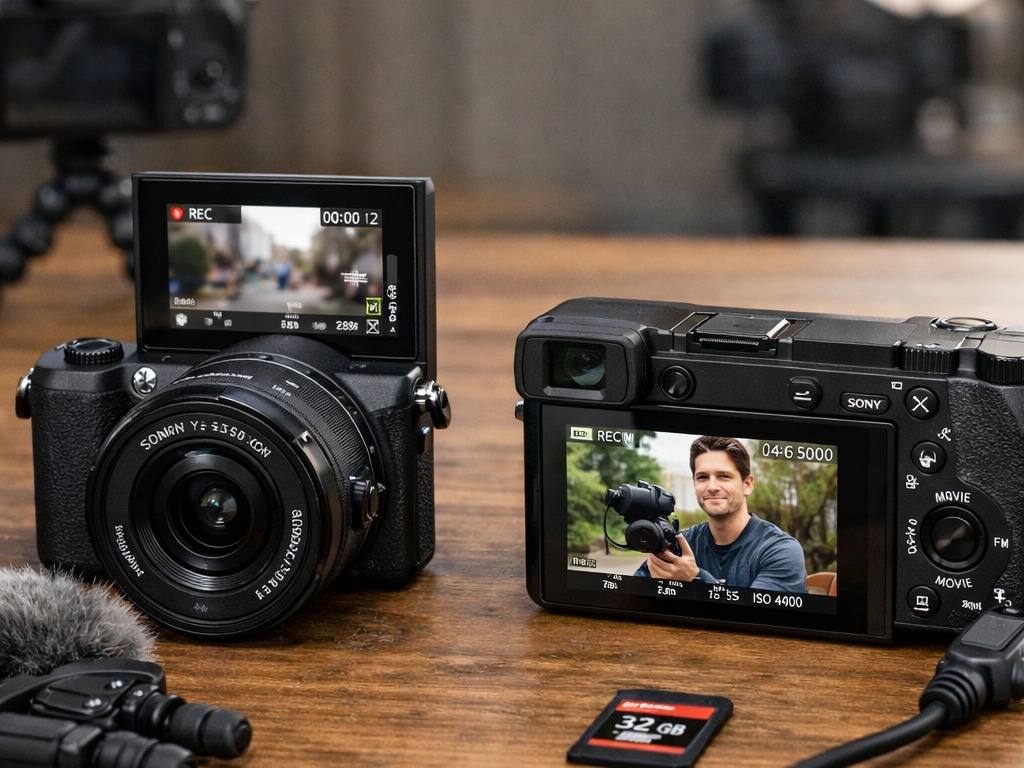
Flip screen, focus behavior, and audio limitations
For video, both the Sony a5100 and a6000 can still produce solid 1080p footage, but the shooting experience is very different. For anyone considering vlogging, self-filming, or frequent video content, the differences in screens, autofocus, and audio options matter a lot.
The Sony a5100 video experience is surprisingly smooth for a camera its size. The standout feature for vlogging is its 180-degree flip-up touchscreen. This lets you easily frame yourself while recording, which is essential for solo creators. Touch to focus works well for video, so you can tap the screen to pick your subject and the camera will track it. The autofocus system inherited from the a6000 means you get fast, confident subject tracking even as you move. The a5100 also avoids the distracting “hunting” that older compact digital cameras sometimes have, so your focus transitions look natural.
However, the a5100 has one notable limitation: it lacks any kind of microphone input. That means you’re stuck with the built-in stereo mics, which are decent in quiet indoor spaces but underwhelming if you want crisp audio or plan to shoot outdoors. For travel vlogs, daily logs, or talking-head content in a controlled setting, it’s probably enough. But if audio quality is a top priority, this can be a dealbreaker.
The Sony a6000 video capabilities are similar in technical specs: both record 1080p at up to 60 frames per second, and both use the same sensor. However, the a6000’s screen is not fully articulating – it only tilts up about 90 degrees and down for high or low angles. This makes traditional vlogging, where you want to see yourself on camera, much less practical. If you’re mostly shooting behind the camera, this isn’t a problem, but if you want to film yourself, you’ll need to get creative with setups or external monitors.
Autofocus during video on the a6000 is excellent, with phase-detect points covering much of the frame. Face detection works reliably, and the camera tracks movement well, even with fast subjects. Like the a5100, though, there’s no mic input, so you’re limited to the onboard audio. This is a common tradeoff on compact digital cameras from this era.
If you’re searching for the best Sony camera for vlogging between these two, the a5100 is the clear winner thanks to its flip screen and intuitive touch controls. For more advanced video work, both are limited compared to later models with 4K or audio inputs, but for casual YouTube or personal projects, they still deliver pleasing footage and the kind of “look” that made Sony E-mount popular with creators.
Lens options and long-term system value
Both the Sony a5100 and a6000 use the Sony E-mount system, which is one of the most versatile and well-supported lens mounts in the mirrorless world. This is where both cameras really shine compared to fixed-lens compact digital cameras, and where the decision between bodies becomes less important than your lens choices.
The E-mount lineup covers everything from affordable kit zooms to fast primes, telephotos, wide-angles, and even high-end G Master glass. Many photographers start with the 16-50mm power zoom, which is lightweight and compact – a nice match for both bodies. However, to see what these cameras are truly capable of, I always recommend adding a prime lens.
The best lens for Sony a6000 will depend on your shooting style. For street or travel, the Sony 35mm f/1.8 OSS is a favorite: it’s sharp, compact, and adds great low-light performance. Portrait shooters love the 50mm f/1.8 OSS, which creates beautiful background blur and sharp faces. If you need even more flexibility, there are Tamron and Sigma primes in E-mount that offer wide apertures in small packages.
The best lens for Sony a5100 is often the same as for the a6000, since both share the same sensor and mount. I’ve found the a5100 pairs especially well with smaller primes, as it keeps the overall setup pocketable. For vlogging or handheld video, wide primes like the Sigma 16mm f/1.4 can give you sharp, bright footage with natural background separation.
One thing that makes both cameras appealing long-term is their compatibility with future E-mount lenses. You can start with affordable zooms and upgrade to pro glass as your needs grow. Sony’s commitment to the mount means your investment in lenses will carry over if you ever upgrade to a newer body, like one in the a6000-series or even a full-frame model.
For those exploring the used market, the sheer variety of Sony E-mount lenses makes it easy to tailor a kit that fits your budget and needs. Whether you’re shooting landscapes, portraits, sports, or video, you’ll find options that work well with either camera. This long-term system value is a strong reason to pick Sony over rivals with more limited lens selections.
Pros, cons, and which one I would buy today
When weighing the Sony a5100 pros and cons against the Sony a6000 pros and cons, it mostly comes down to how you like to shoot and what features you value most.
Sony a5100 pros:
- Extremely compact and lightweight, even with a small prime lens
- 180-degree flip-up touchscreen, useful for vlogging and self-portraits
- Intuitive touch focus for both photos and videos
- Excellent autofocus performance inherited from the a6000
- Simple interface makes it friendly for beginners
Sony a5100 cons:
- No electronic viewfinder (EVF), which can make shooting in bright sunlight challenging
- No microphone input for improved audio
- Fewer physical controls, which limits quick manual adjustments
- Less ergonomic grip for larger hands or heavier lenses
Sony a6000 pros:
- Built-in EVF for composing in any lighting conditions
- More physical dials and controls for faster manual adjustments
- Stronger grip and balance for bigger lenses
- Faster maximum burst rate for action or sports
- Same excellent sensor and autofocus as the a5100
Sony a6000 cons:
- No fully articulating or flip-up screen, limiting vlogging options
- No microphone input, just like the a5100
- Not quite as compact or pocketable
So, which Sony camera should I buy if I were choosing today? If my primary use was travel, daily life, or simple self-filming, I would pick the a5100 for its flip screen, tiny size, and ease of use. If I wanted to learn photography seriously, I would choose the a6000 and also read our Sony a6000 series guide before spending more on newer bodies. It remains one of the best compact digital cameras for casual photography and simple video, especially as we see a resurgence of compact models in 2026.
However, if I wanted room to grow, plan to shoot outdoors often, or value manual controls and a viewfinder, the a6000 is the more versatile choice. It’s a camera you can start with as a beginner and keep using as your skills improve, especially with the ever-expanding E-mount lens lineup.
Frequently asked questions
Is the Sony a6000 better than the a5100 for beginners?
Both are excellent entry points, but the a5100 is slightly easier for complete beginners thanks to its touch screen and simpler controls. If you want more room to grow, the a6000’s viewfinder and extra dials help you learn manual settings over time.
Does the Sony a5100 have the same image quality as the a6000?
Yes, both share a 24.3MP APS-C sensor generation and BIONZ X processing. In real-world use, you’ll see very similar results in sharpness, color, and low-light performance. Your choice of lens makes a bigger difference.
Which is better for video, the Sony a5100 or a6000?
For vlogging or self-filming, the a5100 is usually better thanks to its flip-up screen and touch focus. For video behind the camera, both perform similarly, but neither has a microphone input or 4K video.
Is the viewfinder on the Sony a6000 worth the extra cost?
If you shoot outdoors or in bright light, the a6000’s EVF is a big advantage. It also makes it easier to compose and focus precisely, especially with manual lenses or tricky lighting.
Key takeaways
- The Sony a5100 and a6000 share similar core image quality, but the shooting experience feels quite different.
- The a5100 is the better fit if you want the smallest body, a flip screen, and simple everyday use.
- The a6000 is easier to grow with thanks to its EVF, stronger controls, and more confident handling for action and outdoor shooting.
- Your best choice depends less on specs alone and more on how you like to shoot and which lenses you plan to add later.