

This Nikon PROSTAFF P7 10×42 review reaches a balanced verdict: the P7 10×42 is a strong all-purpose binocular for birding, wildlife, hiking, and sports when you want more reach without a narrow, tunnel-like view. Its wide field of view, dielectric and phase-corrected prisms, locking diopter, and weatherproof build are meaningful strengths. The main cautions are the modest 15.7mm eye relief, a 9.8-foot close-focus distance, and the greater hand shake that comes with any 10x binocular.
Best for: daylight wildlife viewing, distant birds, aircraft, sporting events, and anyone who values 10x detail. Consider the 8×42 instead if you wear glasses, often watch in dim light, or want the steadiest and most forgiving view.
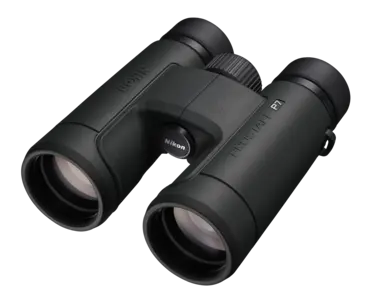
Nikon PROSTAFF P7 10×42: pros and cons
Pros
- Unusually wide 367-foot field of view for a 10×42 binocular
- Dielectric and phase-correction prism coatings
- Locking diopter prevents accidental adjustment
- Waterproof, nitrogen-filled, and fogproof construction
- Oil- and water-repellent coating on exposed lens surfaces
- Comfortable full-size weight at 21.2 ounces
Cons
- 15.7mm eye relief may be marginal for some glasses wearers
- 10x magnification is harder to hold steady than 8x
- 9.8-foot close focus is poor for insects and very near subjects
- Nikon does not list ED glass or field-flattener elements
- The supplied soft case and separate objective caps are basic
Key specifications
| Specification | Nikon PROSTAFF P7 10×42 |
|---|---|
| Magnification | 10x |
| Objective diameter | 42mm |
| Prism type | Roof prism |
| Field of view | 367 ft at 1,000 yd (7°) |
| Apparent field of view | 62.9° |
| Close focus | 9.8 ft |
| Exit pupil | 4.2mm |
| Eye relief | 15.7mm |
| Weight | 21.2 oz (600 g) |
| Dimensions | 5.9 × 5.1 in |
| Weather protection | Waterproof to 3.3 ft for 10 minutes; nitrogen filled and fogproof |
| Prism coatings | Dielectric and phase correction |
These figures come from the official Nikon USA specifications. They correct two common errors in older descriptions of this model: the field of view is 367 feet, not 362 feet, and Nikon does not promise a generic “10-year warranty” for this binocular.
Optical performance: wide, bright and practical
The standout specification is not simply 10x magnification. It is the combination of 10x reach and a 367-foot field of view at 1,000 yards. Many affordable 10×42 binoculars make locating a moving bird harder because the visible area is narrow. The P7 gives you more room to acquire and follow a subject while retaining the extra detail of 10x.
Nikon uses dielectric high-reflective multilayer coatings and phase-correction coatings on the roof prisms. Dielectric coatings improve light transmission and color neutrality, while phase correction helps preserve resolution and contrast. Fully multilayer-coated lenses complete a sensible optical package for this class.
The 4.2mm exit pupil is normal for a 10×42 design. In daylight it provides a bright, useful view. At dawn, dusk, or under a dense canopy, an 8×42 model has a larger 5.3mm exit pupil and is easier for many people to use. The P7 10×42 is therefore better described as a versatile daylight binocular than a specialist low-light model.
There is one optical limitation worth stating plainly. Nikon does not list extra-low-dispersion glass or field-flattener elements for the PROSTAFF P7. Some color fringing can appear around dark subjects against a bright sky, and the extreme edges will not look as controlled as they do through a premium binocular. Neither issue makes the center view poor; it sets the correct expectation for the product tier.
Handling and build quality
At 21.2 ounces, the P7 10×42 is light enough for a neck strap or daypack without feeling insubstantial. Rubber armor protects the fiberglass-reinforced polycarbonate body and adds grip. The large center focus wheel is easy to reach, and the turn-and-slide eyecups have multiple click positions.
The locking diopter is a particularly useful feature. Set the right barrel for the difference between your eyes, push the ring into its locked position, and it is less likely to move when the binocular goes in and out of a case. That sounds minor until a conventional diopter gets knocked out of adjustment in the field.
Nikon rates the binocular waterproof to 3.3 feet for up to 10 minutes and fills it with nitrogen to reduce internal fogging. The external oil- and water-repellent coating makes fingerprints and moisture easier to remove. This is good protection against rain, damp mornings, and temperature changes, but it is not permission to treat the binocular as a diving optic.
The included accessories are adequate rather than luxurious: a soft case, neck strap, eyepiece cap, and objective caps. The separate front caps deserve attention because they are easier to misplace than tethered caps. A harness can also be more comfortable than the supplied neck strap during long walks.
Is 15.7mm eye relief enough for glasses?
Possibly, but this is the specification to test before buying. Nikon describes the P7 line as suitable for glasses wearers, and some users will see the full field at 15.7mm. Frame shape, lens distance, and facial structure all affect the result. People whose glasses sit farther from their eyes may lose part of the outer field.
If glasses are always on while viewing, the PROSTAFF P7 8×42 is the safer choice on paper. Its 20.2mm eye relief provides substantially more room. Buy the 10×42 from a seller with a practical return policy if you cannot try it first.
Nikon PROSTAFF P7 10×42 vs 8×42
| Difference | P7 10×42 | P7 8×42 |
|---|---|---|
| Magnification | More distant detail | Easier to hold steady |
| Field of view | 367 ft | 377 ft |
| Eye relief | 15.7mm | 20.2mm |
| Exit pupil | 4.2mm | 5.3mm |
| Weight | 21.2 oz | 20.8 oz |
Choose the 10×42 for distant perched birds, open-country wildlife, aircraft, shorelines, and stadium use. The subject appears larger, and the P7 retains a notably broad view for its magnification.
Choose the 8×42 for woodland birding, long handheld sessions, low light, and easier use with glasses. It gives up some reach but is steadier and more forgiving. For a first serious binocular with no specific long-distance requirement, 8×42 remains the lower-risk choice.
PROSTAFF P7 vs P3 and older 7S
The P7 replaced Nikon’s PROSTAFF 7S line. Against the older 7S 10×42, the current P7 is shorter and lighter, focuses closer, and expands the field of view from 325 to 367 feet. It also adds the locking diopter and repellent exterior lens coating. Those are genuine usability gains, not just a name change.
The P3 10×42 shares several headline numbers with the P7, including the 367-foot view, 9.8-foot close focus, and 15.7mm eye relief. The reason to step up to the P7 is its optical treatment and control: Nikon specifies dielectric and phase-correction prism coatings, the non-stick lens coating, and a locking diopter. Choose the P3 only when the saving is large enough to outweigh those benefits.
Nikon P7 10×42 vs Vortex Diamondback HD 10×42
This is the most useful cross-brand comparison because both are compact, weatherproof 10×42 roof-prism binoculars with dielectric and phase-corrected prisms.
| Difference | Nikon P7 10×42 | Vortex Diamondback HD 10×42 |
|---|---|---|
| Field of view | 367 ft | 330 ft |
| Close focus | 9.8 ft | 5.0 ft |
| Eye relief | 15.7mm | 15.0mm |
| Weight | 21.2 oz | 21.3 oz |
| Diopter | Locking | Conventional |
| Included carry system | Soft case and neck strap | GlassPak harness and neck strap |
Choose the Nikon when a wide view and locking diopter matter most. Choose the Vortex for much closer focusing, a better included carry system, or the company’s unlimited lifetime warranty. Vortex publishes the current details on its Diamondback HD 10×42 product page. Optical preference is personal, so the best answer is to compare both through your own eyes if a retailer makes that possible.
Who should buy the Nikon P7 10×42?
Buy it if:
- You regularly observe subjects at medium or long distances.
- You want 10x detail without accepting an unusually narrow view.
- You value weather protection and a diopter that stays set.
- You want a full-size binocular that remains manageable on a hike.
Skip it if:
- You struggle to hold 10x binoculars steady.
- You always wear glasses and need generous eye relief.
- You watch butterflies or other subjects closer than about 10 feet.
- You are specifically buying for low-light use.
- You expect premium edge sharpness and maximum control of chromatic aberration.
How to set it up correctly
- Adjust the hinge until the two circular views merge into one.
- Close your right eye and focus the center wheel on a detailed distant subject.
- Close your left eye, open your right, unlock the diopter, and turn it until the same subject is sharp.
- Lock the diopter, then use only the center wheel for normal focusing.
- With glasses, start with the eyecups fully down. Without glasses, extend them until the view is comfortable and free of dark crescents.
A correct setup matters more than repeatedly chasing focus with both controls. If the two images never merge comfortably, adjust the interpupillary distance again before judging sharpness.
Final verdict
The Nikon PROSTAFF P7 10×42 earns its recommendation through a useful combination: 10x reach, a wide 367-foot view, good prism coatings, low weight, serious weather protection, and a locking diopter. It is a particularly persuasive choice for open-country wildlife, birds at distance, aircraft, and sports.
It is not automatically the best P7 for everyone. The 8×42 is steadier, brighter in dim conditions, and much friendlier to glasses. The Vortex Diamondback HD focuses far closer and includes a better carry system. Pick the P7 10×42 when its reach and broad view directly match how you observe, not simply because 10x sounds more powerful.
Frequently asked questions
Are Nikon PROSTAFF P7 10×42 binoculars good for birdwatching?
Yes, especially for distant or open-country birds. The 367-foot field of view is wide for a 10×42 and helps with tracking. An 8×42 is easier to hold steady for woodland birding and long sessions.
Are the Nikon P7 10×42 binoculars waterproof?
Yes. Nikon rates them waterproof to 3.3 feet for up to 10 minutes. They are nitrogen filled and fogproof, but they are not designed for extended submersion.
Can you use the P7 10×42 with glasses?
The eyecups retract and Nikon lists 15.7mm of eye relief. That works for some glasses wearers but may not expose the full field for everyone. The P7 8×42 has a more generous 20.2mm.
Does the Nikon PROSTAFF P7 use ED glass?
Nikon does not list ED glass for the PROSTAFF P7 10×42. Buyers who are particularly sensitive to color fringing should compare it with higher-tier binoculars before purchasing.
What comes with the Nikon P7 10×42?
The standard package includes the binocular, soft case, neck strap, eyepiece cap, and objective caps. Retailer bundles vary, so check the exact listing before ordering.