
Contents
- Nikon Coolpix B500 Review 2026: Still Worth Buying Used?
- Quick Verdict: Who Should Buy the Nikon B500?
- What the Nikon Coolpix B500 Is Good At
- Where the B500 Struggles
- Real-World Testing Notes
- Nikon Coolpix B500 Specs That Actually Matter
- Real-World Image Quality
- Nikon Coolpix B500 Price and Buying Advice
- Nikon Coolpix B500 Pros and Cons
- Best Settings for the Nikon Coolpix B500
- Nikon Coolpix B500 vs B600, P900, and Mirrorless Cameras
- Who I Would Still Recommend It To
- Frequently Asked Questions
- Is the Nikon Coolpix B500 worth buying in 2026?
- Is the Nikon Coolpix B500 a good camera?
- Can the Nikon B500 take good pictures?
- Does the Nikon Coolpix B500 shoot RAW?
- What is the Nikon Coolpix B500 video quality like?
- What batteries does the Nikon Coolpix B500 use?
- Is the Nikon Coolpix B500 good for bird photography?
- Is the Nikon Coolpix B500 better than a phone?
- Final Verdict
Nikon Coolpix B500 Review 2026: Still Worth Buying Used?
The Nikon Coolpix B500 is not a camera I would recommend to everyone in 2026. It is old, it does not shoot RAW, it has no viewfinder, and a good phone will beat it for most everyday photos. But it still has one thing phones do not have: a real 40x optical zoom that reaches the equivalent of 900mm.
That is why this Nikon Coolpix B500 review needs a practical answer, not nostalgia. If you want a cheap bridge camera for birds at a feeder, kids playing sports from the stands, school events, zoo trips, or family travel where you cannot walk closer, the B500 can still make sense. If you want the best image quality, low-light performance, fast autofocus, or modern video, skip it.
I first understood the appeal when I handed a B500 to my nephew during a Yellowstone family trip. Within minutes he was zooming in on bison from a safe distance and getting photos no phone in the group could match. His reaction was simple: “This is like having binoculars and a camera in one.” That is still the B500’s entire charm.
Released in 2016, the Coolpix B500 now lives mostly as a used or renewed buy. I would not treat it like a modern all-purpose camera. I would treat it like an affordable long-zoom tool for people who value reach and simplicity more than image quality perfection.
Quick Verdict: Who Should Buy the Nikon B500?
Buy the Nikon Coolpix B500 if you specifically need a cheap camera with a long optical zoom. It is best for daylight wildlife, backyard birds, kids’ sports, casual travel, older adults who prefer physical buttons, and beginners who want an easy point-and-shoot style camera with far more reach than a phone.
Do not buy it as a general smartphone replacement. For portraits, indoor photos, food, night scenes, social media video, and most everyday snapshots, a recent iPhone, Pixel, or Galaxy will usually produce cleaner and more attractive files.
My fair-price advice: the B500 is most interesting used around $120-$220 depending on condition, color, accessories, and whether the battery door and zoom mechanism are healthy. Above that, compare it carefully with newer bridge cameras, the Nikon Coolpix B600, or a used mirrorless camera if you do not need extreme zoom.
What the Nikon Coolpix B500 Is Good At
40x Optical Zoom Is the Reason to Buy It
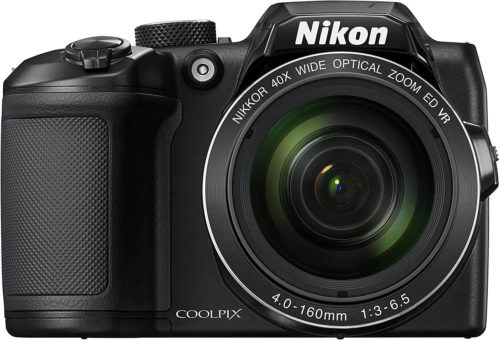
The 22.5-900mm equivalent lens is the B500’s real feature. At the wide end, it is useful for travel scenes, family groups, and landscapes. At the long end, it reaches subjects that are impossible with normal phone cameras.
This matters most when you cannot move closer: birds, wildlife, school performances, sports from bleachers, distant details on vacation, and casual moon shots. A phone can crop aggressively, but cropping a tiny subject is not the same as using actual optical reach.
The long end is not perfect. At 900mm equivalent the lens is slow, atmospheric haze matters, camera shake matters, and fine detail gets softer. Still, getting a recognizable photo is often better than getting no photo at all.
It Is Easy for Beginners and Older Adults
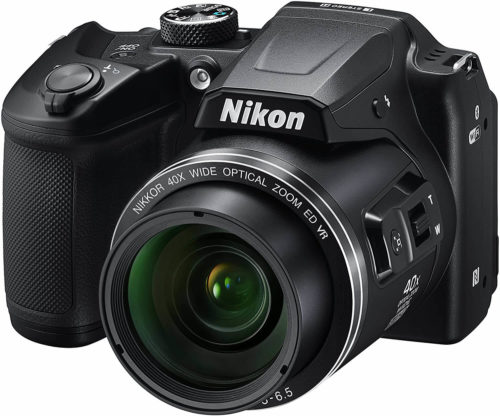
The B500 has a large grip, a physical zoom lever, a mode dial, big buttons, and a simple menu. That sounds basic, but it is exactly why some people enjoy it more than a phone or mirrorless camera.
Older adults who dislike touchscreen-only photography often adapt quickly to the B500. Teen beginners can use Auto mode first, then experiment with exposure compensation, scene modes, white balance, and aperture priority without buying lenses.
If the buyer wants a broader learning camera, our best camera for beginners guide has better long-term options. If the buyer wants simple zoom reach, the B500 remains easier.
AA Batteries Are Both Good and Bad
The B500 runs on four AA batteries. In 2026 that feels unusual, but it is not automatically a weakness.
The advantage is travel convenience. If batteries die at a zoo, school game, or national park, you can buy replacements almost anywhere. There is no proprietary battery to hunt down.
The disadvantage is that disposable alkaline batteries are wasteful and not ideal long-term. I would buy two sets of rechargeable NiMH AAs, preferably Panasonic Eneloop or similar high-capacity cells, plus a charger. That makes the B500 much easier to live with.
Where the B500 Struggles
Image Quality Is Only Good in the Right Conditions
The 16MP 1/2.3-inch sensor is small. In bright daylight at low ISO, the B500 produces pleasant photos for web sharing, family albums, and small prints. Colors are punchy enough, and the files look fine if you do not crop heavily.
The limits appear quickly in dim light. ISO 800 already looks noisy. ISO 1600 loses fine detail. ISO 3200 and above are mostly emergency settings. If you shoot indoor events, evening sports, restaurants, concerts, or family gatherings in poor light, a modern phone or larger-sensor camera is better.
Dynamic range is also limited. Bright skies can clip while shadows go muddy. Because the camera shoots JPEG only, you do not have the same recovery latitude you would get from RAW files on a mirrorless camera.
Autofocus Is Adequate, Not Modern
For static subjects in good light, focus is fine. For moving subjects at moderate zoom, it can work with patience. For fast action at full zoom, expect missed frames.
This is the most important limitation for sports parents. The B500 can absolutely get useful soccer, baseball, track, and school-event photos from a distance. But it is not a modern sports camera. The burst buffer is limited, focus tracking is not advanced, and you need to anticipate moments rather than spray endlessly.
Video Quality Is Outdated
The Nikon Coolpix B500 video quality is acceptable for casual 1080p clips, but it is not competitive by 2026 standards. There is no 4K, no 60fps, no serious stabilization for walking footage, and autofocus can pulse when zoomed in.
The long optical zoom is useful for school plays, wildlife clips, and sideline moments. For YouTube, vlogging, travel filmmaking, or polished family video, use a modern phone or a camera designed for video.
Real-World Testing Notes
Wildlife and Travel Reach
The B500 makes the strongest impression outdoors. At a national park, beach overlook, zoo, or roadside pull-off, the 40x zoom gives casual photographers a type of photo they normally cannot get. Elk, birds, boats, distant architecture, and mountain details all become reachable.
This is where the camera feels genuinely fun. You raise it, zoom in, and the subject suddenly fills the frame. For a non-photographer, that experience is more meaningful than sensor-size arguments.
The image quality at full zoom is not magic. Fine detail softens, contrast drops, and heat shimmer can ruin distant subjects. But the B500 still captures identifiable photos that a phone would reduce to tiny crops. For family travel albums and social sharing, that matters.
Youth Sports From the Stands
Youth sports may be the B500’s most practical use. From soccer bleachers, baseball fences, track sidelines, or school events, phones often make kids look like small figures in a wide scene. The B500 lets you isolate faces and action from across the field.
The trick is to stay realistic. Use good light, keep shutter speed high, and avoid maxing out the zoom unless you need to. The camera can follow moderate movement, but it is not reliable enough for every sprint, slide, or sudden direction change.
If the moment matters, take more than one shot. The limited burst buffer means you cannot hold the shutter forever, so timing matters more than with a modern mirrorless sports camera.
Smartphone Comparison
A recent phone wins for near subjects. Portraits, food, indoor family photos, pets on the couch, and night scenes look better from a good smartphone because computational photography handles exposure, noise, HDR, skin tones, and stabilization so well.
The B500 wins when the subject is far away. At 20x, 30x, or 40x, optical zoom still beats phone digital zoom. This is why the camera is not obsolete for everyone. It is obsolete as a general camera, but still relevant as a cheap long-reach camera.
Handling in Bright Sun
The missing viewfinder is one of the B500’s most annoying real-world limitations. The tilting rear screen helps, but in bright sunlight you may struggle to compose at long zoom. That makes birds and sports harder than they should be.
If you regularly shoot in harsh daylight and have a higher budget, a bridge camera with an electronic viewfinder is easier to use. If you are buying the B500 cheaply, accept that the screen-only design is part of the compromise.
Nikon Coolpix B500 Specs That Actually Matter
- Sensor: 16MP 1/2.3-inch BSI CMOS
- Lens: 40x optical zoom, 22.5-900mm equivalent
- Aperture: f/3.0-6.5
- Stabilization: Lens-shift vibration reduction
- Screen: 3-inch tilting LCD, no viewfinder
- Video: Full HD 1080p
- RAW support: No, JPEG only
- Batteries: Four AA batteries
- Connectivity: Wi-Fi, Bluetooth, NFC through Nikon SnapBridge
- Best use: Daylight long-zoom photography on a budget
The most important missing spec is RAW support. Many buyers search for Nikon Coolpix B500 RAW support, and the answer is simple: it does not shoot RAW. That does not matter for casual users, but it is a major reason serious photographers should buy something else.
Real-World Image Quality
Daylight Photos
In bright daylight, the B500 is at its best. Wildlife at a distance, kids on a sports field, zoo animals, beach scenes, and travel details all suit the camera. Keep ISO low, avoid heavy cropping, and the photos are good enough for sharing and small prints.
The lens is strongest through the middle of the zoom range. At extreme telephoto, sharpness drops, but the reach is still useful. You are buying the B500 to bring distant subjects closer, not to produce large gallery prints.
Low-Light Photos
Low light is the wrong environment for this camera. The small sensor and slow long-end aperture force high ISO, and the JPEG noise reduction smears detail.
If you mostly photograph indoor family events, restaurants, evening travel, or night streets, do not buy the B500. A current phone will usually be cleaner, faster, and more reliable.
Phone Comparison
A modern phone beats the B500 for nearby subjects, portraits, food, indoor scenes, night photos, and video. Computational photography has moved far beyond what an older small-sensor bridge camera can do.
The B500 wins when distance matters. At 300mm, 600mm, or 900mm equivalent, optical zoom still beats digital zoom. That is the narrow but real reason this camera continues to attract searches and buyers.
Nikon Coolpix B500 Price and Buying Advice
The Nikon Coolpix B500 price varies heavily because many listings are used, renewed, imported, or bundled with accessories. I would judge the deal by condition first and bundle second.
A clean used kit around $120-$180 is attractive. Around $200-$220 can still be fair if it includes a case, memory card, charger, and good rechargeable batteries. Above $250, I would pause and compare alternatives.
Check the zoom movement, lens condition, battery compartment, screen hinge, and whether the camera powers on reliably with fresh batteries. Battery-door damage and corrosion are deal breakers.
If you are comparing older long-zoom Nikon models, our Nikon Coolpix camera guide gives better context across the lineup.
Nikon Coolpix B500 Pros and Cons
Pros
- Excellent 40x optical zoom for the price
- Easy physical controls for beginners and older users
- Good daylight reach for birds, sports, wildlife, and travel
- AA batteries are convenient when traveling
- Tilting screen helps with high and low angles
- Usually affordable used compared with mirrorless plus telephoto lens
Cons
- No RAW support
- No viewfinder
- Poor low-light image quality
- Only 1080p video
- Autofocus and burst shooting are limited for fast action
- Modern phones beat it for most everyday photos
Best Settings for the Nikon Coolpix B500
For complete beginners, Auto mode is fine. But a few settings improve results:
- Sports and kids: Use Sports mode or Shutter Priority if available, aim for 1/500s or faster, and shoot in good light.
- Birds and wildlife: Use continuous shooting, keep the zoom slightly below maximum when possible, and brace your elbows.
- Travel: Use Auto or Program mode, keep exposure compensation ready, and avoid pushing ISO indoors.
- Video: Frame before recording, avoid zooming while filming, and use a tripod or railing for long zoom clips.
- Batteries: Use rechargeable NiMH AAs, not cheap disposable batteries for regular use.
The biggest practical tip is simple: do not use full 40x zoom unless you need it. Photos are usually sharper at 15x-30x, and the camera focuses more reliably.
Nikon Coolpix B500 vs B600, P900, and Mirrorless Cameras
B500 vs Nikon Coolpix B600
The B600 is the successor with a longer 60x zoom. It reaches farther, but the extra reach is not always as useful as it sounds. At extreme focal lengths, haze, shake, and soft detail become real problems.
If the B600 is only slightly more expensive, it is worth considering. If it costs $100+ more, I would often rather buy the B500 and spend the difference on batteries, a case, or a better tripod. For more detail, read our Nikon Coolpix B600 review.
B500 vs Nikon Coolpix P900
The P900 is the more serious superzoom with far more reach and a stronger enthusiast feel. It is also larger and usually more expensive. The B500 is the simpler family camera; the P900 is the better choice if your main interest is birds, moon shots, and extreme telephoto.
We also have a dedicated Nikon Coolpix B500 vs P900 comparison if you are choosing between the two.
B500 vs Used Mirrorless
A used mirrorless camera like a Sony A6000 gives much better image quality, autofocus, low-light performance, and upgrade potential. But it does not give you 900mm equivalent reach unless you buy a large and expensive telephoto lens.
That is the whole trade-off. If you want better photos in normal situations, buy mirrorless. If you want cheap long zoom in one simple package, the B500 makes more sense.
Who I Would Still Recommend It To
I would recommend the B500 to a grandparent photographing backyard birds and grandkids, a parent shooting youth sports from bleachers, a teen who wants an inexpensive long-zoom camera, or a traveler who wants reach without learning lenses.
I would not recommend it to someone who wants to become a serious photographer, shoot paid work, film YouTube videos, photograph indoors often, or replace a recent flagship phone for everyday photography.
For budget alternatives, compare it with our best cameras under $200, best cameras under $300, and best bridge cameras guides.
Frequently Asked Questions
Is the Nikon Coolpix B500 worth buying in 2026?
Yes, but only for the right buyer. It is worth buying if you want cheap 40x optical zoom for daylight wildlife, sports, travel, or simple family use. It is not worth buying as a general camera if you already have a good phone and do not need long zoom.
Is the Nikon Coolpix B500 a good camera?
It is a good camera for reach and simplicity, not for overall image quality. In bright light with distant subjects, it can be genuinely useful. In low light, video, portraits, and fast action, it shows its age quickly.
Can the Nikon B500 take good pictures?
Yes, in good light and with realistic expectations. It can produce nice family, travel, wildlife, and sports photos for sharing or small prints. It is not a camera for large prints, heavy editing, or professional-looking low-light work.
Does the Nikon Coolpix B500 shoot RAW?
No. The B500 shoots JPEG only. That limits editing flexibility, especially for recovering highlights, fixing white balance, or lifting shadows.
What is the Nikon Coolpix B500 video quality like?
It records usable 1080p video for casual clips, but it is outdated compared with modern phones and creator cameras. The long zoom is useful, but autofocus, stabilization, and detail are limited.
What batteries does the Nikon Coolpix B500 use?
It uses four AA batteries. I recommend rechargeable NiMH AAs rather than disposable alkaline batteries. Buy two sets and a charger if you plan to use the camera regularly.
Is the Nikon Coolpix B500 good for bird photography?
It is good for casual bird photography, especially perched birds in daylight. The 40x zoom is useful. Birds in flight are much harder because autofocus and burst performance are limited.
Is the Nikon Coolpix B500 better than a phone?
Only for distant subjects. A good phone is better for most everyday photos and video. The B500 wins when optical zoom matters more than computational image quality.
Final Verdict
The Nikon Coolpix B500 is a narrow-purpose camera, and that is exactly how I would buy it in 2026. Do not buy it because you think any dedicated camera must beat a phone. In many situations, it will not.
Buy it because you want a simple, affordable camera with real optical reach. For birds, youth sports, zoo trips, school events, and daylight travel details, the B500 still does something useful at a low price.
If you find a clean used or renewed kit at a fair price, it remains a smart budget superzoom. If the price climbs too high, move up to a better bridge camera or buy a used mirrorless body instead.
Review updated June 2026 | Based on long-term real-world use with family members, students, travel, youth sports, and side-by-side comparisons with modern phones and older mirrorless cameras.
Casual wildlife, family travel, zoo, sports-field, and vacation shooters who want huge zoom reach without changing lenses.
You need a viewfinder, RAW files, strong low-light quality, manual exposure control, or reliable autofocus for fast action.
Low for Auto-mode shooting, but long-zoom technique and AA battery quality matter more than beginners may expect.
Limited because the lens is fixed; move to a better bridge camera or an entry mirrorless kit if image quality matters more than zoom reach.
Full HD is fine for casual clips, but there is no 4K, no microphone input, and autofocus is basic by modern standards.
Yes if the price is low and the camera is fully working; no if it costs close to newer superzoom or mirrorless alternatives.
Last update on 2026-06-17 / Affiliate links / Images from Amazon Product Advertising API