
The DJI Osmo 360 is the 360 camera to buy for high-frame-rate 8K, built-in storage and direct DJI Mic support. It is not the automatic winner over the Insta360 X5. The Osmo’s lenses cannot be replaced by the owner, and that matters on a camera whose glass protrudes on both sides.
This DJI Osmo 360 review concentrates on the decisions that survive the spec sheet: how much detail remains after reframing, whether DJI’s editing workflow suits you, and what happens if a lens meets a rock, railing or motorcycle mirror.
DJI Osmo 360 review: quick verdict
DJI’s first 360 camera is a serious piece of hardware. It records panoramic video at up to 8K50, offers 10-bit D-Log M, stores about 105GB internally and uses the same 1950mAh battery family as recent Osmo Action cameras. The 120MP panoramic photo mode also gives photographers more room to crop than the headline video specifications suggest.
The buying decision is less flattering to DJI. The Insta360 X5 has user-replaceable lenses and the more established editing ecosystem. The GoPro MAX2 also has field-replaceable glass and adds true 8K capture, GPS and GoPro Labs. Osmo 360 makes the most sense for careful shooters who value DJI’s capture options and already own compatible DJI microphones or batteries.
What we like
- 8K panoramic video at up to 50fps
- 10-bit color and D-Log M
- 105GB of usable internal storage plus microSD
- Direct connection to compatible DJI Mic transmitters
- Compact 183g body with tripod and magnetic quick-release mounting
What would stop us buying it
- The lenses are not user-replaceable
- DJI’s 360 editing ecosystem is less mature than Insta360’s
- 8K covers the complete sphere, not the final reframed view
- DJI does not recommend body-only underwater 360 recording
DJI Osmo 360 specifications
| Sensor | Dual 1/1.1-inch square CMOS sensors |
|---|---|
| Lens | f/1.9, focus from 0.35m |
| Maximum 360 video | 8K50, 6K60 or 4K100 |
| Single-lens video | 5K60; Boost Video up to 4K120 |
| Panoramic photos | Up to 120MP |
| Color | 10-bit normal color and D-Log M |
| Maximum video bitrate | 170Mbps |
| Stabilization | RockSteady 3.0 and HorizonSteady |
| Storage | 128GB internal, about 105GB usable, plus microSD up to 1TB |
| Battery | 1950mAh removable battery |
| Weight | 183g |
| Water resistance | IP68, camera body rated to 10m |
Those figures come from DJI’s current Osmo 360 specifications. DJI’s phrase “1-inch 360 imaging” should not be read as two conventional 1-inch-type sensors. The camera uses two 1/1.1-inch square sensors, shaped to waste less sensor area behind the circular image.
Image quality: what 8K means after reframing
The most important 360-camera fact is easy to hide in a specification table: 8K describes the entire stitched sphere. A normal 16:9 export uses only a section of that sphere. The tighter and more rectilinear the crop, the fewer source pixels remain in the finished frame.
That does not make 8K a gimmick. More source resolution gives the editor more freedom to pan, level and follow a subject without the picture falling apart immediately. Osmo 360’s 8K50 mode is especially useful for action because it offers smoother motion and a cleaner 2x slow-down on a 25fps timeline. Insta360 X5 and GoPro MAX2 top out at 8K30 in panoramic capture.
For difficult light, the Osmo’s large square sensors, f/1.9 lenses and 10-bit D-Log M are a credible combination. They do not change the physics of a tiny fixed-focus camera. Night footage still needs a sensible shutter speed, restrained movement and realistic expectations about noise reduction. SuperNight can rescue a scene, but it cannot preserve fine detail in a moving subject the way a larger conventional camera can.
Are the 120MP photos useful?
Yes, when the final job is a panorama, virtual-tour frame or a reframed still from a scene that was difficult to compose in real time. The extra pixels provide useful crop room. They do not turn the Osmo 360 into a replacement for a mirrorless camera. A 120MP spherical file spreads those pixels across every direction, while the tiny lenses, fixed focus and aggressive stitching still set the practical limit.
DJI Osmo 360 vs Insta360 X5 vs GoPro MAX2
| Camera | Strongest reason to buy | Main compromise | Best fit |
|---|---|---|---|
| DJI Osmo 360 | 8K50, internal storage, D-Log M and DJI Mic integration | Lenses require professional repair | DJI users and careful action or travel shooters |
| Insta360 X5 | Mature app, deep reframing tools and owner-replaceable lenses | 8K panoramic video stops at 30fps | Most first-time 360 buyers and mobile editors |
| GoPro MAX2 | True 8K, replaceable glass, GPS and GoPro Labs | Less convincing low-light proposition | GoPro users, motorsports and demanding outdoor rigs |
The X5 remains the safer general recommendation. Its lens replacement system directly addresses the most common expensive accident in 360 shooting, and Insta360 has spent years refining mobile and desktop editing. Read our Insta360 X5 review before choosing the DJI on hardware specifications alone.
The MAX2 is the more interesting alternative for hard use. Replaceable lenses, 10-bit GP-Log, high-bitrate GoPro Labs options and built-in GPS make sense on vehicles and exposed mounts. Buyers who mostly want a conventional forward-facing action camera should also compare the best current GoPro alternatives. A 360 camera adds flexibility, but it also adds reframing time and two exposed lenses.
Design and the nonreplaceable-lens problem
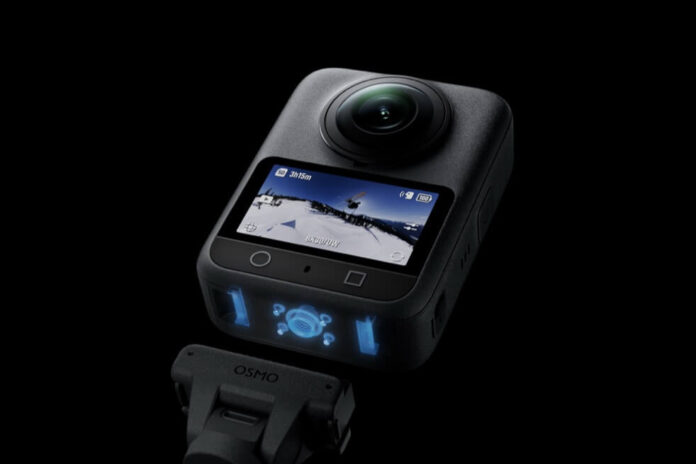
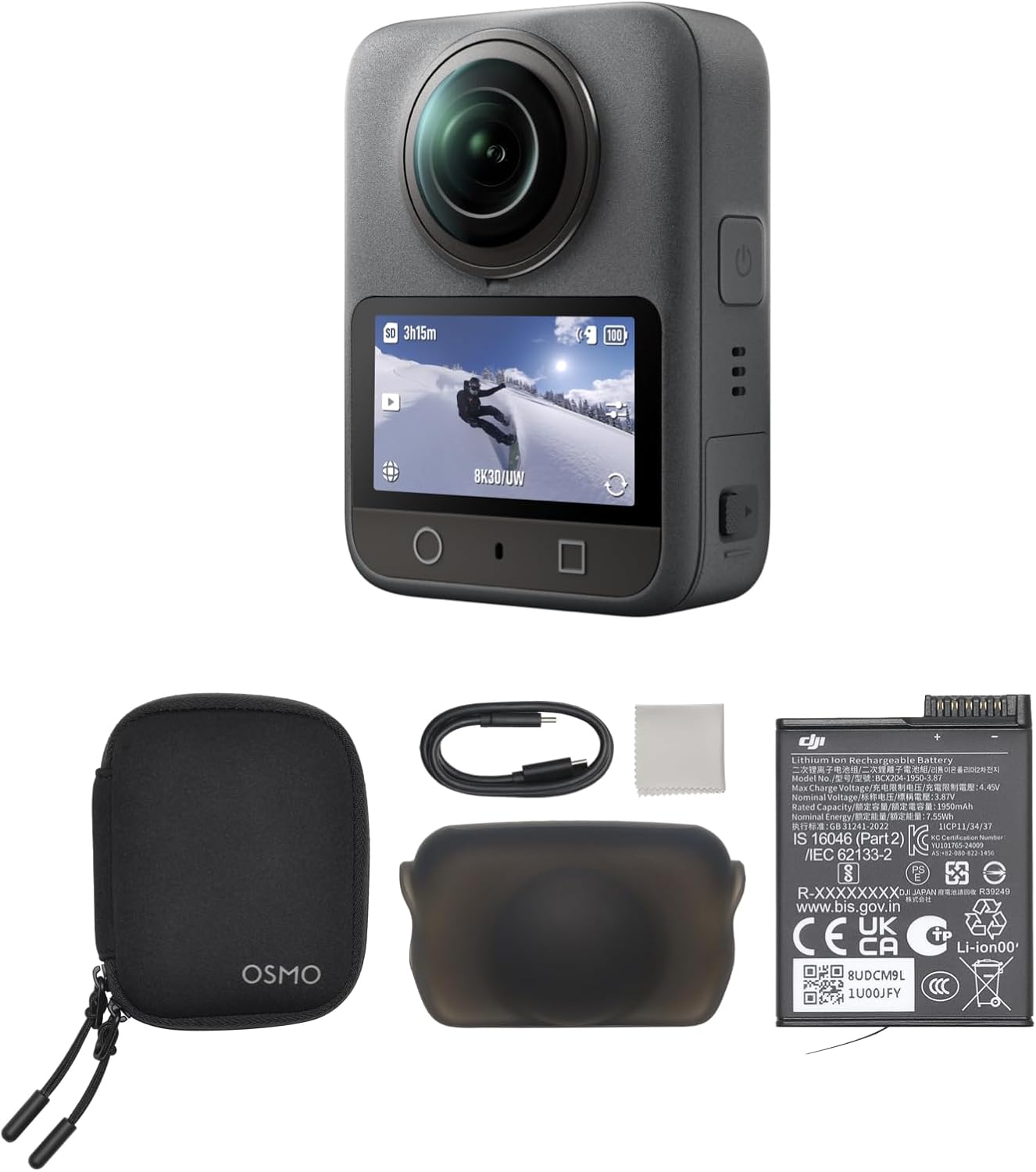
At 183g, the Osmo 360 is compact without using the tall stick shape of the X5. The body has a 2-inch touchscreen, USB-C, a removable battery, a microSD slot, a standard 1/4-inch tripod socket and DJI’s magnetic quick-release clips. SnapShot can power the camera and begin recording with one press, which is genuinely useful when the camera spends most of the day switched off.
The weak point is obvious the moment you set down any 360 camera: one lens always faces the surface. DJI supplies a rubber protector and a pouch, and optional clear lens protectors are available. Use them. Unlike the X5 and MAX2, scratched Osmo 360 lenses are not a quick owner repair. For skiing, mountain biking or a camera mounted outside a vehicle, this single issue can outweigh DJI’s frame-rate advantage.
Keep the camera vertical on an invisible selfie stick and leave the immediate stitch zone clear. DJI specifies a safe stitching distance of at least 0.75m. Hands, helmet peaks and close subjects placed between the lenses are where even good stitching becomes conspicuous.
Editing and file handling
Buying a 360 camera means choosing software as well as hardware. DJI Mimo handles phone transfers, tracking, keyframes and quick reframing. DJI Studio is the desktop route for larger jobs. Both can turn the spherical recording into a normal horizontal or vertical video, but that extra stage is not optional if you want to direct the viewer’s attention.
DJI’s 105GB of usable internal storage is more valuable than it sounds. It can save a shoot when a microSD card is full, missing or misbehaving. A card is still sensible for a trip because high-bitrate 8K files consume space quickly. The USB 3.1 port and Wi-Fi 6 support help with transfers, but a cable remains the rational choice for a full card.
Insta360 still has the advantage for people who want the broadest set of templates, effects and established tutorials. DJI’s workflow is perfectly usable for deliberate reframing, but software maturity is part of the X5’s price, not a minor bonus.
Audio, battery life and mounts
The camera has four built-in microphones. More importantly, OsmoAudio can connect directly to compatible DJI Mic transmitters without a receiver hanging in the stitch line. That is a real advantage for a presenter on a bike, a walk-and-talk video or any shot where a cable would appear in both lenses. The original draft’s claim that ordinary wireless earbuds can serve as the microphone was incorrect.
DJI rates the 1950mAh battery for up to 100 minutes at 8K30 and 190 minutes at 6K24 under controlled conditions. Screen use, wireless connections, temperature and stabilization settings will change that. The Adventure Combo is the sensible package for long days because it adds two batteries, the multifunction charging case, a quick-release adapter and a 1.2m invisible selfie stick.
The standard 1/4-inch socket is welcome because it avoids locking every setup to DJI accessories. The magnetic clips are faster when moving the camera between a pole, grip and fixed mount. Check that both clips are seated before trusting the camera to speed or vibration.
Waterproofing has an important caveat
The Osmo 360 body is IP68 rated and waterproof to 10m with the covers correctly closed. That rating is useful for rain, spray and an accidental dunk. DJI nevertheless advises against body-only underwater 360 capture because water refraction causes distortion and stitching errors. It also advises against prolonged underwater use or high water-impact pressure.
Do not read “waterproof to 10m” as “ready for a 10m 360 dive.” Use the dedicated invisible dive case for intentional underwater work, and follow DJI’s depth and setup instructions. This is one area where a casual reading of the retail listing can lead to bad footage or an expensive mistake.
Who should buy the DJI Osmo 360?
Buy it if you want 8K50 action footage, already use DJI Mic transmitters, own compatible Osmo Action batteries, or value internal storage. It is also a strong choice for travel and property work where the camera can be protected and the 120MP panoramic mode has a clear purpose.
Buy the Insta360 X5 instead if this is your first 360 camera, you edit mainly on a phone, or you expect the lenses to take abuse. Its replaceable-lens design and mature software are more important than a small specification win for many owners.
Buy the GoPro MAX2 instead if GPS, GoPro Labs, very high bitrates and quick field replacement of the lens glass matter more than DJI’s low-light and audio ecosystem.
Skip all three if you rarely reframe video. A conventional action camera is cheaper to run, faster to edit and easier to protect. The value of 360 capture is choosing the angle after the event. If that does not solve a real problem for you, it only creates more work.
Frequently asked questions
Is the DJI Osmo 360 better than the Insta360 X5?
The DJI is better for 8K50 capture, built-in storage, D-Log M and direct use with compatible DJI Mic transmitters. The X5 is the safer all-round purchase because its lenses are user-replaceable and its editing ecosystem is more mature.
Can you replace a scratched DJI Osmo 360 lens?
Not yourself. DJI does not provide the owner-replaceable lens system found on the Insta360 X5 or GoPro MAX2. A damaged Osmo 360 lens requires service, so a protector and careful storage are unusually important.
Does the DJI Osmo 360 need a microSD card?
No. It has 128GB of internal storage, with about 105GB available for recording. It also accepts microSD cards up to 1TB, which are useful for long trips and high-bitrate 8K recording.
Is DJI Osmo 360 really 8K?
It records a 7680 x 3840 panoramic file, which DJI describes as native 8K 360 video. That resolution covers the complete sphere. A normal reframed 16:9 view uses only part of those pixels, so it should not be expected to match a conventional 8K camera frame.
Can the DJI Osmo 360 record underwater?
The camera body is rated to 10m, but DJI does not recommend body-only underwater 360 shooting because refraction can cause distortion and stitching errors. Use the dedicated dive case for intentional underwater recording.
Which microphones work with the DJI Osmo 360?
Its OsmoAudio connection supports direct use of compatible DJI Mic transmitters. Ordinary Bluetooth earbuds should not be treated as a supported external microphone solution.
Final verdict
The DJI Osmo 360 gets the hard engineering right: useful 8K frame rates, good color options, generous internal storage, sensible mounts and clean wireless audio integration. Its biggest weakness is not hidden in a menu. Two exposed lenses define the life of a 360 camera, and DJI makes neither one user-replaceable.
For a careful DJI owner, the Osmo 360 is an excellent fit. For a first-time buyer or anyone mounting a camera where impact is likely, the Insta360 X5 is still the more defensible purchase. That is the choice this review should make clear.