
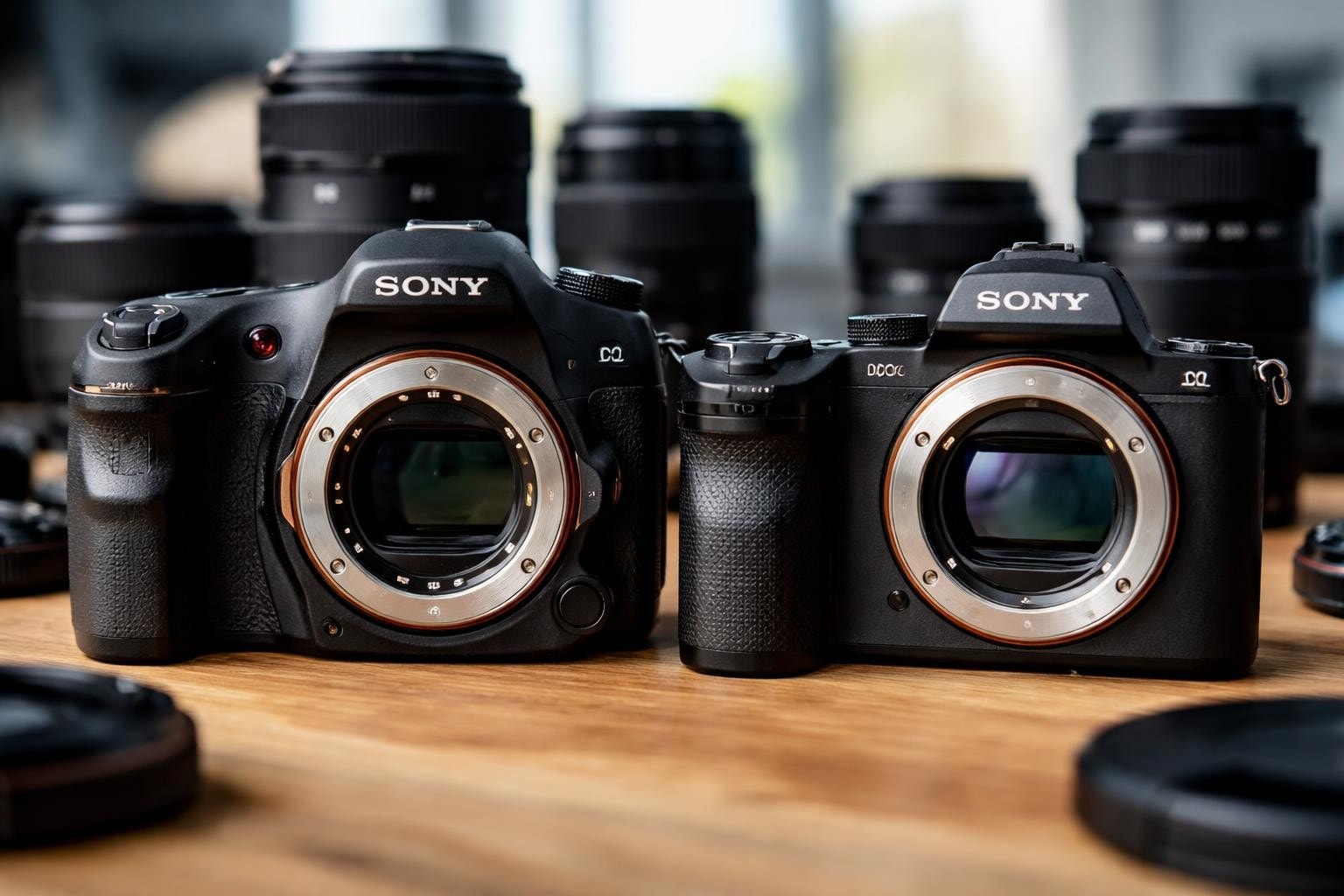
When I first started researching Sony’s lens ecosystem, I encountered something that confused many photographers. The term sony dslr camera lens gets thrown around frequently, but here’s something important to understand right from the start: Sony hasn’t manufactured traditional DSLR cameras since they discontinued their A-mount SLT (Single Lens Translucent) cameras several years ago. Instead, Sony has gone all-in on mirrorless technology with their E-mount system. That said, understanding this history and the available lens options remains crucial for anyone invested in or considering Sony’s camera systems, especially since many photographers still use A-mount glass with adapters on modern mirrorless bodies.
Contents
- Understanding Sony’s lens mount systems
- Prime lenses versus zoom lenses for Sony systems
- Popular focal lengths and their applications
- Standard zoom lenses as the foundation
- Portrait-specific prime lenses
- Third-party lens manufacturers worth considering
- Autofocus performance across different lens categories
- Lens construction quality and weather sealing
- Image stabilization considerations
- Selecting lenses for specific photography genres
- Macro photography and close-up work
- Building a lens collection strategically
- Used lens market considerations
- Video-specific lens requirements
- Specialty lenses and creative options
- Lens filters and protective accessories
- Firmware updates and lens performance optimization
- Future-proofing your lens investments
Understanding Sony’s lens mount systems
Sony’s camera lens history splits into two distinct categories that every photographer should understand before investing hundreds or thousands of dollars into glass. The A-mount system served as Sony’s DSLR-style camera mount, inherited from their partnership with Minolta. This mount featured a translucent mirror technology in later models, which technically made them SLT cameras rather than traditional DSLRs, though many people still refer to them as DSLRs.
The E-mount system represents Sony’s mirrorless revolution. Introduced in 2010 with the NEX series, E-mount has evolved into one of the most robust lens ecosystems available today. Within E-mount, you’ll find two sub-categories: APS-C lenses (designated with an E) and full-frame lenses (designated with FE).
A-mount legacy and adapter options
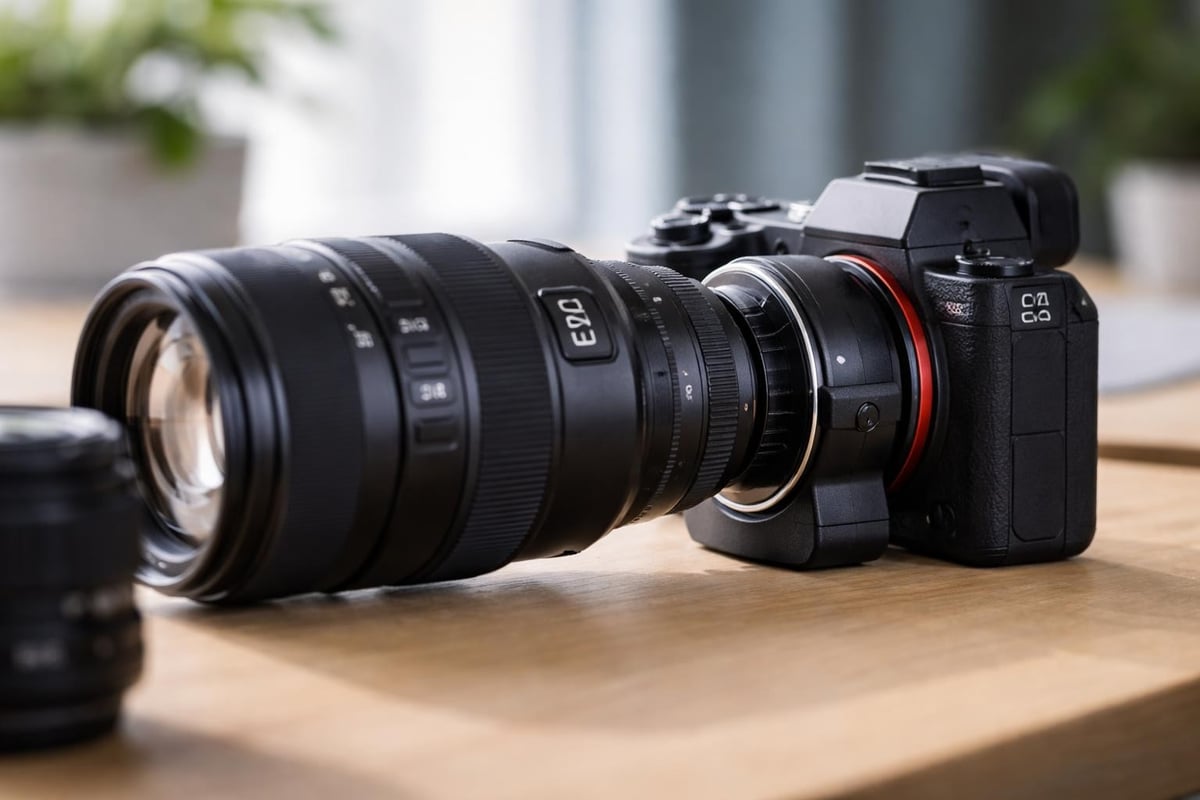
For photographers who invested heavily in A-mount glass during the DSLR era, the good news is that these lenses remain usable on modern Sony mirrorless cameras through adapters. The LA-EA3 and LA-EA5 adapters allow you to mount A-mount lenses on E-mount bodies while maintaining autofocus capabilities. I’ve tested both adapters extensively, and while they work reasonably well for slower-paced photography like landscapes and portraits, the autofocus performance lags behind native E-mount lenses for action photography.
The adapter approach makes sense if you already own quality A-mount glass. Some photographers have collections worth thousands of dollars, and adapters provide a bridge to modern camera bodies without requiring a complete system overhaul.
Prime lenses versus zoom lenses for Sony systems
This debate never gets old in photography circles, and for good reason. Prime lenses offer fixed focal lengths, typically with wider maximum apertures and superior optical quality. Zoom lenses provide flexibility across a range of focal lengths but often sacrifice some optical performance and maximum aperture.
Prime lens advantages:
- Superior optical sharpness
- Wider maximum apertures (f/1.4, f/1.8, f/2.0)
- Smaller and lighter form factor
- Better low-light performance
- More attractive background blur
Zoom lens advantages:
- Versatility across multiple focal lengths
- Fewer lens changes in the field
- Better for event and wedding photography
- Single lens can replace multiple primes
- Easier for beginners to frame shots
I personally carry both types depending on the assignment. For portrait sessions, I rarely leave home without an 85mm prime. For travel photography, a quality zoom lens like the 24-70mm saves weight and provides creative flexibility when I can’t predict what I’ll encounter.
Popular focal lengths and their applications
Understanding which focal length serves different photography genres helps you build a lens collection strategically rather than impulsively buying every piece of glass that catches your eye.
| Focal Length | Primary Use | Characteristics | Typical Price Range |
|---|---|---|---|
| 16-35mm | Landscapes, architecture | Wide perspective, depth | $500-$2,400 |
| 24-70mm | General purpose, events | Versatile, workhorse | $800-$2,300 |
| 70-200mm | Sports, wildlife, portraits | Compression, reach | $1,300-$2,800 |
| 85mm | Portraits | Flattering perspective | $400-$1,800 |
| 50mm | Street, general | Natural perspective | $200-$2,500 |
Wide angle options for Sony cameras
Wide angle lenses between 16mm and 35mm excel at landscape photography, real estate, and architecture. The distortion characteristics at the extreme wide end require careful composition to avoid awkward stretching of subjects near the frame edges.
Sony offers several excellent wide-angle options in their FE lineup. The FE 16-35mm f/2.8 GM represents their professional-grade option, though it carries a professional price tag. For photographers working with tighter budgets, third-party manufacturers like Tamron and Sigma produce quality wide-angle zooms at more accessible price points.
One lens that surprised me with its performance is the Viltrox AF 16mm F1.8, which provides exceptional wide-angle coverage for Sony E-mount systems at a fraction of the cost of Sony’s own wide-angle primes. The f/1.8 aperture also makes it surprisingly capable for astrophotography.
Standard zoom lenses as the foundation
If you only own one lens for your sony dslr camera lens collection, a standard zoom in the 24-70mm range makes the most sense for general photography. This focal length range covers everything from moderate wide-angle to short telephoto, handling landscapes, portraits, street photography, and event coverage with reasonable competence.
Sony’s FE 24-70mm F2.8 GM II lens represents the pinnacle of standard zoom performance, incorporating improvements over the original version including better corner sharpness and faster autofocus. However, at over two thousand dollars, this lens represents a significant investment.
Third-party manufacturers have stepped up their game considerably in recent years. Tamron’s approach to creating lighter alternatives to traditional 24-70mm f/2.8 lenses demonstrates how competition benefits photographers. Their 35-100mm f/2.8 Di III VXD offers professional aperture in a more compact, affordable package, though the narrower wide end might not suit everyone’s needs.
For photographers just starting out, consider looking at cameras and lenses together as a system. Sometimes bundled kits provide better value than purchasing bodies and glass separately, especially when starting your photography journey.
Telephoto zoom capabilities
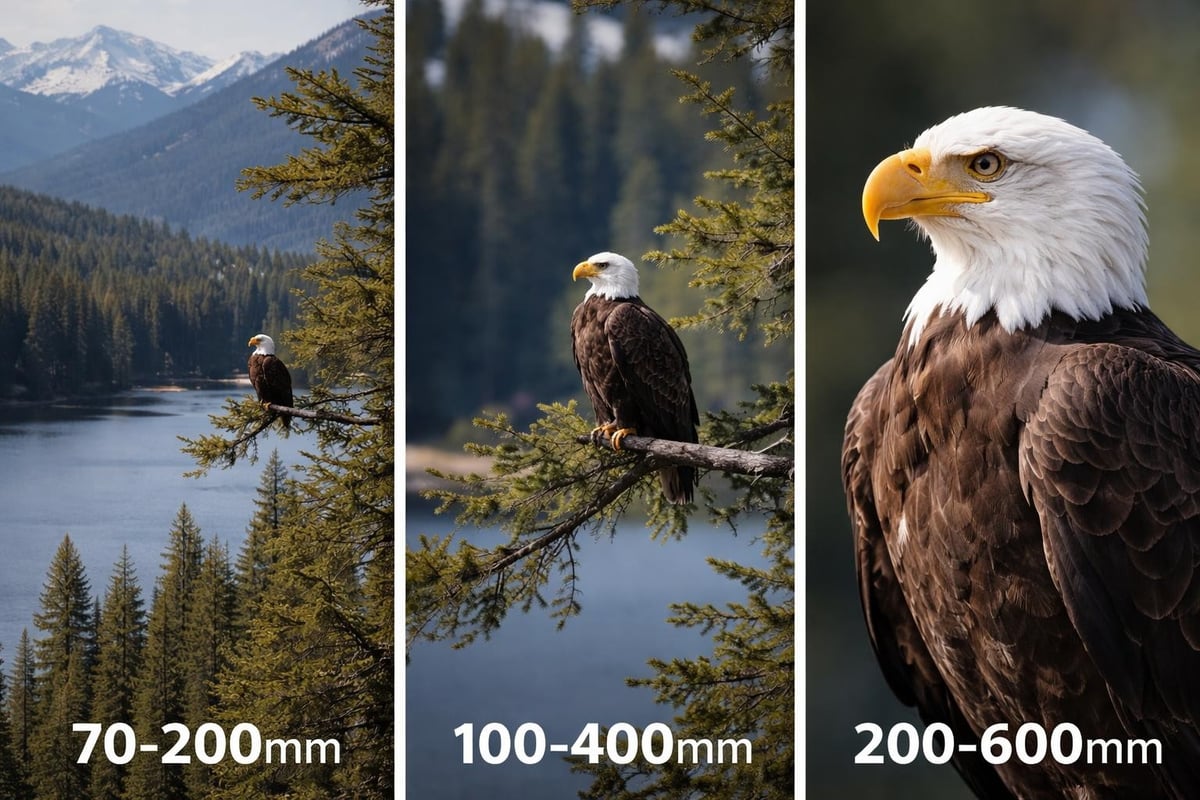
Telephoto zooms in the 70-200mm range serve sports photographers, wildlife enthusiasts, and portrait photographers who want strong background compression. The reach allows you to capture distant subjects while the longer focal lengths create pleasingly blurred backgrounds that isolate subjects.
The Sony FE 70-200mm F2.8 GM OSS has become a staple for event photographers and photojournalists who need consistent f/2.8 performance across the entire zoom range. The optical stabilization helps when shooting handheld at longer focal lengths, though Sony’s in-body stabilization on modern cameras has reduced the critical importance of lens-based stabilization.
Weight becomes a real consideration with telephoto zooms. Professional f/2.8 versions typically weigh between 3 and 4 pounds, which gets heavy during all-day shoots. Variable aperture versions like 70-300mm f/4.5-5.6 lenses weigh significantly less but sacrifice low-light capability and background blur potential.
Portrait-specific prime lenses
Portrait photography benefits enormously from fast prime lenses in the 50mm to 135mm range. These focal lengths provide flattering perspective that doesn’t distort facial features while offering wide apertures that create beautiful background separation.
Top portrait focal lengths:
- 50mm – Natural perspective, affordable options, versatile beyond portraits
- 85mm – Classic portrait length, beautiful compression, widely available
- 105mm – Strong compression, excellent for headshots, requires more working distance
- 135mm – Maximum compression, stunning bokeh, best for outdoor portraits
The Sony FE 85mm F1.8 delivers exceptional sharpness for portrait work at a price point that makes sense for enthusiast photographers. While Sony also offers an 85mm f/1.4 GM lens with superior bokeh rendering and build quality, the f/1.8 version provides 90% of the performance at roughly 40% of the cost.
I’ve shot hundreds of portrait sessions with both the 85mm f/1.8 and the 50mm f/1.8. The 85mm produces more pleasing facial proportions and better subject separation, but the 50mm offers more versatility for environmental portraits where you want to include more context around your subject.
Third-party lens manufacturers worth considering
Sony’s native FE lenses deliver excellent quality, but the premium pricing pushes many photographers toward third-party alternatives. The good news is that third-party manufacturers have dramatically improved their offerings for Sony E-mount in recent years.
| Manufacturer | Strengths | Considerations | Price Positioning |
|---|---|---|---|
| Sigma | Excellent optics, Art series quality | Heavier builds, some AF inconsistency | Mid to high |
| Tamron | Great value, good stabilization | Plastic construction on some models | Budget to mid |
| Samyang/Rokinon | Very affordable, manual focus options | Hit or miss quality control | Budget |
| Viltrox | Impressive value, improving AF | Limited lineup, newer to market | Budget |
| Zeiss | Superior build and optics | Expensive, often manual focus | Premium |
Sigma’s Art series lenses compete directly with Sony’s GM lineup for optical quality while typically costing 20-30% less. Their 35mm f/1.4 Art and 85mm f/1.4 Art lenses deliver stunning image quality that rivals anything Sony produces.
Tamron has carved out a reputation for producing practical, well-rounded lenses that prioritize real-world usability over spec sheet bragging rights. Their 28-75mm f/2.8 Di III RXD became hugely popular as an affordable alternative to Sony’s 24-70mm f/2.8 GM, offering 90% of the performance at half the price.
Autofocus performance across different lens categories
Autofocus speed and accuracy vary considerably across different sony dslr camera lens options, even within Sony’s own lineup. The latest GM lenses incorporate linear motors that deliver near-instantaneous focus acquisition, while older designs sometimes hunt in challenging lighting conditions.
For photographers shooting moving subjects like sports, wildlife, or active children, autofocus performance matters as much as optical quality. You can have the sharpest lens in the world, but it’s useless if it can’t lock focus on your subject quickly enough.
Linear motor technology advantages
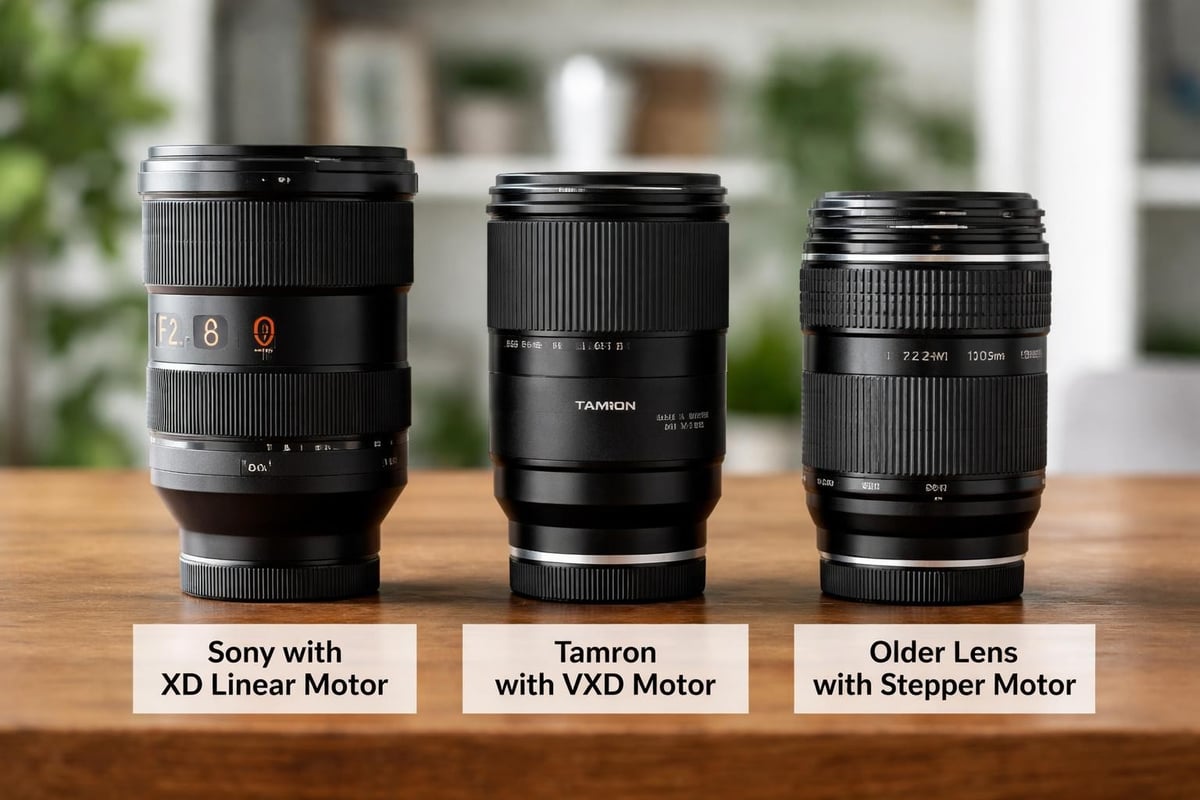
Sony’s XD Linear motors represent their latest autofocus technology, found in newer GM lenses. These motors move lens elements precisely and nearly silently, making them ideal for both photo and video work. The difference becomes immediately apparent when comparing older lens designs to newer models.
I’ve tested this extensively with the original Sony FE 85mm f/1.4 GM versus the newer GM II version. Both lenses produce stunning image quality, but the GM II locks focus noticeably faster, particularly in lower light situations. For portrait photographers who primarily shoot static subjects, the difference matters less. For event photographers capturing candid moments, that speed advantage translates to more keeper shots.
Third-party lenses have also adopted advanced motor designs. Tamron’s VXD (Voice-coil eXtreme-torque Drive) motors and Sigma’s HSM (Hyper Sonic Motor) systems provide competitive autofocus speeds that work well for most photography applications.
Lens construction quality and weather sealing
Build quality varies dramatically across different price points in Sony’s lens lineup. Professional GM lenses feature metal construction, robust weather sealing, and fluorine-coated front elements that repel water and fingerprints. Budget-friendly lenses often use plastic construction with minimal or no weather sealing.
Weather sealing matters more for certain photography genres than others. Landscape photographers regularly encounter rain, snow, and dusty conditions that can damage unsealed lenses. Studio portrait photographers rarely expose their gear to harsh elements, making weather sealing less critical.
That said, even casual photographers benefit from some level of environmental protection. I’ve had unexpected weather changes during outdoor shoots, and having weather-sealed gear provides peace of mind. The question becomes whether the premium pricing for weather sealing justifies the added protection based on your shooting style.
Image stabilization considerations
Sony bodies since the A7 II generation have included in-body image stabilization (IBIS), which stabilizes any lens mounted to the camera. This changes the calculus for whether you need optical stabilization in your lenses.
In-body stabilization advantages:
- Works with any lens, including adapted and manual focus options
- No added weight or complexity in lenses
- Provides stabilization on all axes
- Generally more effective for wide to normal focal lengths
Optical stabilization advantages:
- More effective for longer telephoto focal lengths
- Provides stabilized viewfinder image for composition
- Can combine with IBIS for maximum stability
- Works on non-stabilized camera bodies
For telephoto lenses longer than 200mm, optical stabilization still provides meaningful advantages. The stabilized viewfinder image makes composition easier when tracking moving subjects. For wide-angle and normal focal lengths, Sony’s IBIS performs admirably on its own.
Selecting lenses for specific photography genres
Different photography specializations require different lens priorities. Understanding these requirements helps you build an efficient lens collection without wasting money on glass you’ll rarely use.
Landscape photography priorities
Landscape photographers prioritize corner-to-corner sharpness, minimal chromatic aberration, and resistance to flare. Wide-angle lenses in the 16-35mm range form the foundation, though telephoto lenses also serve landscape photography for compressing distant elements.
Sony provides official guidance on selecting lenses for various shooting scenarios, which helps photographers understand the technical considerations for different applications.
Maximum aperture matters less for landscape work since most shots use f/8 to f/16 for maximum depth of field. This opens up more affordable lens options since you don’t need f/2.8 performance. Many landscape photographers achieve excellent results with f/4 zoom lenses that cost significantly less and weigh considerably less than their f/2.8 counterparts.
Portrait photography requirements
Portrait photographers need lenses that render skin tones accurately, produce pleasing background blur, and provide sufficient working distance from subjects. Focal lengths between 50mm and 135mm work best, with 85mm representing the most popular choice.
Maximum aperture becomes more important for portraits since f/1.4 to f/2.8 apertures create the strong background separation that makes subjects pop from their surroundings. The quality of the bokeh (out-of-focus areas) matters as much as the quantity of blur. Some lenses produce smooth, creamy bokeh while others create harsh, busy backgrounds that distract from the subject.
Sports and wildlife photography needs
Sports and wildlife photographers need three things above all else: reach, speed, and autofocus performance. Telephoto lenses starting at 200mm and extending to 600mm or beyond become essential tools. Fast autofocus tracking and high maximum apertures (f/2.8 to f/4) allow for faster shutter speeds that freeze action.
Recommendations for Sony lenses span various photography needs, including specialized applications like astrophotography that require specific optical characteristics.
Weight becomes a practical concern with super-telephoto lenses. A 600mm f/4 lens can weigh over 7 pounds, requiring monopods or tripods for extended shooting sessions. Variable aperture telephoto zooms like 200-600mm f/5.6-6.3 lenses sacrifice some light-gathering ability but save considerable weight and cost.
Macro photography and close-up work
Macro lenses allow you to photograph subjects at 1:1 magnification or greater, revealing details invisible to the naked eye. Sony’s FE 90mm f/2.8 Macro G OSS represents their flagship offering in this category, delivering exceptional sharpness and a useful focal length that doubles as a portrait lens.
True macro lenses designed for 1:1 reproduction differ from lenses marketed with macro capabilities. Many zoom lenses claim macro functionality but only achieve 1:4 or 1:2 magnification. For serious close-up work, dedicated macro lenses provide superior results.
Focal length choice in macro lenses affects working distance from your subject. A 50mm macro requires you to get very close to achieve maximum magnification, which can be problematic for skittish insects or when you need to position lighting. A 90mm or 100mm macro provides more comfortable working distance for both the photographer and the subject.
Building a lens collection strategically
New photographers often make the mistake of buying lenses randomly based on excitement rather than building a strategic collection that covers their actual shooting needs. I’ve made this mistake myself, ending up with duplicate focal lengths and gaps in my kit.
Recommended first three lenses:
- Standard zoom (24-70mm) – Covers 80% of general photography needs
- Fast prime (50mm or 85mm) – Handles low light and creative work
- Telephoto zoom (70-200mm) – Provides reach and compression effects
After establishing this foundation, additional lenses should fill specific needs based on your primary photography genres. Landscape photographers add ultra-wide options, portrait photographers add longer primes, and wildlife photographers invest in super-telephoto lenses.
Renting lenses before purchasing provides valuable hands-on experience without the financial commitment. I always recommend renting an expensive lens for a weekend shoot before buying it. You’ll quickly discover whether the lens fits your shooting style and whether the improvements justify the cost over alternatives.
Used lens market considerations
The used lens market offers significant savings, particularly on older lens designs that remain optically excellent despite being replaced by newer versions. A used Sony FE 85mm f/1.8 might cost 30-40% less than new while delivering identical image quality.
Buying used lenses safely:
- Purchase from reputable dealers with return policies
- Check for fungus, scratches on glass elements, and autofocus accuracy
- Test all aperture settings and focus ranges before completing purchase
- Verify serial numbers against stolen equipment databases
- Avoid lenses with oil on aperture blades or separated lens elements
Some lenses hold their value better than others. Sony’s GM lenses depreciate slowly because they maintain desirability even when newer versions launch. Budget third-party lenses depreciate quickly since they lack the brand cachet and often get replaced by improved models frequently.
Video-specific lens requirements
Video shooters have different lens requirements than still photographers. Smooth, silent autofocus motors become critical for recording audio during shooting. Parfocal designs that maintain focus across the zoom range prevent unwanted focus shifts during recordings.
Breathing characteristics (how the field of view changes during focusing) bother video shooters more than still photographers. Some lenses exhibit significant breathing that creates distracting focus pumping in video footage. Sony’s more recent GM lenses incorporate breathing compensation, though this feature requires compatible camera bodies.
Manual aperture control rings allow smooth exposure adjustments during recording without the stepwise changes that create exposure jumps in footage. Not all sony dslr camera lens options include de-clicked aperture rings, so video-focused photographers should verify this feature before purchasing.
Specialty lenses and creative options
Beyond standard focal lengths, specialty lenses open creative possibilities that differentiate your work from typical photography. Tilt-shift lenses allow perspective control for architecture photography. Super-telephoto lenses compress distant elements dramatically. Ultra-wide fisheye lenses create distinctive distorted perspectives.
These specialty lenses rarely justify their cost for general photographers, but they become valuable tools for specific applications. Architectural photographers billing thousands per shoot can justify a $2,000 tilt-shift lens. Hobbyists shooting occasional architecture might rent the lens for specific projects.
Manual focus lenses from manufacturers like Voigtlander and Zeiss provide exceptional optical quality and tactile focus control for deliberate, methodical shooting styles. These lenses work beautifully for landscape, still life, and portrait work where autofocus speed doesn’t matter. The focus peaking and magnification features in Sony mirrorless cameras make manual focusing practical and even enjoyable.
Lens filters and protective accessories
UV filters, polarizers, and neutral density filters expand your creative control and protect expensive front elements. However, cheap filters can degrade image quality by introducing flare, reducing sharpness, or adding color casts.
Quality filters from B+W, Hoya, or Breakthrough Photography cost more but maintain the optical performance you paid for in your lenses. For a $2,000 lens, spending $100-150 on a quality filter makes sense. Skimping with a $20 filter potentially compromises the image quality of that expensive glass.
Essential filter types:
- UV/clear filters – Protect front element from scratches and dirt
- Circular polarizers – Reduce reflections, enhance sky and water
- Variable ND filters – Control exposure in bright conditions for video
- Graduated ND filters – Balance exposure between sky and foreground
Lens hoods prevent flare and provide physical protection for the front element. Always use the dedicated hood designed for your specific lens, as generic hoods may cause vignetting or fail to provide adequate protection.
Firmware updates and lens performance optimization
Sony regularly releases firmware updates that improve autofocus performance, fix bugs, and occasionally add new features to existing lenses. Keeping your lenses updated ensures optimal performance with current camera bodies.
Video guides help photographers understand the best lens options for Sony E-Mount cameras across different categories and price points.
Updating lens firmware requires connecting the lens to a computer using Sony’s Lens Firmware Update software. The process takes only a few minutes but can meaningfully improve performance. I’ve seen noticeable autofocus improvements after updating older lenses to work better with newer camera bodies.
Camera body firmware updates sometimes include improvements specifically for certain lenses. Sony’s latest bodies benefit from computational photography features that work with lens correction profiles to reduce aberrations and improve corner sharpness digitally.
Future-proofing your lens investments
Lenses typically outlast camera bodies by significant margins. A quality lens purchased today should deliver excellent results for 10-15 years or longer. This longevity makes lenses worth investing in more heavily than camera bodies.
Sony’s commitment to the E-mount system since 2010 provides confidence in long-term compatibility. Unlike some manufacturers who have changed mounts multiple times, Sony has maintained E-mount across their entire mirrorless evolution. Lenses purchased for the original NEX cameras still mount and function on the latest A7 IV and A1 bodies.
Investing in full-frame FE lenses makes sense even if you currently shoot APS-C cameras. These lenses work perfectly on crop sensor bodies (with a focal length multiplication of 1.5x) and remain fully compatible when you eventually upgrade to full-frame. APS-C-specific E-mount lenses work on full-frame bodies but with reduced resolution since they only cover the smaller sensor area.
Understanding the sony dslr camera lens ecosystem and its evolution into mirrorless E-mount systems helps photographers make smart investment decisions that serve their creative vision for years to come. Whether you’re building your first lens collection or expanding an existing kit, prioritizing optical quality and compatibility with your shooting style ensures every dollar spent delivers value. Lens and Shutter provides comprehensive reviews and expert guidance to help you navigate the complex world of camera lenses and accessories, making informed decisions that elevate your photography without breaking your budget.