
Starting your photography journey with Canon means entering a world that balances accessibility with serious creative potential. The question of which camera to buy first keeps countless aspiring photographers up at night, scrolling through endless forums and reviews. Having tested dozens of DSLRs over the years, I can tell you that Canon makes this decision both easier and harder. Easier because their entry-level lineup consistently delivers quality. Harder because several models offer genuinely compelling arguments for your hard-earned money. Let me walk you through what actually matters when choosing the best beginner Canon DSLR camera, based on real-world experience rather than spec sheets alone.
Contents
- Understanding what you actually need
- Canon EOS Rebel T7 analysis
- Canon EOS Rebel SL3 for compact shooting
- Canon EOS Rebel T8i stepping up
- Lens considerations matter more than bodies
- Budget versus features breakdown
- Mirrorless alternative consideration
- What specifications actually matter
- Common beginner mistakes to avoid
- Learning resources that complement your camera
- Making the final decision
- Future-proofing your investment
- Accessories that actually enhance photography
- Video capabilities comparison
- The honest recommendation
- Storage and workflow essentials
- Long-term satisfaction factors
- Weather sealing and durability considerations
- Community and support ecosystem
- Understanding your actual photography goals
- Comparing Canon to other manufacturers
Understanding what you actually need
The photography industry loves pushing megapixels and frame rates, but your first camera needs different priorities. Image quality matters, sure, but so does how the camera feels in your hands after a three-hour shoot. The best beginner Canon DSLR camera should teach you photography fundamentals without overwhelming you with controls you won’t touch for years.
Weight deserves more attention than most reviews give it. A camera that stays home because it’s too heavy to carry serves nobody. Canon’s Rebel series keeps this in mind, though some models handle better than others. The grip design, button layout, and menu system determine whether you’ll actually learn your camera or just leave it in auto mode forever.
Breaking down the current Canon DSLR lineup
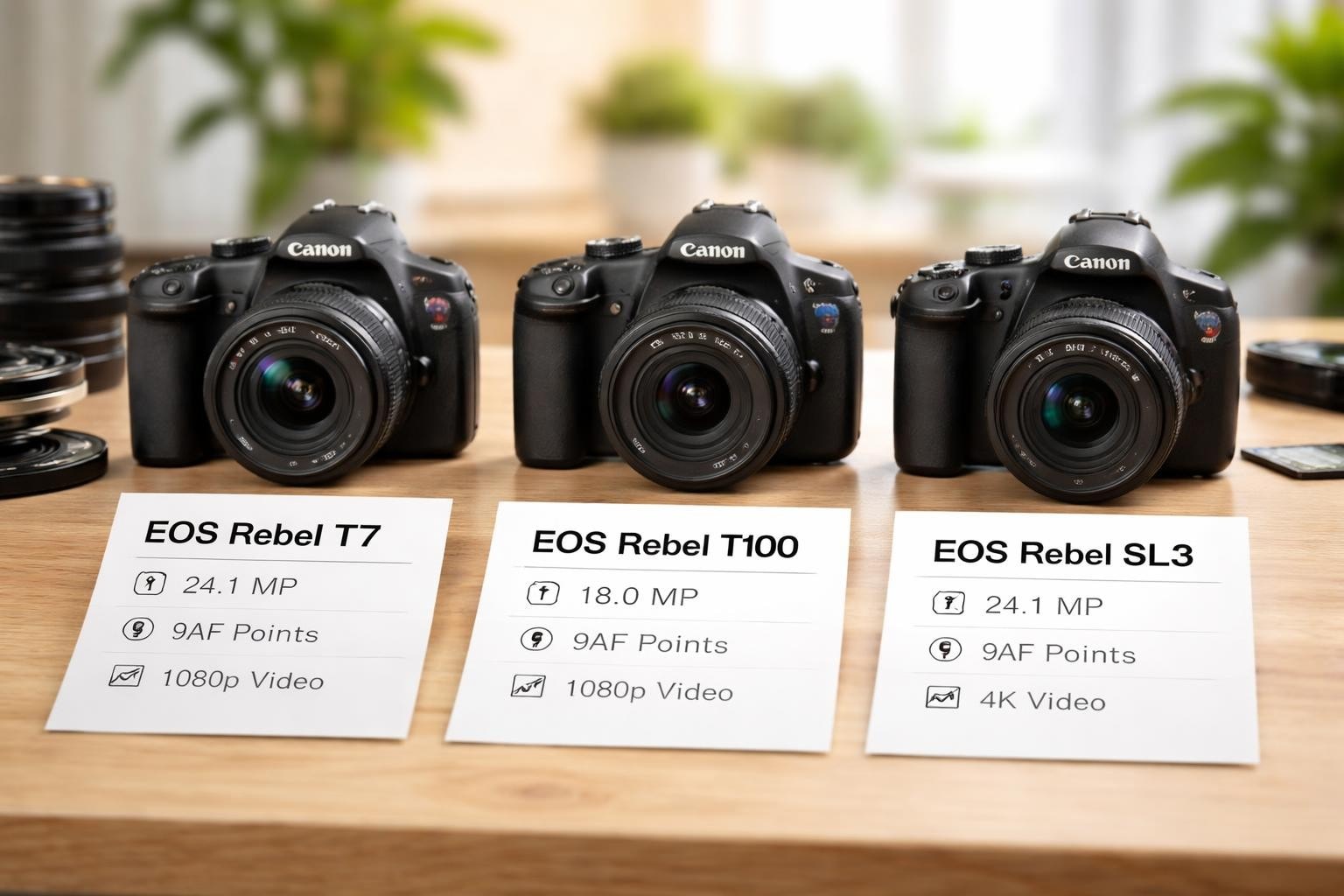
Canon’s DSLR range for beginners centers around the EOS Rebel family (known as EOS Kiss in some markets). Each model targets a specific use case, though marketing materials won’t always make this clear.
The active models worth considering include:
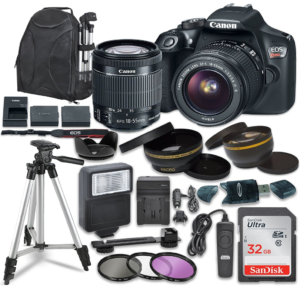
- Canon EOS Rebel T7 (EOS 2000D) for absolute beginners on tight budgets
- Canon EOS Rebel T100 (EOS 4000D) as the most affordable entry point
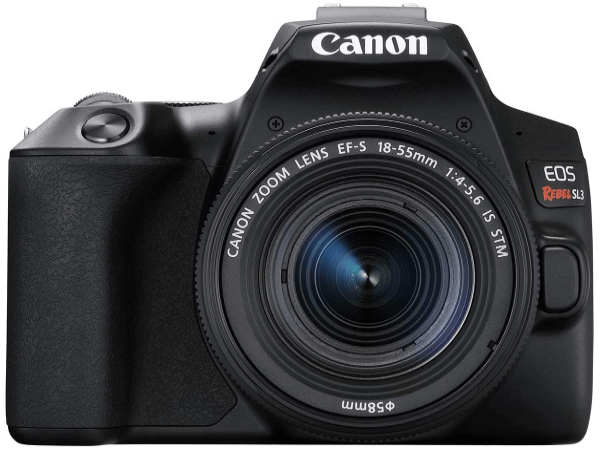
- Canon EOS Rebel SL3 (EOS 250D) for those wanting compact size
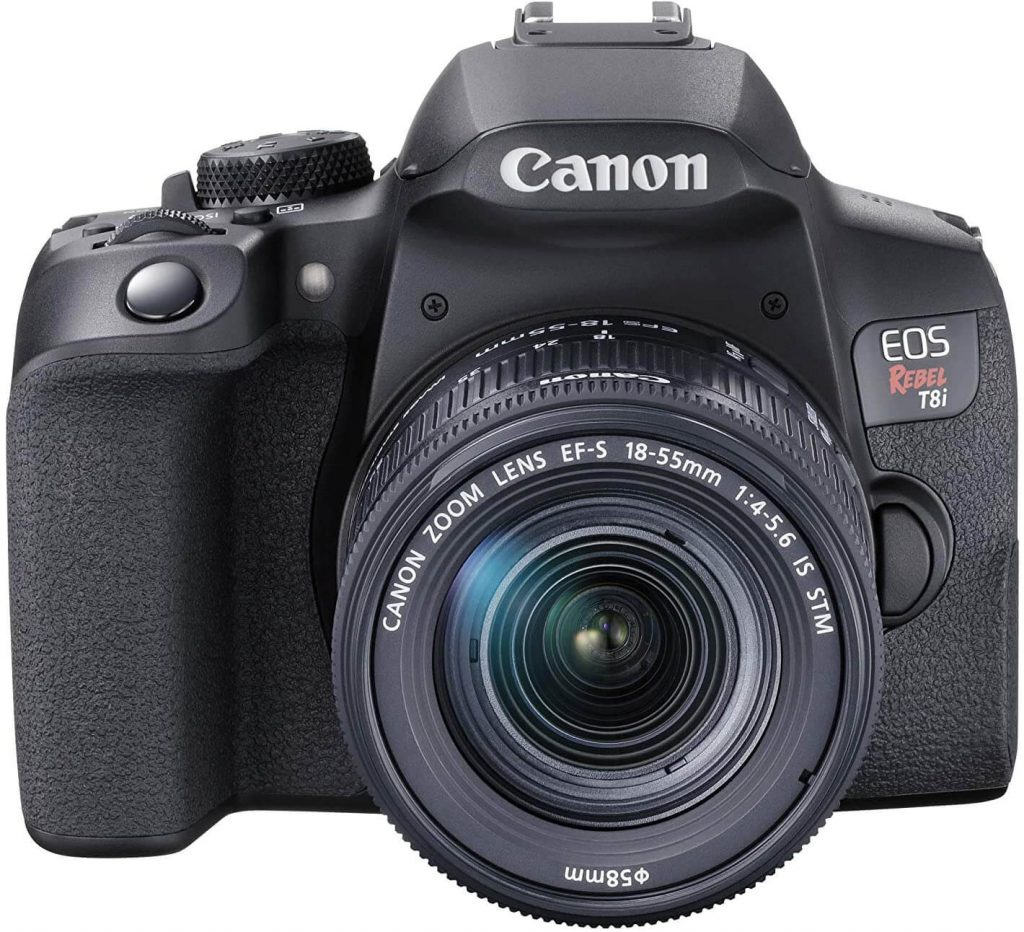
- Canon EOS Rebel T8i (EOS 850D) for advanced beginners ready to grow
Notice I’m not listing every camera Canon ever made. The used market tempts many beginners, but buying discontinued models often means limited lens selection guidance and outdated connectivity features that frustrate modern workflows.
Canon EOS Rebel T7 analysis
The Rebel T7 dominates Amazon’s best-seller lists for good reason, though its popularity reflects pricing strategy as much as capability. This camera delivers 24.1 megapixels through an APS-C sensor that handles everything from family gatherings to landscape photography. The DIGIC 4+ processor feels dated compared to newer models, but it gets the job done for still photography.
Where the T7 shines:
- Price point that leaves budget for lenses
- Battery life around 500 shots per charge
- Built-in Wi-Fi and NFC for easy phone transfers
- Kit lens options that provide good starting focal ranges
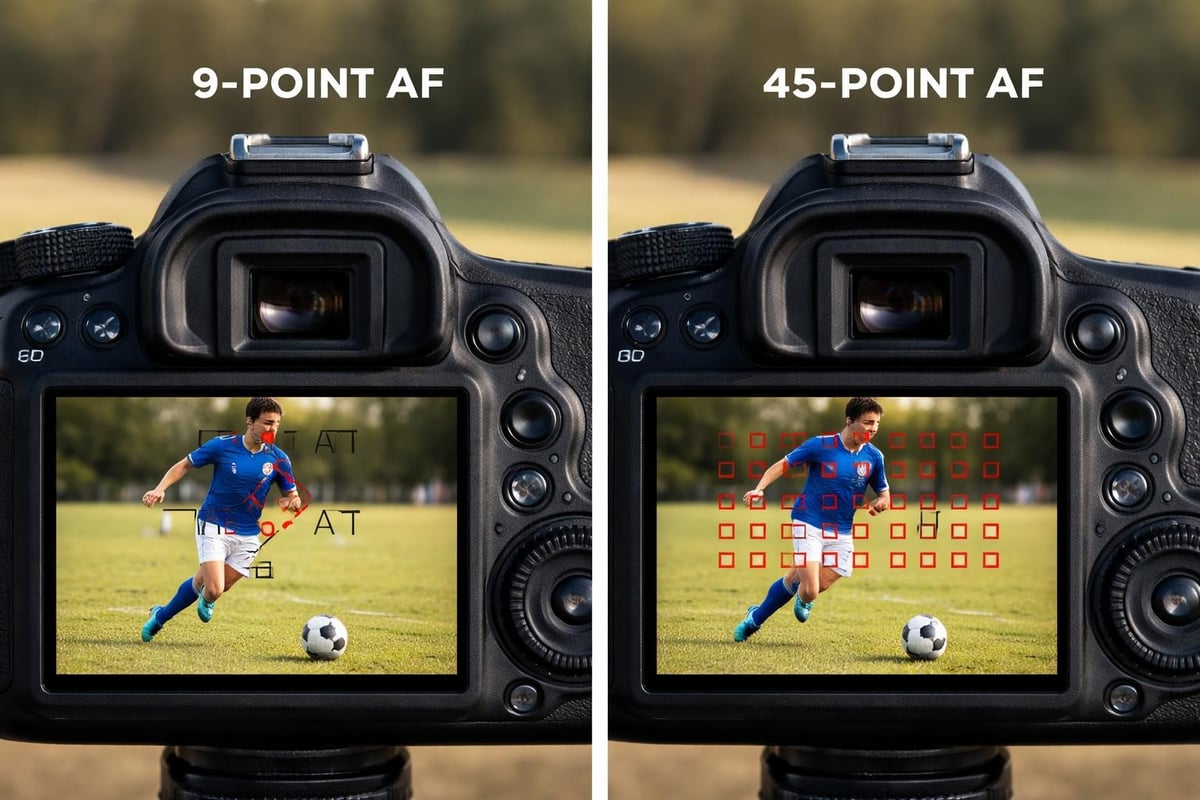
The autofocus system uses 9 points, which sounds limited until you realize most beginners compose with the center point anyway. Live View autofocus crawls compared to mirrorless cameras, making this primarily a viewfinder shooting experience. Video tops out at 1080p/30fps without any advanced features like zebras or focus peaking.
Real-world performance notes
Shooting with the T7 reveals its strengths in good light and controlled situations. The sensor produces clean images up to ISO 1600, with acceptable noise at 3200 if you expose correctly. Beyond that, quality drops noticeably. This matches the expected performance for a camera at this price point in 2026.
Low-light autofocus struggles in dimly lit restaurants or evening events. The camera hunts more than you’d like, though learning to use the center AF point and lock focus helps. Continuous shooting reaches 3 frames per second, adequate for casual sports but nothing special.
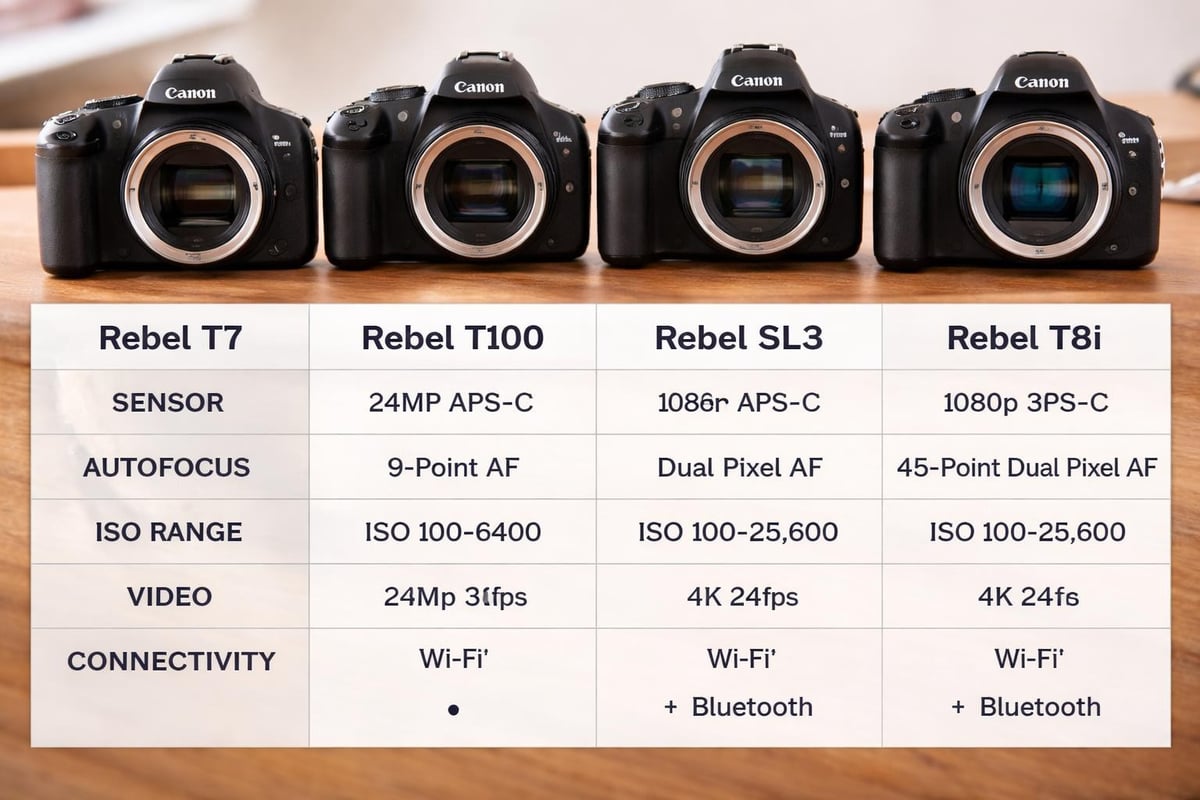
| Feature | Specification | Practical Impact |
|---|---|---|
| Sensor | 24.1MP APS-C | Plenty of resolution for prints up to 16×20 inches |
| ISO Range | 100-6400 (expandable to 12800) | Clean images to 1600, usable to 3200 |
| Autofocus | 9-point AF system | Center point reliable, outer points struggle in low light |
| Continuous Shooting | 3 fps | Adequate for kids, insufficient for serious sports |
| Video | 1080p/30fps | Basic quality, no manual controls during recording |
| Weight | 475g (body only) | Light enough for all-day carry |
Canon EOS Rebel SL3 for compact shooting
The SL3 earns its place as the world’s lightest DSLR with a fully articulating screen, though few buyers understand why this matters. Weighing just 449 grams, this camera disappears in a bag while maintaining the full DSLR experience. The articulating touchscreen transforms how you compose shots, especially for overhead or ground-level angles.
This model includes 4K video recording at 24fps, a significant upgrade over the T7. The Dual Pixel autofocus in Live View mode makes video work actually practical, though it crops the sensor by approximately 1.6x. For photography, the 9-point AF system matches the T7, but the newer DIGIC 8 processor handles high-ISO noise better.
Key advantages of the SL3:
- Smallest and lightest body in the Canon DSLR lineup
- 4K video capability with decent autofocus
- Eye detection autofocus in Live View
- Improved high-ISO performance versus older models
- Better battery efficiency (around 1070 shots)
The compact size does create handling compromises. Photographers with larger hands find the grip shallow, and the smaller body doesn’t balance well with heavier lenses. I’d pair this with pancake lenses or compact zooms rather than telephoto glass.
Canon EOS Rebel T8i stepping up
Positioned between beginner and intermediate, the T8i offers features that matter as your skills develop. The 45-point all cross-type AF system represents a massive upgrade from the 9-point setup in cheaper models. This means faster, more accurate focusing across the frame, particularly valuable for tracking moving subjects.
The sensor resolution stays at 24.1 megapixels, but the DIGIC 8 processor and improved algorithms deliver better image quality. Eye detection works in both viewfinder and Live View modes, a feature once reserved for professional bodies. Video capabilities expand to 4K/30fps with full sensor width and improved autofocus tracking.
When the extra investment makes sense
Spending more on the T8i pays off if you plan to shoot sports, wildlife, or events where autofocus performance matters. The deeper buffer allows 7 fps continuous shooting until your card fills, versus the T7’s 3 fps that stops after a few frames. This difference separates getting the shot from missing it entirely.
The optical viewfinder displays more information without cluttering the view, and the menu system provides faster access to critical settings. These refinements seem minor in store but compound over thousands of shots. If you’re serious about learning photography rather than just taking casual snapshots, the T8i belongs in conversations about best cameras under $700 when it appears on sale.
Lens considerations matter more than bodies
Here’s what camera companies won’t emphasize: your lens choice impacts image quality far more than the camera body. The best beginner Canon DSLR camera becomes mediocre with poor glass, while even an older body sings with quality lenses.
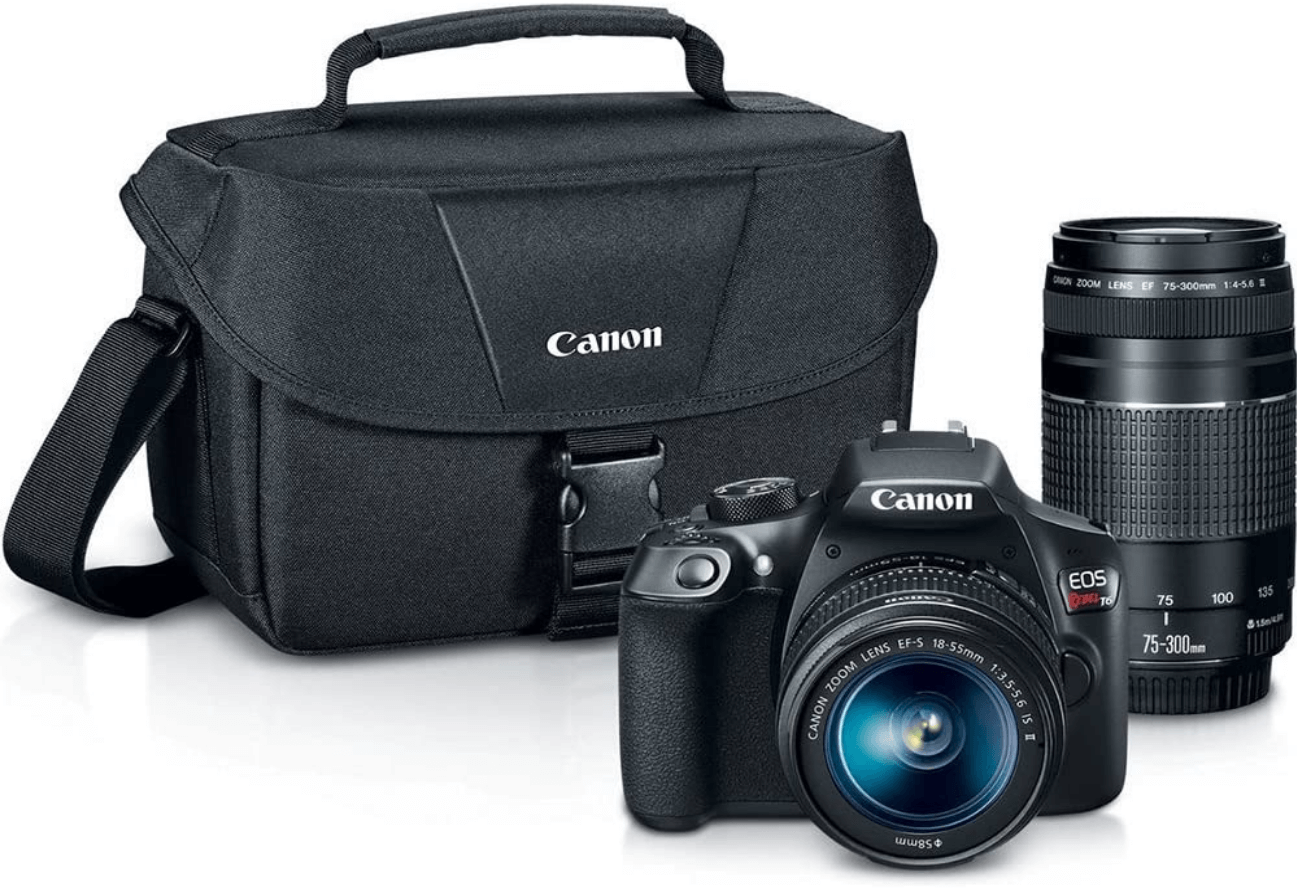
Most Canon DSLRs ship with the EF-S 18-55mm f/3.5-5.6 IS STM kit lens. This optic gets unfairly criticized by pixel peepers, but it delivers respectable sharpness and versatility for learning. The STM motor provides quiet autofocus for video, and the image stabilization helps in lower light.
Smart lens upgrades for beginners:
- Canon EF 50mm f/1.8 STM for learning depth of field control and low-light shooting
- Canon EF-S 24mm f/2.8 STM as a compact, sharp wide-angle pancake
- Canon EF-S 55-250mm f/4-5.6 IS STM for telephoto reach without breaking the bank
- Sigma or Tamron 17-50mm f/2.8 for a constant aperture standard zoom
Avoid the temptation to buy expensive L-series glass until you understand what focal lengths you actually use. The data from your first 10,000 shots tells you exactly which lenses deserve investment. Many beginners discover they rarely zoom past 35mm or never use anything wider than 24mm.
Budget versus features breakdown
Determining the best beginner Canon DSLR camera requires honest assessment of your actual budget, including lenses and accessories. A camera body alone doesn’t take pictures.
| Model | Typical Body Price | Recommended Total Budget | Best For |
|---|---|---|---|
| Rebel T100 | $350-400 | $600-700 | Absolute beginners wanting to test interest in photography |
| Rebel T7 | $400-500 | $700-900 | General purpose photography with room for lens growth |
| Rebel SL3 | $600-700 | $900-1100 | Travel and compact carry with 4K video needs |
| Rebel T8i | $750-850 | $1100-1400 | Serious beginners planning to advance skills quickly |
These budgets assume you’ll add a 50mm f/1.8 lens, extra battery, memory card, and basic bag. Many retailers bundle these items, though quality varies significantly. Check what you’re actually getting before assuming a bundle saves money.
The used market deserves consideration, particularly for bodies that depreciate faster than lenses. A used Rebel T7i (predecessor to the T8i) often costs less than a new T7 while offering superior autofocus and features. Just verify shutter count and seller reputation.
Mirrorless alternative consideration
Canon’s shift toward mirrorless cameras raises legitimate questions about DSLR longevity. The EOS R system offers compelling options like the R50 and R100, with the R100 frequently appearing on sale. These cameras provide electronic viewfinders, better video features, and more compact designs.
However, DSLRs maintain advantages for beginners that marketing won’t tell you about. Optical viewfinders work without battery power and show the actual scene without processing lag. Battery life extends significantly when you’re not powering an electronic viewfinder. The EF and EF-S lens ecosystem offers decades of affordable used glass.
Why DSLR still works in 2026
The photography community loves declaring technologies dead, yet DSLRs continue selling for practical reasons. They feel more substantial and traditional, which helps some photographers connect with the shooting experience. The viewfinder blackout during exposure provides clear feedback about when the shutter fired.
Learning exposure becomes more intuitive when you see the actual scene brightness, then check your LCD after shooting. Mirrorless cameras preview exposure in the viewfinder, which sounds helpful but can create dependency on the camera’s interpretation rather than developing your own vision.
Repair costs and durability favor DSLRs in harsh conditions. Fewer electronic components mean less to break, and service networks understand these cameras thoroughly. A dropped DSLR often survives impact that would destroy a mirrorless LCD or EVF.
What specifications actually matter
Marketing materials emphasize specs that sound impressive but rarely impact real photography. The best beginner Canon DSLR camera succeeds based on different criteria than megapixels and maximum ISO.
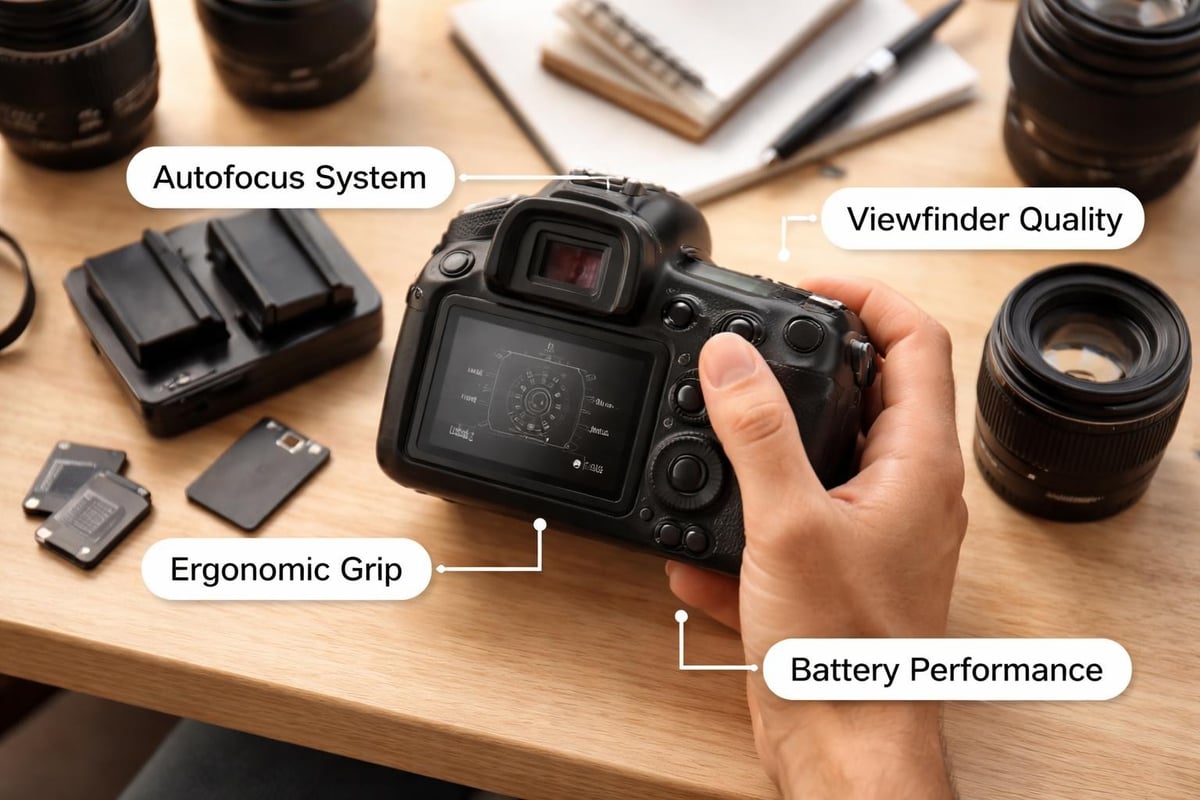
Prioritize these factors:
- Autofocus reliability in the conditions you’ll actually shoot
- Ergonomics that encourage taking the camera everywhere
- Battery life for full-day shooting without swapping cells
- Viewfinder coverage showing close to 100% of the final image
- Menu logic that you can navigate without constant manual checking
Ignore maximum ISO ratings beyond 6400. You’ll rarely use them, and quality degrades so badly that you’d choose to not take the photo rather than use ISO 25600. Continuous shooting speed matters only if you plan to shoot sports or fast action regularly.
Megapixels beyond 20 serve limited purpose for most beginners. Social media compresses everything, standard prints look great at 12MP, and most monitors can’t display full resolution anyway. The jump from 18MP to 24MP sounds significant but produces minimal visible difference in typical use.
Common beginner mistakes to avoid
Watching new photographers navigate their first DSLR purchase reveals patterns that waste money and create frustration. The best beginner Canon DSLR camera won’t overcome poor purchasing decisions around accessories and workflow.
Skip these common traps:
- Buying protective filters for every lens before understanding if you need them
- Investing in expensive tripods before learning what features you actually use
- Purchasing complete lighting kits for product photography you haven’t started yet
- Loading up on batteries and memory cards beyond what two shooting sessions require
Start minimal. Buy the camera, one extra battery, a 32GB card, and maybe the 50mm f/1.8 lens. Shoot for three months, then assess what you actually need based on real experience. This approach prevents closets full of unused accessories that seemed essential in the moment.
Many beginners underestimate how much they’ll need to learn software. Your camera produces RAW files containing tremendous data, but you need editing software to unlock that potential. Budget for Adobe Lightroom, Capture One, or quality free alternatives like Darktable. Understanding post-processing matters as much as camera selection.
Learning resources that complement your camera
The best beginner Canon DSLR camera reaches its potential only when paired with quality education. Canon’s own resources provide solid starting points, though they naturally emphasize features their cameras possess.
YouTube channels run by working photographers teach more than equipment-focused reviewers. Look for creators showing complete workflows from concept through final image, not just gear comparisons. Understanding how professional photographers think through challenges matters more than knowing which camera they use.
Building skills systematically
Photography fundamentals haven’t changed since film days. Exposure triangle principles work identically regardless of camera choice. Composition guidelines like rule of thirds, leading lines, and negative space apply universally. Learning these concepts well means any camera becomes capable in your hands.
Practice deliberately rather than randomly. Spend a week shooting only in aperture priority mode, controlling depth of field consciously. Next week, switch to shutter priority and master motion control. This focused approach builds understanding faster than leaving the camera in auto and hoping for improvement.
Join local photography groups or online communities focused on learning rather than gear arguments. Sharing your work and receiving constructive feedback accelerates growth dramatically. Most cities have photography meetups where beginners can learn from more experienced shooters in a supportive environment.
Making the final decision
After reviewing specifications, reading reviews, and comparing options, the choice often comes down to personal factors that spreadsheets can’t capture. The best beginner Canon DSLR camera for you depends on individual circumstances.
Ask yourself these questions:
- Will I primarily shoot indoors or outdoors?
- Do I plan to shoot video seriously or occasionally?
- How important is carrying a compact camera everywhere?
- Am I willing to learn manual controls or prefer automation?
- What’s my realistic all-in budget including lenses?
Someone planning beach vacations and travel photography should lean toward the SL3’s compact size and weather-sealed kit lens option. A parent wanting to capture kids’ sports needs the T8i’s superior autofocus tracking. A hobbyist exploring photography without major plans finds the T7 provides everything necessary at the lowest investment.
Testing cameras in person reveals crucial information that specifications hide. Visit retailers that allow hands-on experience rather than buying based solely on online research. How the camera feels matters tremendously for long-term satisfaction. Some people immediately connect with the grip and button layout, while others find the same camera awkward.
Future-proofing your investment
Photography equipment evolves constantly, but DSLRs reached maturity years ago. The improvements between current models and five-year-old versions matter less than marketing suggests. This stability means your beginner Canon DSLR camera remains relevant longer than phones or computers.
The EF lens mount dates back to 1987, meaning lenses from that era still work perfectly on modern bodies. This ecosystem depth provides incredible value through the used market. Professional photographers upgrade bodies regularly, flooding resale channels with excellent glass at fraction of original prices.
Consider upgrade paths when choosing your first camera. If you buy into the EOS system now, future purchases build on existing lenses and accessories. Canon’s complete camera lineup provides clear progression from entry-level through professional models, all sharing similar control layouts and menu logic.
Accessories that actually enhance photography
Beyond the camera and lenses, a few accessories genuinely improve your photography rather than just lightening your wallet. Focus on tools that solve real problems you’ve encountered while shooting.
| Accessory | Priority Level | Typical Cost | When You Need It |
|---|---|---|---|
| Extra Battery | High | $40-60 | Immediately, for all-day shooting |
| Fast SD Card (UHS-I U3) | High | $20-40 | Immediately, prevents buffering |
| Simple Camera Bag | Medium | $30-80 | When you own 2+ lenses |
| Basic Tripod | Medium | $60-120 | After identifying need through shutter speed issues |
| External Flash | Low | $80-150 | When consistent indoor lighting becomes necessary |
| Lens Cleaning Kit | High | $15-25 | Immediately, maintains image quality |
Camera straps deserve more attention than they receive. The default Canon strap screams “I’m carrying expensive equipment” while digging into your neck. A simple cross-body strap like Peak Design or BlackRapid transforms comfort during long shooting sessions.
Remote shutter releases matter primarily for tripod work exceeding 1-second exposures. Until you’re shooting long exposures regularly, the self-timer function handles the few times you need hands-free triggering. Save that $30 for better investments.
Video capabilities comparison
While DSLRs earned their reputation through still photography, video features increasingly influence purchase decisions. The best beginner Canon DSLR camera for hybrid shooters balances both mediums, though compromises exist.
The T7’s 1080p/30fps video works for casual family clips and basic YouTube content. No advanced features like zebras, focus peaking, or logarithmic profiles exist, limiting creative control. Autofocus during video recording struggles noticeably, making manual focus the better choice for anything important.
Stepping up to the SL3 or T8i unlocks 4K recording and Dual Pixel autofocus that actually works during video. The 4K crop factor on the SL3 frustrates wide-angle shooting, while the T8i provides full-width 4K that preserves lens focal lengths as expected. Both cameras record to internal SD cards only, without clean HDMI output for external recorders.
Understanding video limitations
DSLRs weren’t designed primarily for video, and certain limitations reflect this heritage. Recording time caps at 29 minutes 59 seconds due to camera classification regulations in some markets. Overheating can occur during extended 4K recording, though normal use rarely triggers this.
Audio quality from the built-in microphone disappoints for anything beyond casual recording. The 3.5mm input jack accepts external microphones, essential for acceptable sound. Consider budget for a simple shotgun mic like the Rode VideoMicro if video matters to your workflow.
The honest recommendation
After testing these cameras extensively and teaching countless beginners, I recommend the Canon EOS Rebel T7 for most people starting their photography journey. The combination of price, features, and capability hits the sweet spot for learning fundamentals without overwhelming complexity or excessive cost.
That said, specific situations call for different choices. Travel photographers benefit from the SL3’s compact dimensions and 4K video. Action shooters should stretch budgets toward the T8i’s superior autofocus. Someone uncertain about photography commitment might try the T100 to minimize financial risk.
The phrase “best beginner Canon DSLR camera” actually describes different cameras for different people. No single model dominates every use case, which explains why Canon maintains multiple options. Understanding your specific needs matters more than following general recommendations.
Storage and workflow essentials
Memory cards represent one area where beginners consistently under-invest, creating frustration later. The best beginner Canon DSLR camera paired with a slow card produces buffer delays and missed shots.
Recommended memory card specifications:
- Minimum 32GB capacity for RAW shooting
- UHS-I U3 speed rating (minimum 30MB/s write speed)
- Reputable brands only (SanDisk, Lexar, Sony, Kingston)
- Buy two cards rather than one large card for redundancy
Avoid cheap no-name cards from questionable sellers. Data corruption from failed cards hurts far worse than the $15 you saved. Camera stores and major retailers provide legitimate products, while marketplace sellers sometimes ship counterfeit cards in authentic-looking packaging.
Computer requirements for editing deserve consideration before shooting thousands of images. RAW files from these cameras average 25-30MB each, demanding adequate storage. An external hard drive provides affordable expansion, with 2TB drives costing under $60 in 2026.
Long-term satisfaction factors
Camera purchases succeed or fail based on whether you still enjoy using the equipment six months later. The best beginner Canon DSLR camera becomes whatever model you’ll actually grab when opportunities arise rather than leaving home because it’s too complicated or cumbersome.
Size and weight impact usage patterns more than specifications suggest. A camera that stays in the bag because it’s inconvenient to carry teaches nothing. The SL3’s compact dimensions encourage everyday carry, while the T8i’s larger grip suits longer planned shooting sessions better.
Menu navigation frustrates beginners across all camera brands, but Canon’s interface remains relatively logical. You’ll memorize the path to frequently-used settings within weeks. Custom function buttons help, though entry-level models offer fewer customization options than advanced bodies.
Battery performance degrades over time, with noticeable capacity loss after 2-3 years of regular use. Canon batteries cost $50-70 for genuine units, while third-party alternatives risk compatibility issues. Factor replacement costs into long-term ownership calculations.
Weather sealing and durability considerations
Entry-level DSLRs skip weather sealing to hit price targets, making them vulnerable in harsh conditions. Light rain or dusty environments pose legitimate risks without protection. A simple rain cover costs $15-20 and prevents disaster during unexpected weather.
Build quality across Canon’s beginner lineup favors polycarbonate over metal to reduce weight and cost. This feels less premium than professional bodies but proves adequately durable for normal use. I’ve seen Rebel cameras survive drops that would destroy phones, though I don’t recommend testing this.
The shutter mechanism rates for 100,000 actuations on higher-end Rebels like the T8i, dropping to 50,000 cycles on budget models. For context, shooting 100 photos weekly takes nearly 10 years to reach 50,000 actuations. Most photographers upgrade long before wearing out shutters.
Community and support ecosystem
Canon maintains one of photography’s largest user communities, providing tremendous resources for learning and troubleshooting. Forums, YouTube channels, and local camera clubs overflow with Canon shooters willing to share knowledge.
The massive user base means you’ll find answers to virtually any question through simple searches. Specific techniques, creative approaches, and technical problems have detailed solutions documented across countless sources. This support network provides immense value that smaller camera systems can’t match.
Canon’s service network operates globally with authorized repair centers in most major cities. While entry-level cameras rarely justify repair costs versus replacement, knowing support exists provides peace of mind. Warranty coverage spans one year for new bodies, with extended options available through retailers.
Understanding your actual photography goals
Before committing to any camera purchase, honestly assess what you plan to photograph. The best beginner Canon DSLR camera aligns with your actual shooting subjects rather than hypothetical scenarios.
Common beginner photography paths include:
- Family documentation and events
- Travel and landscape photography
- Portrait work for friends and family
- Sports and action photography
- Product photography for online selling
- General hobbyist exploration
Each path emphasizes different camera features. Family shooters benefit from reliable autofocus and good high-ISO performance. Landscape photographers value resolution and dynamic range over continuous shooting speed. Portrait work requires pleasing color rendering and flexible lens options.
Product photographers might discover that camera choice matters less than lighting setup and macro lens quality. Many successful product shooters use entry-level bodies with professional lighting because the subjects don’t move and you control all variables.
Comparing Canon to other manufacturers
While this focuses on Canon options, understanding alternatives provides context for making informed decisions. Nikon’s D3500 and D5600 compete directly with Canon’s Rebel line, offering comparable features at similar prices.
Canon’s color science tends toward warmer, more saturated tones that many beginners prefer straight from camera. Nikon produces slightly cooler, more neutral files that provide greater editing flexibility. These differences matter more to pixel-peepers than practical photography, but they influence brand loyalty.
Lens selection favors Canon slightly at the entry level, with more affordable third-party options available. However, both systems provide everything a beginner could possibly need. The best beginner Canon DSLR camera isn’t necessarily superior to Nikon equivalents, just different.
Finding the right entry-level DSLR requires balancing specifications against personal shooting style, budget realities, and realistic assessment of how you’ll use the camera. The best beginner Canon DSLR camera ultimately becomes whichever model helps you develop skills and passion for photography. Whether you choose the budget-friendly Rebel T7, the compact SL3, or the feature-rich T8i, the real value comes from learning to see light, composition, and decisive moments that make compelling images. For detailed reviews comparing these cameras alongside other options and expert guidance on building your complete photography kit, Lens and Shutter provides the comprehensive resources you need to make confident decisions and grow as a photographer.
Last update on 2026-03-26 / Affiliate links / Images from Amazon Product Advertising API