
Contents
- Sony a6400 vs a6600: the short answer
- The main difference: value versus endurance
- Who should buy the Sony a6400?
- Who should buy the Sony a6600?
- Autofocus and image quality
- Video: why the a6600 is more comfortable
- Handling, battery life, and lens pairing
- Price and value in 2026
- Frequently asked questions
- Final verdict
- Key takeaways
Sony a6400 vs a6600: the short answer
| If you care most about… | Pick this camera | Why it makes sense |
|---|---|---|
| Best value | Sony a6400 | Same 24MP class image quality, strong autofocus, lower price, lighter body. |
| In-body stabilization | Sony a6600 | Its 5-axis IBIS helps with unstabilized lenses, slower shutter speeds, and handheld video. |
| Battery life | Sony a6600 | The larger NP-FZ100 battery lasts much longer than the a6400’s smaller NP-FW50. |
| Travel and street | Sony a6400 | It is lighter, cheaper, and still has Sony’s excellent Real-time Tracking autofocus. |
| Long shooting days | Sony a6600 | The grip and battery make it more comfortable for events, wildlife walks, and all-day shooting. |
| Video monitoring | Sony a6600 | It adds a headphone jack, which the a6400 lacks. |
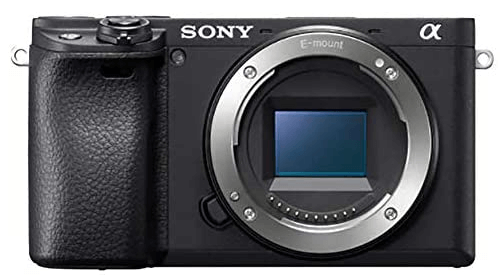
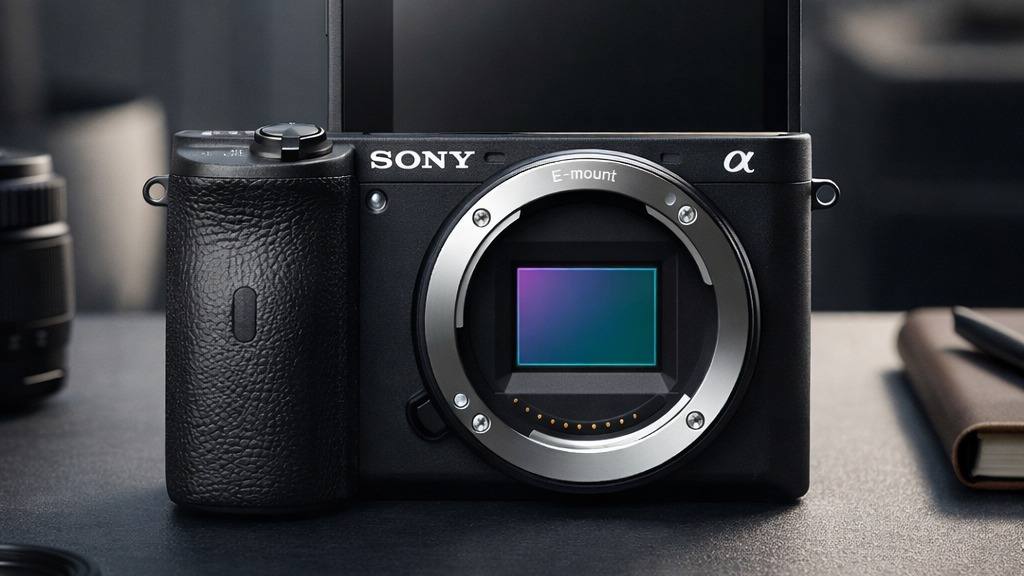
For more model-specific detail, read the dedicated Sony a6400 review and Sony a6600 review. If you are still mapping the full APS-C lineup, start with the Sony a6000 series guide.
The main difference: value versus endurance
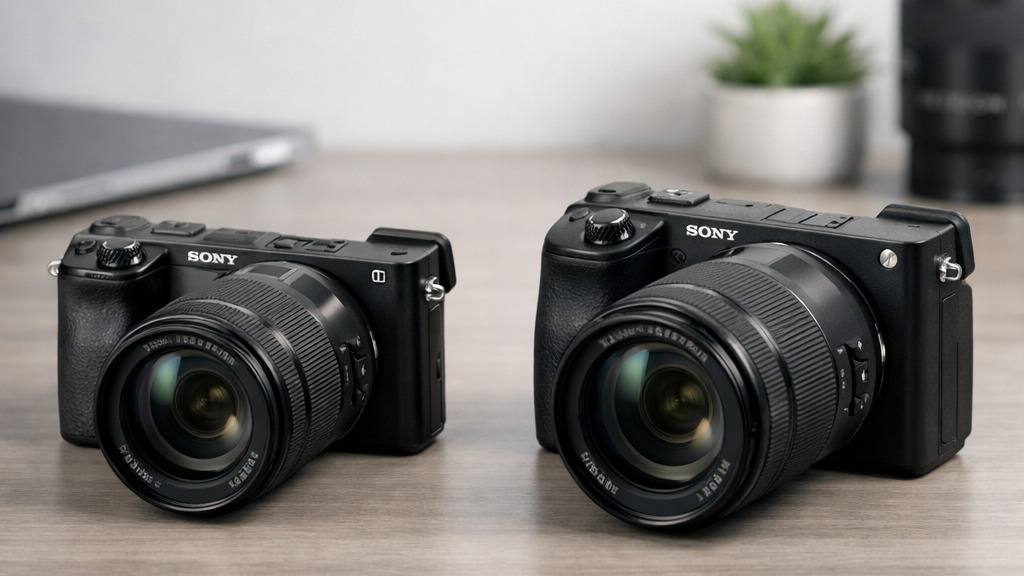
The Sony a6400 and a6600 are close enough that the wrong comparison can make the decision feel harder than it really is. Both are 24.2MP APS-C E-mount cameras. Both have excellent Sony autofocus. Both shoot detailed stills and attractive 4K video. Neither is the newest Sony APS-C body now that the a6700 exists.
The difference is practical. The a6400 is the lighter, cheaper, value-first camera. The a6600 is the more comfortable, longer-lasting, stabilized body. If you mostly shoot stills with modern autofocus lenses, the a6400 already gives you most of what matters. If you shoot long days, use unstabilized primes, or care about handheld video, the a6600 starts to justify itself.
| Feature | Sony a6400 | Sony a6600 |
|---|---|---|
| Sensor | 24.2MP APS-C Exmor CMOS | 24.2MP APS-C Exmor CMOS |
| Autofocus | 425 phase-detection / 425 contrast-detection points | 425 phase-detection / 425 contrast-detection points |
| Stabilization | Lens-based only | 5-axis in-body stabilization |
| Battery | NP-FW50 | NP-FZ100 |
| Rated battery life | Approx. 360 shots EVF / 410 shots LCD | Approx. 720 shots EVF / 810 shots LCD |
| Video | 4K up to 30p, microphone input | 4K up to 30p, microphone input, headphone jack |
| Best fit | Value, travel, street, family, beginners | IBIS, long days, larger lenses, hybrid creators |
Sony’s official specifications confirm the practical split: the a6400 relies on lens-based stabilization and uses the smaller NP-FW50 battery, while the a6600 adds 5-axis sensor-shift stabilization and the larger NP-FZ100 battery.
Who should buy the Sony a6400?
Buy the Sony a6400 if you want the best balance of price, autofocus, image quality, and portability. It remains one of the most sensible Sony APS-C bodies for photographers who shoot travel, family, street, portraits, and everyday work. The autofocus is fast enough that you rarely feel like you are using an older camera.
The a6400 is also the better choice if you would rather spend the difference on lenses. A Sigma 18-50mm f/2.8, Sony 18-135mm OSS, Sony 35mm f/1.8 OSS, or Sigma 56mm f/1.4 will change your photos more than moving from a6400 to a6600 for many stills-first shooters.
I would choose the a6400 for a lightweight travel kit, a first serious mirrorless camera, or a budget Sony APS-C setup. The main caveat is stabilization. If you use unstabilized lenses in low light or shoot a lot of handheld video, the lack of IBIS becomes the a6400’s biggest weakness.
Who should buy the Sony a6600?
Buy the Sony a6600 if you want a more serious-feeling APS-C body without jumping to the newer a6700. The deeper grip, larger battery, in-body stabilization, and headphone jack make it better suited to long shooting days and hybrid work.
The a6600 is especially appealing with unstabilized primes or adapted lenses. IBIS will not freeze a moving subject, but it can help with slower shutter speeds, static scenes, handheld portraits, and video clips where tiny shakes become distracting. The larger battery is also a real quality-of-life upgrade. Fewer battery swaps matter when you are traveling, filming, or shooting events.
I would choose the a6600 if the price is clearly below the a6700 but not too far above the a6400. If the a6600 costs close to the newer a6700, I would usually move up to the a6700 instead.
Autofocus and image quality
Image quality is not the reason to choose one over the other. Both cameras use a similar 24.2MP APS-C sensor class, and in good light the files are extremely close. Lens choice, exposure, and editing will matter more than the body difference.
Autofocus is also closer than many buyers expect. The a6400 was important because it brought Sony’s newer Real-time Tracking behavior into a smaller, cheaper body. The a6600 uses a very similar AF generation and adds the more premium body features around it. For people, pets, travel, events, and everyday movement, both cameras are strong.
The a6600 can feel slightly more stable with larger lenses because of the grip and IBIS, but the a6400 does not feel meaningfully behind in focus reliability. If you mainly shoot action and want a true autofocus generation jump, the newer a6700 is the more relevant upgrade.
Video: why the a6600 is more comfortable
Both cameras shoot detailed 4K up to 30p and both can produce good-looking video. The a6600 is the better video body because it adds IBIS, much longer battery life, and a headphone jack. Those three things matter more during real filming than a small spec-table difference.
The a6400 is still good for simple YouTube, family clips, travel videos, and tripod-based work. It has a microphone input and a flip-up screen. But handheld footage depends heavily on stabilized lenses, technique, or a gimbal. The a6600 gives you more flexibility when you want to keep the kit small.
Neither camera is a modern 10-bit hybrid body. If serious video is the main reason you are shopping, compare both against the Sony a6700 before buying.
Handling, battery life, and lens pairing
Handling is where the a6600 feels like the more premium body. The deeper grip makes a difference with lenses like the Sony 70-350mm, Sony 16-55mm f/2.8, Tamron 17-70mm f/2.8, or longer telephoto setups. The a6400 is easier to carry, but it can feel cramped with larger glass.
Battery life is the a6600’s biggest everyday advantage. Sony rates the a6400 around 360 shots through the viewfinder or 410 on the LCD. The a6600 jumps to roughly 720 through the viewfinder or 810 on the LCD. In real shooting, that means the a6600 can often get through a full day while the a6400 owner should carry spares.
For lenses, I would pair the a6400 with OSS zooms if handheld stability matters: the Sony 18-135mm OSS is a practical travel option, and the Sony 35mm f/1.8 OSS is a small stabilized prime. With the a6600, unstabilized lenses like the Sigma 18-50mm f/2.8 and Sigma 56mm f/1.4 become easier to recommend because the body adds stabilization.
Price and value in 2026
The a6400 wins on value unless you specifically need the a6600’s strengths. If the goal is simply better photos, the cheaper body plus a better lens is usually the smarter path. This is especially true for travel, family, and street photography.
The a6600 is a good buy when the used or renewed price is attractive and you know you will benefit from IBIS, the larger battery, or the deeper grip. But I would be careful not to overpay. The a6700 now owns the premium Sony APS-C position, so the a6600 only makes sense when its price reflects that it is an older flagship.
Frequently asked questions
Is the Sony a6600 worth the extra money over the a6400?
Yes, if you need in-body stabilization, much better battery life, a deeper grip, or a headphone jack. If you mostly shoot stills with stabilized lenses, the a6400 is usually the better value.
Do the Sony a6400 and a6600 have the same image quality?
Image quality is very similar. Both use 24.2MP APS-C sensors, so lenses, light, and technique will matter more than the body difference for most photos.
Does the Sony a6400 have IBIS?
No. The Sony a6400 does not have in-body stabilization. You need stabilized OSS lenses, a tripod, faster shutter speeds, or a gimbal if stabilization is important.
Which is better for video, the Sony a6400 or a6600?
The Sony a6600 is better for video because it has IBIS, a larger battery, and a headphone jack. The a6400 is still good for casual video, especially with stabilized lenses or tripod use.
Should I buy the a6400, a6600, or a6700?
Buy the a6400 for value, the a6600 for IBIS and battery life at a good used price, and the a6700 if you want the most modern Sony APS-C autofocus and video features.
Final verdict
For most buyers, I would choose the Sony a6400. It gives you the image quality and autofocus that make Sony APS-C attractive, while leaving more money for lenses. If you are building a compact photography kit, that is usually the better decision.
The Sony a6600 is the better tool if you already know why you need it. IBIS, battery life, the deeper grip, and the headphone jack are real advantages. They just need to matter to your shooting. If they do, the a6600 remains a strong used or renewed buy in 2026.
Key takeaways
- The Sony a6400 is the better value for most stills-first buyers.
- The Sony a6600 is better for IBIS, battery life, handling, and more serious video use.
- Image quality is very close, so do not upgrade for photos alone.
- The a6400 is lighter and cheaper; the a6600 is more comfortable and longer-lasting.
- If the a6600 costs close to the a6700, compare the newer a6700 before buying.
Official spec references: Sony a6400 specifications and Sony a6600 specifications.
Last update on 2026-06-15 / Affiliate links / Images from Amazon Product Advertising API