
Contents
- Sony a6300 vs a6400: the short answer
- The main difference: older enthusiast body versus modern value body
- Who should buy the Sony a6300?
- Who should buy the Sony a6400?
- Autofocus and real-world shooting
- Image quality and low light
- Video: the a6400 is easier to live with
- Handling, battery life, and lenses
- Price and value in 2026
- Frequently asked questions
- Final verdict
- Key takeaways
Sony a6300 vs a6400: the short answer
| If you care most about… | Pick this camera | Why it makes sense |
|---|---|---|
| Best overall buy | Sony a6400 | Newer tracking AF, flip-up touchscreen, better video reliability, and stronger long-term value. |
| Lowest price | Sony a6300 | It can still be worthwhile if the used or renewed price is clearly lower. |
| People, pets, kids, events | Sony a6400 | Real-time Tracking and newer Eye AF are much easier to trust. |
| Basic still photography | Sony a6300 | It still has a good 24MP APS-C sensor and strong image quality for careful shooting. |
| Video and long clips | Sony a6400 | It removes the old 29-minute recording limit and is less frustrating for creators. |
| Best used-camera safety | Sony a6400 | It is newer, easier to live with, and usually worth the extra money if prices are close. |
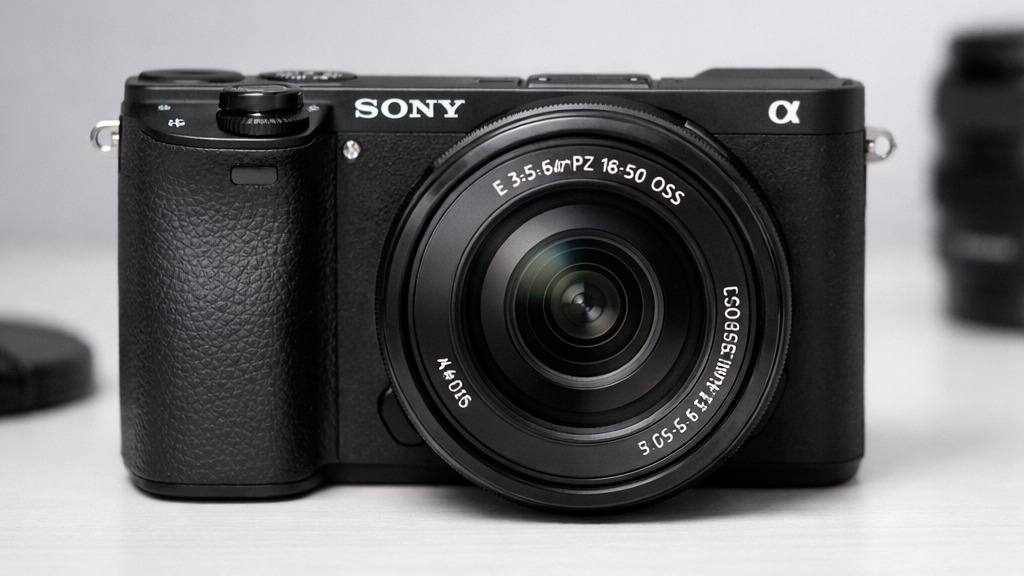
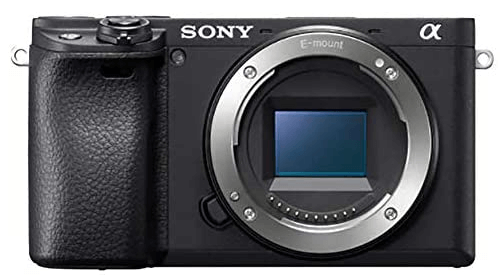
For individual deep dives, read the dedicated Sony a6300 review and Sony a6400 review. If you are still comparing the whole lineup, start with the Sony a6000 series guide.
The main difference: older enthusiast body versus modern value body
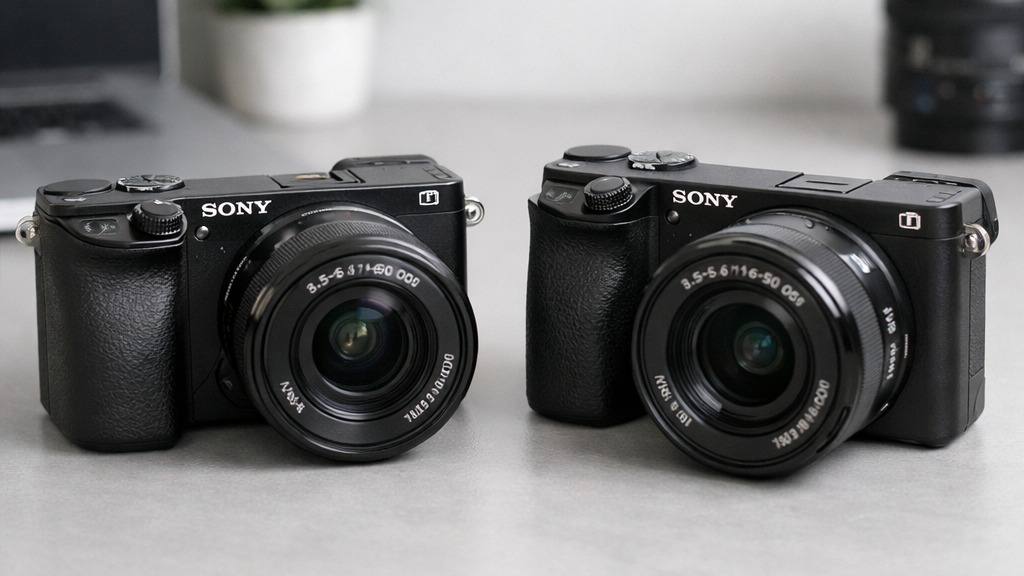
The Sony a6300 and a6400 look extremely similar. Both are compact APS-C E-mount cameras with 24.2MP sensors, electronic viewfinders, 4K video, 11 fps burst shooting, microphone inputs, and no in-body stabilization. If you only compare headline specs, the a6300 can look like the better bargain.
In real shooting, the a6400 is easier to recommend. It does not transform still image quality, but it makes focusing, video recording, self-framing, and everyday use less frustrating. The a6300 is still capable, but it feels more like a used-camera bargain. The a6400 feels like a camera you can keep using without constantly working around its age.
| Feature | Sony a6300 | Sony a6400 |
|---|---|---|
| Sensor | 24.2MP APS-C Exmor CMOS | 24.2MP APS-C Exmor CMOS |
| Autofocus points | 425 phase / 169 contrast | 425 phase / 425 contrast |
| Tracking | Older Lock-on AF and Eye AF behavior | Real-time Tracking and newer Eye AF |
| Video | 4K up to 30p, 29-minute clip limit | 4K up to 30p, no 29-minute clip limit |
| Screen | Tilting screen, no forward-facing selfie position | 180-degree flip-up touchscreen |
| Viewfinder | 2.36M-dot OLED EVF | 2.36M-dot OLED EVF |
| Stabilization | Lens-based only | Lens-based only |
| Best fit | Budget stills and short 4K clips | Travel, family, events, video, long-term ownership |
Sony’s official specifications show why the comparison is close but not equal. The a6300 already has a 24.2MP APS-C sensor, 4K recording, and 425 phase-detection AF points. The a6400 keeps that core but improves the autofocus generation, contrast AF coverage, screen design, and video usability.
Who should buy the Sony a6300?
Buy the Sony a6300 only if the price is clearly lower than the a6400 and your needs are modest. It is still a good stills camera for travel, street photography, family photos, casual portraits, and learning Sony E-mount. With a good lens, the image quality still holds up well.
The a6300 can also make sense if you mostly shoot controlled subjects and short video clips. It has a good viewfinder, a compact body, and detailed 4K for its age. But I would not buy it for long interviews, vlogging, fast family/action work, or situations where autofocus reliability matters more than saving money.
The price has to be the reason. If the a6300 is only slightly cheaper than a clean a6400, the newer body is the smarter purchase.
Who should buy the Sony a6400?
Buy the Sony a6400 if you want the safer, more modern used Sony APS-C body. It is better for people, pets, kids, events, travel, street photography, and hybrid shooting. The autofocus is the main reason: Real-time Tracking and the newer Eye AF behavior make the camera easier to trust when subjects move.
The a6400 is also better for video creators. It does not have in-body stabilization, and it is not a modern 10-bit camera, but it gives you detailed 4K, a flip-up screen, microphone input, better continuous recording behavior, and more dependable video autofocus. That makes it far more usable than the a6300 for YouTube, travel clips, family videos, and interviews.
I would choose the a6400 for most buyers unless the a6300 discount is substantial.
Autofocus and real-world shooting
Autofocus is where the a6400 pulls ahead most clearly. The a6300 was strong for its time and still focuses well on static subjects, slower portraits, and predictable movement. But it belongs to an older Sony generation, so tracking can feel less sticky when subjects move across the frame or when backgrounds get busy.
The a6400’s Real-time Tracking is the practical upgrade. Photographing kids, pets, candid street scenes, portraits at wide apertures, or small moments at events is easier because the camera holds onto the subject more confidently. It is not just about focus-point counts. It is about fewer missed frames and less time fighting the camera.
Both cameras can shoot up to 11 fps. The a6400 is the better action camera because the autofocus and buffer behavior make those bursts more useful.
Image quality and low light
Still image quality is close. Both cameras use 24.2MP APS-C sensors and produce detailed files with good lenses. In good light, I would not upgrade from a6300 to a6400 just for image quality. Your lens, exposure, and editing will matter more.
The a6400 can give better-looking JPEGs, more natural color in some scenes, and a stronger keeper rate because focus is more dependable. But if you shoot RAW and mostly photograph still subjects, the difference is subtle.
Neither body has in-body stabilization. For low light, choose stabilized OSS lenses, faster primes, a tripod, or higher shutter speeds. The a6400 helps by focusing better in real-world situations, but it does not replace a larger sensor or IBIS.
Video: the a6400 is easier to live with
Both cameras can produce sharp 4K footage, but the a6400 is the better video camera. The a6300’s 4K looks good, but the old clip limit, warmer-running reputation, non-selfie screen, and older video AF make it less comfortable for modern creator work.
The a6400 removes the 29-minute recording limit, adds a flip-up touchscreen, and gives you more dependable focus during recording. It also offers useful profiles such as S-Log and HLG. It is still 8-bit, so serious color work has limits, but compared with the a6300 it is the obvious choice for hybrid shooters.
Handling, battery life, and lenses
The bodies feel familiar: compact, light, and easy to pack. The a6400 feels more refined because of its screen, touch focus, updated interface, and general responsiveness. The a6300 is still solid, but it feels older when you are changing settings quickly or trying to self-frame.
Battery life is not a deciding factor. Both use the smaller NP-FW50 battery, and Sony rates both around 400 shots depending on viewfinder or LCD use. Carry spares if you shoot video, travel, or long days.
Lens choice matters more than many buyers expect. For either body, the Sony 18-135mm OSS is a practical travel lens, the Sony 35mm f/1.8 OSS is a compact family/street prime, the Sigma 18-50mm f/2.8 is a strong everyday zoom, and the Sigma 56mm f/1.4 is excellent for portraits. The a6400’s autofocus makes fast primes easier to use with moving subjects.
Price and value in 2026
The a6300 is a good value only when it is genuinely cheap. It makes sense as a budget stills-first body or a secondary camera, but it should not cost close to the a6400. Once the price gap narrows, the a6400’s autofocus, video usability, screen, and newer ownership experience are worth paying for.
The a6400 is the better long-term value for most people. It sits in a useful spot: much more modern than the a6300, usually cheaper than the a6600 or a6700, and still strong enough for serious hobbyist work.
Frequently asked questions
Is the Sony a6400 worth the extra money over the a6300?
Yes, for most buyers. The a6400 is worth the extra money if you shoot people, pets, events, travel video, interviews, or anything where autofocus and video reliability matter.
Does the Sony a6400 have better image quality than the a6300?
Not dramatically. Both are 24.2MP APS-C cameras. The a6400 can have better JPEG color and more consistent focus, but RAW still image quality is close.
Which is better for video, the Sony a6300 or a6400?
The Sony a6400 is better for video. It removes the old 29-minute clip limit, has better video autofocus, and uses a more practical flip-up touchscreen. The a6300 can still shoot good-looking 4K, but it feels older.
Does either camera have in-body stabilization?
No. Neither the Sony a6300 nor the Sony a6400 has in-body stabilization. Use stabilized OSS lenses, faster shutter speeds, a tripod, or a gimbal when stabilization matters.
Is the Sony a6300 still worth buying in 2026?
Yes, but only at a clearly lower price. The a6300 still makes good still photos and detailed short 4K clips. The a6400 is the better choice if prices are close.
Final verdict
For most buyers, I would choose the Sony a6400. It is not a huge still-image-quality upgrade, but it is a much better everyday camera because autofocus, screen design, video usability, and reliability all improve.
The Sony a6300 still has a role as a low-cost used APS-C body. If the discount is large and you mainly shoot stills, it can be a smart buy. If the price gap is small, skip the older body and get the a6400.
Key takeaways
- The Sony a6400 is the better camera for most buyers.
- The Sony a6300 is still useful only when it is much cheaper.
- Image quality is close; autofocus and video usability are the real differences.
- Neither camera has IBIS, so lens stabilization and technique still matter.
- If you shoot people, pets, events, or video, the a6400 is worth the step up.
Official spec references: Sony a6300 specifications and Sony a6400 specifications.
Last update on 2026-06-18 / Affiliate links / Images from Amazon Product Advertising API