
Contents
- Understanding the Kodak Pixpro FZ series
- Core specs comparison: Kodak Pixpro FZ45 vs FZ55 at a glance
- Design, size, and handling in the real world
- Lens and zoom performance for everyday photography
- Image quality and shooting performance
- Video features and audio for casual filming
- Battery life, storage, and everyday reliability
- Ease of use, modes, and learning curve
- Price, value, and long‑term cost of ownership
- Pros and cons: Kodak Pixpro FZ45 vs FZ55
- Real‑world use cases and photographer recommendations
- Final verdict: how to choose between the FZ45 and FZ55
Understanding the Kodak Pixpro FZ series
What the FZ45 and FZ55 are designed for
The Kodak Pixpro FZ series sits firmly in the world of compact digital cameras, designed with simplicity and everyday usability in mind. Both the FZ45 and FZ55 aim to deliver reliable point-and-shoot performance for people who value ease over complexity. These cameras are built for the casual photographer – think day trips, family gatherings, or travel – when you want better quality than a basic phone snap but don’t want to fuss with manual controls or changeable lenses.
The FZ45 and FZ55 both offer:
- Lightweight, truly pocketable bodies
- Easy-to-use interfaces and automatic modes
- All-in-one zoom lenses for flexibility
- Affordable price tags compared to premium compacts
Their main selling point is the balance between cost, portability, and simplicity. If you’re after a camera you can hand to anyone – grandparents, kids, or a friend at a party – these FZ models are designed for exactly that.
Where they sit in the compact camera market
The compact camera market has seen a resurgence in 2026, as more people crave devices that do one job well without the distractions of a smartphone. The Kodak Pixpro FZ series fills the gap between basic smartphone photography and more advanced enthusiast compacts like the Canon PowerShot G series or Sony RX100 line.
Within the FZ series, the FZ45 and FZ55 are entry-level options priced below $200 in most regions. They compete with offerings from Nikon’s Coolpix and Canon’s Ixus/Elph lines, targeting users who want a no-fuss camera with a zoom lens and decent image quality, but who don’t need RAW files or high-end video.
Who should consider an FZ camera instead of a phone
You might wonder if there’s still a reason for a compact camera like the Kodak Pixpro FZ45 or FZ55 when phones are so capable. Here’s when an FZ camera makes sense:
- You prefer a physical camera for events, travel, or family photos
- You want optical zoom for distant subjects (beyond what your phone offers)
- You’d rather not use your expensive phone in risky conditions – beach, hiking, or kids’ parties
- You want to hand a camera to a child or elderly family member without worrying about your phone
For those who want a dedicated device that just takes photos and videos reliably, and don’t care for apps or social media integration, the FZ45 and FZ55 are strong contenders.
Core specs comparison: Kodak Pixpro FZ45 vs FZ55 at a glance
Side‑by‑side spec sheet overview
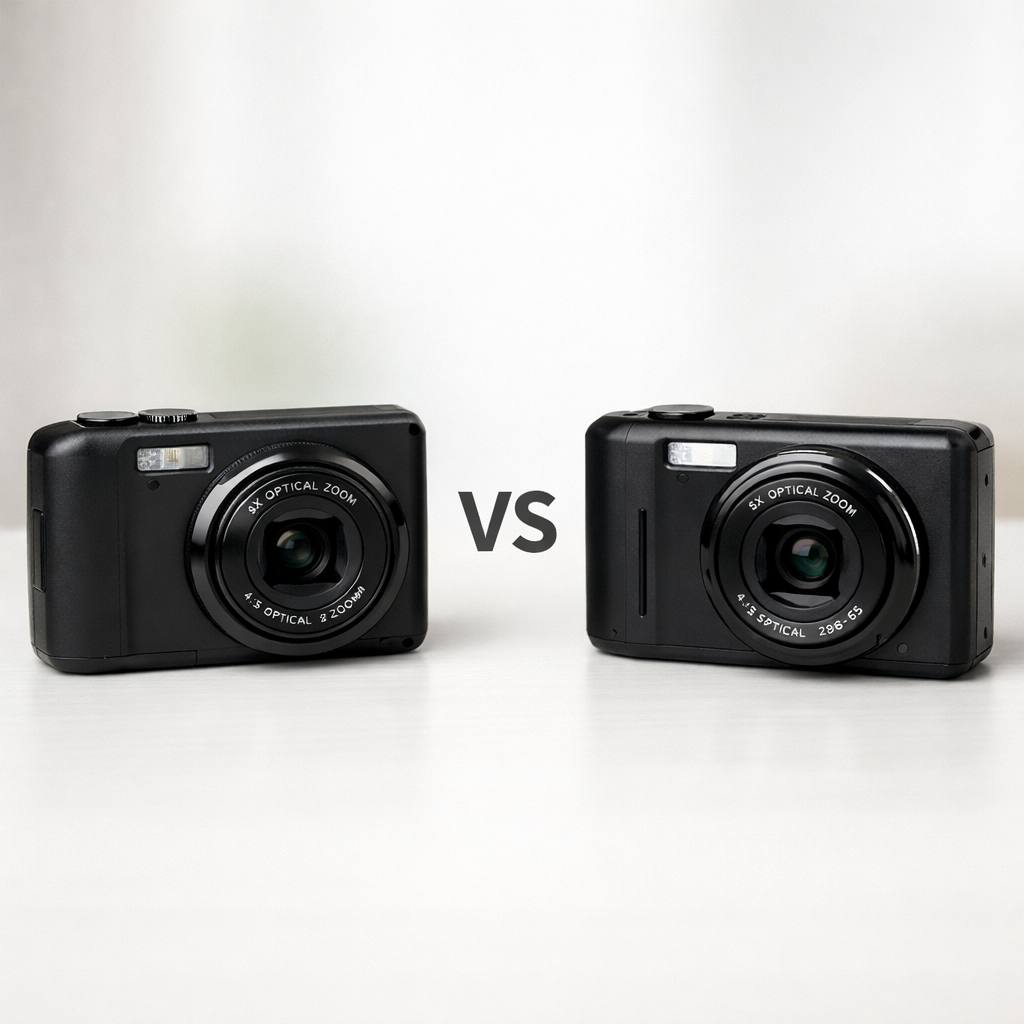
Let’s look at the essentials for the Kodak Pixpro FZ45 vs FZ55. Both share the same sensor, a 16MP 1/2.3-inch CCD, and a similar compact form factor, but differ in lens reach and a few usability tweaks.
| Feature | Kodak Pixpro FZ45 | Kodak Pixpro FZ55 |
|---|---|---|
| Sensor | 16MP 1/2.3-inch CCD | 16MP 1/2.3-inch CCD |
| Lens | 27-108mm (4x zoom, f/3.0-6.6) | 28-140mm (5x zoom, f/3.9-6.3) |
| LCD Screen | 2.7-inch, 230k dots, fixed | 2.7-inch, 230k dots, fixed |
| Video | 1080p/30fps | 1080p/30fps |
| Batteries | AA x 2 | Rechargeable Li-ion |
| Weight | Approx. 117g (without batteries) | Approx. 106g (with battery) |
Both cameras support SD cards (up to 32GB), have built-in flash, and offer basic scene modes.
Key differences that actually matter in real use
On paper, the FZ55’s longer zoom (28-140mm vs 27-108mm) gives it a slight edge for travel or distant subjects. The FZ55 also uses a rechargeable lithium-ion battery, which is more convenient and lighter than the AA batteries in the FZ45. The FZ45, however, has a slightly wider field at the wide end (27mm vs 28mm), which can help for group shots indoors.
One often-overlooked difference: battery type. Swappable AA batteries in the FZ45 can be a lifesaver if you’re traveling far from a charger, while the FZ55’s rechargeable battery cuts weight and is more eco-friendly.
How the specs translate to everyday shooting
Specs only tell part of the story. In practice, both cameras are quick to start up, simple to operate, and responsive enough for casual shooting. The FZ55’s extra zoom is handy for zoo trips or sports days, while the FZ45’s slightly wider angle can make a real difference in cramped indoor settings.
Image quality is very similar due to the shared sensor and processing pipeline, but the lens differences do affect sharpness and low-light performance at full zoom. I’ll cover those details in the lens and image quality sections below.
Design, size, and handling in the real world
Body size, weight, and pocketability
Both cameras are genuinely small even by compact standards. The FZ45 measures roughly 94 x 60 x 28mm, while the FZ55 is a touch slimmer at 91.5 x 56.5 x 23.5mm. Both will fit in a jeans pocket or small handbag easily, and both weigh about as much as a smartphone. The main difference comes down to battery: the FZ45 is heavier if you use alkaline AAs, while the FZ55 is lighter thanks to its lithium cell.
Kodak keeps things straightforward. Both cameras have a traditional d-pad, a dedicated video record button, and direct access to scene modes. The menu systems are text-based, large, and easy to read which is ideal for beginners and seniors. In my experience, you can shoot confidently without ever cracking the manual.
Grip, ergonomics, and one‑handed shooting
Neither the FZ45 nor FZ55 boasts a large grip, but both have a subtle front bump and textured surface for slip-resistance. I found both comfortable to use one-handed, even for longer periods, but those with larger hands may prefer the FZ45’s slightly chunkier feel. Buttons are well spaced, so accidental presses are rare.
Lens and zoom performance for everyday photography
Wide‑angle coverage and field of view
The FZ45’s 27mm equivalent at the wide end is fractionally better for group shots, selfies, or interiors, where every extra millimeter counts. The FZ55 starts at 28mm, which is still quite usable for landscapes and city scenes. For most people, the difference is subtle but noticeable in tight spaces.
Zoom range, maximum aperture, and low‑light impact
The FZ55 has a 5x zoom (28-140mm), giving you more reach for distant subjects—ideal for travel, wildlife, or sports from the sidelines. The FZ45’s 4x zoom (27-108mm) is a bit more limited but covers most everyday needs. However, both cameras have modest maximum apertures (f/3.0-6.6 on the FZ45, f/3.9-6.3 on the FZ55), which means low-light performance drops off quickly at full zoom. Don’t expect DSLR-like background blur, but you can still isolate subjects decently at the telephoto end.
How the lens affects portraits, travel, and family photos
For portraits and family moments, both cameras deliver decent subject isolation at full zoom and natural skin tones. The FZ55’s extra reach is handy for candid shots at gatherings or sightseeing. For travel, the increased telephoto of the FZ55 is a real asset, but the FZ45’s wider field helps in small hotel rooms or bustling markets. Both lenses focus closely enough for simple macro shots of flowers, food, or souvenirs.
Image quality and shooting performance
Sensor, resolution, and detail in good light
Both cameras use a 16MP CCD sensor, which is standard for entry-level compacts. In daylight, you’ll see crisp photos with natural colors, a moderate amount of fine detail, and relatively little distortion. JPEG processing is gentle, so you get realistic results with minimal editing needed.
Low‑light performance, noise, and flash behavior
In low light, the limitations of these small sensors show up. Images can become grainy above ISO 400, and color accuracy drops in dim indoor scenes. The built-in flash is essential for evening events or indoor parties, but it’s not too harsh; just remember to keep your subjects within 2–3 meters for best results. Both cameras handle flash recycling quickly.
Autofocus speed, shutter lag, and burst shooting
Focusing speeds are good for a compact: both lock focus in under a second in bright light, though they can struggle in the dark. Shutter lag is minimal, so you won’t miss casual moments. Neither camera is a burst-shooting king: expect about 1–2 frames per second for short bursts, which is fine for kids, pets, or travel snapshots.
Video features and audio for casual filming
Resolution, frame rates, and file formats
Both the FZ45 and FZ55 offer 1080p Full HD video at 30 frames per second. This is more than enough for casual filming at family events, school plays, or quick travel clips. Videos are saved in .MOV format, which is widely compatible with computers and social platforms.
Stabilization and handheld video usability
Neither camera offers advanced optical or digital stabilization, so handheld clips can be shaky, especially at full zoom. For best results, use two hands or brace yourself against a wall. They’re not designed for vlogging or action sports, but for steady, simple clips, both are easy to use.
Sound quality and when a phone might be better
Audio is recorded via a built-in mono mic. It’s serviceable for casual voice and ambient sound, but wind noise and background chatter can be an issue outside. If audio quality is critical – like for interviews or YouTube – your smartphone or an external recorder will outperform either FZ model.
Battery life, storage, and everyday reliability
Battery capacity and real‑world shot counts
When comparing the Kodak Pixpro FZ45 vs FZ55, one thing most users care about is camera battery life. Both models use standard lithium-ion rechargeable batteries, but their endurance differs slightly in daily use. The FZ45 is rated for around 200 shots per charge, while the FZ55 pushes closer to 220 shots under typical conditions. In practice, these numbers hold up for a day of light shooting.
However, if you like to review photos often or shoot lots of video, expect those numbers to drop. The LCD screens on both cameras are bright and clear, but they do consume battery quickly. Carrying a spare battery is a smart move for either model, especially if you travel or plan extended outings. Fortunately, charging is straightforward via USB, and both cameras top up in a couple of hours.
Memory card types and file sizes
Both the FZ45 and FZ55 accept standard SD, SDHC, and SDXC memory cards. There’s no proprietary format, which adds to their camera reliability and keeps costs low. File sizes for 16MP JPEG images average about 4–5MB per shot, so even a modest 32GB card can store several thousand photos before filling up. For video, a fast card is recommended, especially if you plan to shoot a lot of 1080p clips.
Neither camera supports RAW files, which may disappoint more advanced shooters, but this is typical for this price range. Still, the JPEGs are easy to transfer, share, and back up. Remember to format your card in-camera before first use for best performance.
Durability, build quality, and travel readiness
From a build perspective, both cameras are lightweight and made mostly of plastic, but they feel solid enough for daily handling. The FZ45 is slightly chunkier, while the FZ55 offers a slimmer profile. Neither model is weather-sealed, so you should avoid heavy rain or sandy environments. However, both have survived the bottom of backpacks and the occasional minor drop in my experience.
For travel, their compact size is a huge plus. You can slip either into a jacket pocket or small bag without a second thought. The wrist strap included is handy for quick shots on the move. For best camera reliability, keep a microfiber cloth handy for the lens and screen, and store the camera in a padded pouch when not in use.
Ease of use, modes, and learning curve
Auto modes and scene presets for beginners
Ease of use is where both the FZ45 and FZ55 shine. Each is a beginner friendly camera, offering a full suite of auto modes. The standard Program Auto is perfect for everyday snaps, letting the camera choose all the key settings. Beyond that, you’ll find scene presets like Portrait, Landscape, Sports, and even a dedicated Panorama mode.
For absolute beginners or those who just want to point and shoot, these modes are genuinely helpful. They prevent common mistakes like blurry indoor shots or washed-out outdoor scenes. And, since both cameras have dedicated buttons for Scene and Video, switching between modes is quick and intuitive.
Menu logic and on‑screen guidance
The menu systems on both cameras are simple, with large icons and clear text. The FZ45 menu feels a bit more dated, but it’s always understandable. The FZ55, with its slightly larger screen, offers a more modern look and slightly smoother navigation.
Neither model overwhelms the user with options. Essential settings (flash, timer, exposure compensation) are never more than a button or two away. While there’s not much in the way of on-screen tutorials, the built-in help hints are enough to guide you through the basics. For most users, the learning curve is minimal, making these true easy to use compact cameras.
How friendly each camera is for kids and seniors
If you’re shopping for a family camera for kids or seniors, both models are excellent choices. The buttons are clearly labeled, and there’s little risk of accidentally changing critical settings. The FZ45, with its chunkier grip, is a bit easier for small hands or those with limited dexterity. The FZ55, being slimmer, may feel a bit more “slippery” but is still manageable for most.
In my experience lending these to relatives, both cameras inspire confidence: no one worried about breaking anything, and everyone could get sharp, vibrant photos without fuss. For ultimate simplicity, the FZ45 probably wins by a nose, but neither will frustrate a novice.
Price, value, and long‑term cost of ownership
Typical street prices and seasonal deals
On the camera price comparison front, the FZ45 generally costs about 20-30% less than the FZ55. Expect to see the FZ45 retailing in the lower budget range, and the FZ55 sitting just above, but still far below premium compacts. Seasonal deals around the holidays or back-to-school often bring prices down further, making both models even more accessible.
What you actually get for the extra money
So, is the FZ55 the best value compact camera for the extra cost? You get a slightly longer zoom, a slimmer design, and marginally better low-light performance. For most casual users, these upgrades are nice but not essential. If a lower upfront price and simplicity are your priorities, the FZ45 is hard to beat.
Accessories you should budget for
Regardless of model, budget for a few essentials:
- At least one extra battery (third-party options are affordable)
- A quality SD card (32GB or higher, Class 10 recommended)
- A padded case for travel
- Screen protectors and a lens cloth
None of these accessories are expensive, so the long-term cost of ownership stays reasonable.
Pros and cons: Kodak Pixpro FZ45 vs FZ55
Strengths and weaknesses of the Kodak Pixpro FZ45
Pros:
- Lower price point: great for tight budgets or first-time buyers
- Chunky grip and larger buttons, very user-friendly for kids and seniors
- Simple, reliable operation with no learning curve
Cons:
- Shorter zoom range compared to the FZ55
- Bulkier body – not quite as pocketable
- No standout features for more ambitious photographers
Strengths and weaknesses of the Kodak Pixpro FZ55
Pros:
- Longer 5x optical zoom, better for travel and versatile shooting
- Slim, lightweight design – easier to carry in a pocket
- Marginally better low-light and macro performance
Cons:
- Higher price – may not be worth it if you just want basic snapshots
- Smaller grip – slightly trickier for large hands or younger kids
- No significant manual controls for creative growth
Which camera is the better fit for different users
The FZ45 is for those who want the most affordable, easy-to-use option for daily photos. The FZ55 suits travelers or anyone wanting a bit more zoom flexibility in a compact form. Both are limited for advanced photography, but excel as simple, reliable point-and-shoots.
Real‑world use cases and photographer recommendations
Best choice for travel and vacations
If travel is your main goal, the FZ55 is the travel compact camera I’d reach for. Its slim profile and longer zoom make it perfect for city breaks, museums, and landscapes. You’ll appreciate the extra reach when sightseeing or capturing distant subjects.
Best choice for family events and kids’ activities
For family camera recommendation, the FZ45 is a winner. Its simple controls, robust grip, and easy operation let anyone in the family grab it and start shooting—no tech skills required. It’s also less of a worry if it takes a minor knock.
Best choice for beginners learning photography basics
Both cameras are solid starter tools, but the FZ45 edges ahead for learning photography basics. Its straightforward interface and affordable price mean you can experiment without stress, and you won’t feel bad if you eventually outgrow it.
Final verdict: how to choose between the FZ45 and FZ55
Quick decision guide based on your priorities
If budget and simplicity are top priorities, the FZ45 is the clear winner. If you want extra zoom and a slimmer body for travel, the FZ55 is worth the extra cost. Think about how you’ll use your camera most: everyday family snaps or on-the-go adventures?
When to skip both and consider alternatives
If you’re after serious low-light performance, manual controls, or 4K video, neither camera will satisfy. In that case, consider stepping up to a more advanced compact or even a mirrorless camera. However, for pure point-and-shoot convenience, these models remain tough to beat as compact digital cameras are making a comeback in 2026.
My personal pick as a working photographer
For most casual users, I recommend the FZ55 for its travel readiness and extra zoom, but if every dollar counts, the FZ45 is more than enough. Both offer excellent value and reliability for what they’re designed to do.
In summary, the Kodak Pixpro FZ45 vs FZ55 debate comes down to your priorities: affordability and simplicity vs. flexibility and travel-friendliness. Compact digital cameras are making a comeback for a reason: they just work, and sometimes, that’s all you need.