


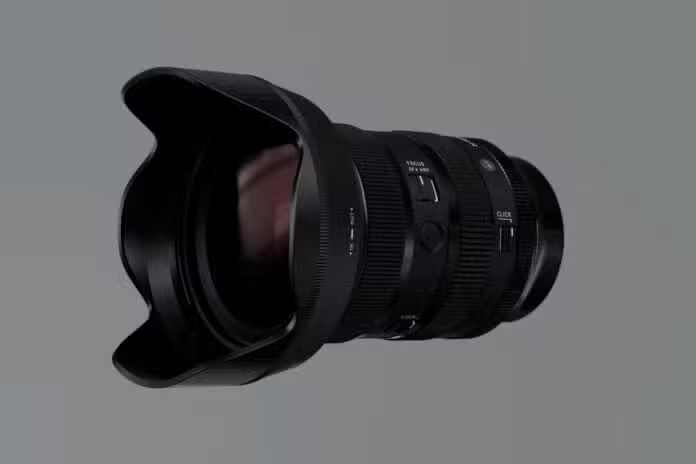
The best Sigma mirrorless lenses have two clear standouts. For full-frame Sony E or L-Mount, start with the 24–70mm F2.8 DG DN II | Art. For APS-C, choose the much smaller 18–50mm F2.8 DC DN | Contemporary. Your mount and sensor size decide which half of Sigma’s catalog is relevant, so confirm both before comparing prices.
Sigma’s value is no longer simply “almost first-party quality for less.” Some lenses now offer ranges or apertures the camera brands do not. Others accept less range, stabilization, or body integration to save weight. These picks favor lenses that change what you can shoot, not small chart differences.
Best Sigma mirrorless lenses at a glance
| Best for | Lens | Native mounts | Main compromise |
|---|---|---|---|
| Full-frame all-round use | 24–70mm F2.8 DG DN II | Art | L, Sony E | No optical stabilization |
| Full-frame one-lens travel | 20–200mm F3.5–6.3 DG | Contemporary | L, Sony E | Slow aperture; no stabilization |
| Full-frame everyday prime | 35mm F1.4 DG II | Art | L, Sony E | Cost and size versus an F2 prime |
| Full-frame portraits | 85mm F1.4 DG DN | Art | L, Sony E | Specialized working distance |
| Macro and product work | 105mm F2.8 DG DN Macro | Art | L, Sony E | No optical stabilization |
| Wildlife on a budget | 150–600mm F5–6.3 DG DN OS | Sports | L, Sony E | 4.6-pound carry |
| APS-C all-round use | 18–50mm F2.8 DC DN | Contemporary | L, RF, X, Sony E | No optical stabilization |
| APS-C low light and video | 17–40mm F1.8 DC | Art | L, RF, X, Sony E | Large for an APS-C standard zoom |
| APS-C ultra-wide | 10–18mm F2.8 DC DN | Contemporary | L, RF, X, Sony E | Few physical controls |
| APS-C one-lens travel | 16–300mm F3.5–6.7 DC OS | Contemporary | L, RF, X, Sony E | Slow at the long end |
| APS-C portraits | 56mm F1.4 DC DN | Contemporary | L, RF, X, Nikon Z, Sony E, MFT, EF-M | No stabilization |
| APS-C wide prime | 15mm F1.4 DC | Contemporary | RF, X, Sony E | Not offered for L or Z |
Check your mount before choosing a Sigma lens
Sigma’s mirrorless range is fragmented by licensing, not just sensor size. Sony E and L-Mount have the broadest native selection, including Sigma’s full-frame DG lenses. Canon RF now has a strong APS-C DC lineup, but no native Sigma full-frame RF lenses. Nikon Z users get only the 16mm, 30mm, and 56mm F1.4 DC DN primes in native mount. Fujifilm X has a useful APS-C range, plus the full-frame-image-circle 100–400mm zoom.
That distinction matters on full-frame Canon and Nikon bodies. A Sigma DC lens is a crop-format lens, so expect crop-mode resolution rather than full-frame coverage. Adapting an older Sigma DSLR lens is a separate decision with different size, autofocus, and firmware considerations.
Before buying, use Sigma’s official camera compatibility checker for your exact body and update both camera and lens firmware. Sony full-frame owners can compare the wider system in our Sony FE lens guide; crop-sensor owners should start with our Sony APS-C lens guide. The best L-Mount lenses guide puts Sigma’s options beside Panasonic and Leica alternatives.
Best full-frame Sigma mirrorless lenses
Best overall: Sigma 24–70mm F2.8 DG DN II | Art
This is the Sigma zoom I would build a full-frame kit around. It weighs 735g in Sony E mount and 745g in L-Mount. That is not small, but it is meaningfully lighter than Sigma’s first version. The 24mm wide end helps with interiors, events, and handheld video. A compact 28–70mm alternative can feel restrictive there.
HLA autofocus is quick. An aperture ring, two customizable buttons, a zoom lock, and extensive sealing make it feel like a working lens. It also focuses to 6.7 inches at 24mm and suppresses focus breathing. The catch is no optical stabilization. Unstabilized bodies and handheld video shooters need to plan accordingly.
Who should skip it: travelers who resent carrying a 1.6-pound lens. The 470g 28–70mm F2.8 DG DN | Contemporary gives up 24mm and extensive controls. Its dust and splash protection is limited to the mount. It is still better when lower weight gets the camera out of the bag.
Best full-frame travel zoom: Sigma 20–200mm F3.5–6.3 DG | Contemporary
The 20–200mm F3.5–6.3 DG starts wider than most travel zooms. The 20mm end handles interiors and large foregrounds. At 200mm, it reaches compressed landscapes and distant details. Weight is 540g in Sony E mount and 550g in L-Mount. That is lighter than the 24–70mm F2.8 II despite the 10× range.
You pay for that range with a variable aperture and no optical stabilization. It suits daylight travel and stabilized bodies far better than dim events or dusk telephoto work. A 24–70mm F2.8 remains the safer paid-assignment lens. Choose the 20–200mm when one-lens reach and a true ultra-wide view matter more than speed.
Best everyday prime: Sigma 35mm F1.4 DG II | Art
The 2026 35mm F1.4 DG II is the current premium 35mm, not the older DG HSM DSLR lens or the first DG DN version. It weighs 525g in Sony E mount, uses a 67mm filter, and employs dual HLA motors. A 35mm lens this fast works for documentary, environmental portraiture, night street work, and a one-prime travel kit without forcing the perspective.
Its tradeoff is simple: F1.4 costs money and bag space. If you usually work around F2.8 to F8, Sigma’s 35mm F2 DG DN I-series prime is far easier to carry. Buy the F1.4 for low light and depth-of-field control, not because “Art” sounds more professional.
Best portrait lens: Sigma 85mm F1.4 DG DN | Art
The 85mm F1.4 remains the sensible portrait specialist. It combines an 85mm working perspective with an F1.4 aperture in a 625g E-mount body—dramatically more practical than Sigma’s older DSLR-era 85mm Art. The aperture ring can be de-clicked for video, and the 11-blade diaphragm helps keep defocused highlights rounded.
This is not automatically a better portrait choice than a compact 85mm F1.8. At events, the smaller lens may focus, balance, and travel more comfortably. Choose the Sigma when its wider aperture and smoother separation matter enough to accept the extra weight. For headshots in cramped rooms, a 50mm may also be easier to use.
Best macro: Sigma 105mm F2.8 DG DN Macro | Art
The 105mm reaches true 1:1 reproduction at a 11.6-inch minimum focusing distance and includes a focus limiter, aperture ring, and weather-resistant construction. That makes it a strong tool for insects, jewelry, copy work, and tightly framed product details. It also doubles as a very sharp longer portrait lens.
The important omission is optical stabilization. At life size, small movements become obvious and in-body stabilization cannot freeze a moving subject. A flash, monopod, tripod, or deliberate shutter-speed margin remains part of the workflow. L-Mount users can pair it with Sigma teleconverters; Sony E users cannot.
Best wildlife value: Sigma 150–600mm F5–6.3 DG DN OS | Sports
For birds, field sports, and distant wildlife, 600mm reach and optical stabilization at this price are persuasive. The lens includes a focus limiter, panning stabilization mode, zoom-torque control, an Arca-compatible tripod foot, and sealing throughout the barrel. It is designed to work outdoors rather than merely look impressive on a spec sheet.
The bill arrives in weight: 2,100g, or 74.1 ounces, before the camera. It also takes 95mm filters. A 100–400mm zoom is the better hiking lens if you can crop or move closer. L-Mount supports Sigma’s 1.4× and 2× teleconverters; E-mount does not. Owners of Sony’s fastest bodies should also know that third-party lenses can reduce AF-C burst speed, so a Sony telephoto remains the safer professional action choice when maximum frame rate is non-negotiable.
Best Sigma APS-C mirrorless lenses
Best first upgrade: Sigma 18–50mm F2.8 DC DN | Contemporary
This is the easy recommendation for most APS-C photographers. It covers a 27–75mm-equivalent range on Sony, Fujifilm, and L-Mount bodies, weighs about 10 ounces, focuses close, and keeps F2.8 throughout the zoom. On Canon’s 1.6× crop bodies, the view is roughly 29–80mm equivalent.
The lens is especially convincing as a kit-zoom replacement: brighter, sharper, and still small enough for daily carry. It has no optical stabilization, however. That matters on Canon bodies without IBIS and for handheld video. Nikon Z users should not order it by mistake; Sigma does not offer this zoom in Z mount.
Best low-light zoom: Sigma 17–40mm F1.8 DC | Art
The 17–40mm offers a 25.5–60mm-equivalent range on 1.5× bodies, or about 27–64mm on Canon APS-C, with a constant F1.8 aperture. Its inner-zoom design keeps the barrel length fixed, HLA autofocus is quiet, and focus breathing is controlled. Those details matter on a gimbal or a rig where balance changes waste time.
At 525–560g depending on mount, this is not the lens that makes APS-C feel tiny. It is the right choice for indoor events, documentary video, and photographers who would otherwise carry two or three fast primes. Daylight travelers will get more pleasure from the 18–50mm F2.8.
Best ultra-wide zoom: Sigma 10–18mm F2.8 DC DN | Contemporary
At 250–270g, the 10–18mm is unusually easy to keep in a small bag. It gives a 15–27mm-equivalent range on 1.5× cameras and roughly 16–29mm on Canon APS-C, which is useful for landscapes, architecture, interiors, vlogging, and establishing shots. It can focus to 4.6 inches at the wide end for exaggerated foregrounds.
The barrel has few direct controls, and compact wide-angle designs benefit from current in-camera and RAW-converter lens profiles. That is a reasonable trade for travel and gimbal use. Architecture photographers who insist on minimally corrected RAW geometry should compare larger alternatives. For stars or low-light vlogging, consider the faster 12mm F1.4 DC in RF, X, or E mount.
Best one-lens travel option: Sigma 16–300mm F3.5–6.7 DC OS | Contemporary
The 16–300mm covers an extraordinary 24–450mm-equivalent range on 1.5× bodies, or about 26–480mm on Canon. It adds HLA autofocus, half-life-size close-up capability at 70mm, and optical stabilization rated at six stops wide and 4.5 stops at the telephoto end. For dusty travel, hiking, and family trips, avoiding lens changes can be worth more than a wider aperture.
It is still a 615–625g superzoom, and F6.7 at the long end raises ISO quickly in poor light. Do not buy it expecting an 18–50mm F2.8 and a dedicated wildlife zoom in one barrel. Buy it because getting the shot from one lens matters more than maximum subject isolation or edge-to-edge perfection.
Best APS-C portrait prime: Sigma 56mm F1.4 DC DN | Contemporary
The 56mm gives an 84mm-equivalent view on Sony, Fujifilm, Nikon DX, and APS-C L-Mount bodies; Canon’s crop makes it roughly 90mm equivalent. It is small, sharp, and bright enough to produce the portrait look a slow kit zoom cannot. For a beginner asking which second lens will most visibly change their pictures, this is often the answer.
It lacks stabilization and is an older stepping-motor design, but it remains relevant because the optical result, size, and price are so well balanced. It is also one of only three native Sigma choices for Nikon Z. Micro Four Thirds users get a tighter 112mm-equivalent view, which is better suited to headshots than casual indoor portraits.
Best APS-C wide prime: Sigma 15mm F1.4 DC | Contemporary
The 2026 15mm F1.4 replaces the familiar 16mm F1.4 for Canon RF, Fujifilm X, and Sony E. It provides a 22.5mm-equivalent view on X and E, or 24mm on Canon, while weighing just 220–240g. It is the stronger current buy for night streets, environmental video, and astrophotography because it is roughly half the weight of the old 16mm and is designed for minimal focus breathing.
The mount list is the catch. L-Mount, Nikon Z, and Micro Four Thirds users still need to consider the older 16mm F1.4 where available. Check the exact model name and mount before accepting a tempting closeout price.
What Sigma’s lens names actually tell you
- DG means the lens covers full frame. It can also be used on a compatible APS-C body with a cropped field of view.
- DC means the image circle is designed for APS-C. On a full-frame body, expect crop mode or dark corners.
- DN identifies many mirrorless-native designs, but Sigma’s newest mirrorless lenses do not always include DN in the name. The 35mm F1.4 DG II and 17–40mm F1.8 DC are native mirrorless lenses.
- OS means optical stabilization. If OS is absent, the lens relies on the camera’s IBIS or your shooting technique.
- Art, Contemporary, and Sports describe design priorities, not a simple good-better-best ladder. Art favors optical ambition, Contemporary balances performance with portability, and Sports emphasizes long-lens handling and durability.
Three buying traps worth avoiding
Do not assume every mount gets every lens
An Amazon variation menu can place several mounts on one page, and product photos often look identical. Confirm the mount engraving, full product name, and image-circle designation. A discounted 35mm F1.4 DG HSM for a DSLR is not the newer 35mm F1.4 DG II mirrorless lens.
Do not ignore stabilization and software corrections
Most Sigma primes and short zooms do not include OS. That is harmless on a well-stabilized body for still subjects, but it changes handheld video and low-light work on cameras without IBIS. Likewise, compact wide lenses often assume that distortion and shading profiles are active. Verify your RAW software supports the exact lens before a paid architecture or stitching job.
Know what first-party glass still buys
Sigma can match or beat first-party optics for less, but body makers reserve some advantages for their own lenses. These may include maximum burst rates, proprietary teleconverters, breathing compensation, or the smoothest possible autofocus behavior. None matters to every photographer. They matter a great deal when one is central to your workflow.
Frequently asked questions
What is the best Sigma lens for a Sony full-frame camera?
The 24–70mm F2.8 DG DN II | Art is the best starting point for most photographers. Choose the 28–70mm F2.8 Contemporary instead if low weight matters more than the 24mm wide end and professional controls.
What is the best Sigma lens for a Canon APS-C camera?
The 18–50mm F2.8 DC DN is the most useful first upgrade from a kit zoom. The 56mm F1.4 is the better second lens if portraits are the priority, while the stabilized 16–300mm is the one-lens travel choice.
Does Sigma make full-frame Canon RF or Nikon Z mirrorless lenses?
Not natively in the current 2026 lineup. Canon RF has Sigma APS-C lenses, while Nikon Z has three APS-C F1.4 primes. Older DSLR lenses can be adapted, but they are not equivalent to Sigma’s newer native mirrorless designs.
Are Sigma mirrorless lenses as good as first-party lenses?
Optically, many are direct competitors. The real decision is usually weight, autofocus integration, stabilization, controls, and system accessories—not whether the Sigma can make a sharp photograph.
Verdict: which Sigma lens should you buy?
For full frame, buy the 24–70mm F2.8 DG DN II | Art unless you prefer primes or need less weight. Travelers who want one lens should pick the 20–200mm instead. For APS-C, start with the 18–50mm F2.8 DC DN | Contemporary. Move to the 17–40mm F1.8 only when low light or video justifies the size. The 56mm F1.4 is the highest-impact affordable second lens for portraits.
Sigma is most compelling when its compromise matches yours. The right lens is not the sharpest model in the catalog. Its mount, field of view, weight, stabilization, and body integration should still make sense after the excitement wears off.