

Are Minolta cameras good? The original Minolta film cameras often are, provided you buy the right model in good condition. Current Minolta-branded digital cameras are a separate proposition: they are licensed budget cameras, not continuations of the classic Japanese camera system. The logo alone does not tell you what kind of camera you are buying.
For a vintage 35mm camera, our most useful starting points are the mechanical SR-T 101, easier auto-exposure X-700, refined XD-11, or autofocus Maxxum 7000. For a new digital camera, the MN67Z is the most interesting current option because its 67x optical zoom does something a phone cannot. The MND23 and MN40WP make sense only for narrower needs.
Best Minolta cameras by need
| Need | Best starting point | Main reason to buy | Main caution |
|---|---|---|---|
| Learn manual film photography | Minolta SR-T 101 | Mechanical shutter and excellent SR-mount lens choice | Heavy; meter battery needs attention |
| Easiest classic Minolta SLR | Minolta X-700 | Program, aperture-priority, and manual exposure | Battery-dependent; capacitor failures are known |
| Premium manual-focus Minolta | Minolta XD-11 | Compact body with aperture- and shutter-priority modes | Condition and electronic health matter |
| Autofocus film | Minolta Maxxum 7000 | Historically important AF system with affordable lenses | A-mount is different from older MC/MD lenses |
| Long zoom in a new camera | Minolta MN67Z | 67x optical zoom in one fixed-lens body | Small sensor and no 4K video |
| Cheap waterproof use | Minolta MN40WP | Waterproof body and front/rear screens | Fixed focus, digital-only zoom, modest image quality |
A simple rule: choose a vintage Minolta for the shooting experience and lenses. Choose a current licensed model when a particular feature, usually long optical zoom or low-cost waterproofing, solves a real need.
Does Minolta still make cameras?
The answer is “yes” on store shelves but “not in the original sense.” Konica Minolta withdrew from the camera and photo business in 2006, transferring part of its camera-related assets to Sony. The current Minolta Digital site states that the trademark is owned by JMM Lee Properties and used by Elite Brands under license.
That creates three distinct Minolta eras:
- Original Minolta: classic manual-focus film bodies and lenses, followed by Maxxum autofocus cameras.
- Konica Minolta digital: early digital cameras such as the Maxxum 7D and DiMAGE line, now legacy equipment.
- Current Minolta Digital: licensed fixed-lens budget cameras sold under the Minolta name.
A modern MN-series camera does not use classic Minolta lenses and should not be judged as the successor to an X-700 or Maxxum 7D. It competes with other inexpensive compact and bridge cameras.
Current Minolta digital camera reviews
These recommendations are based on the cameras’ published capabilities and the job each model can realistically do. Marketing numbers such as interpolated megapixels and low-frame-rate “4K” should not be treated as equivalent to the output of a modern large-sensor camera.
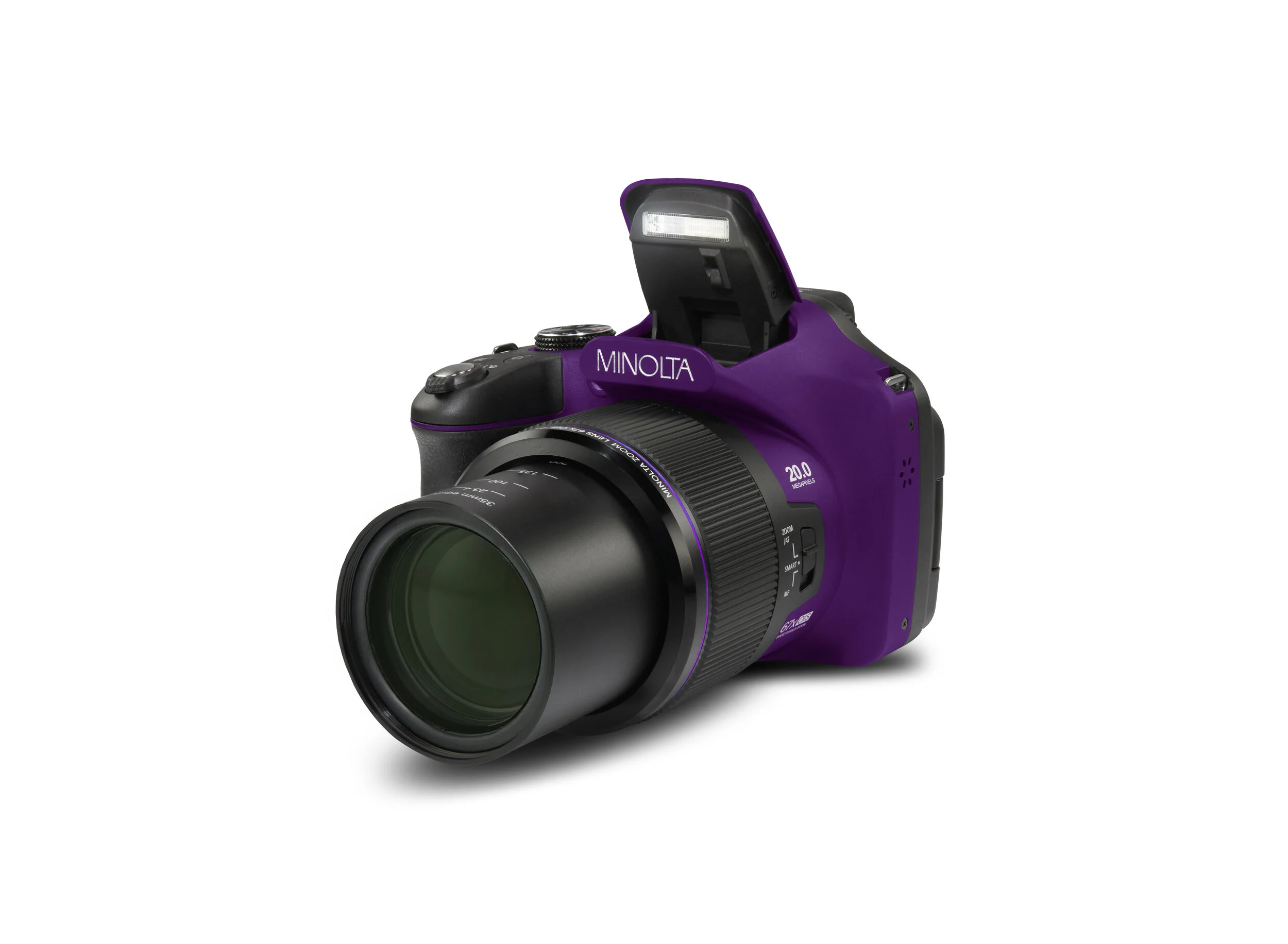
Minolta MN67Z: best current Minolta for long zoom
The MN67Z is a fixed-lens bridge camera, not a DSLR. Its real advantage is reach: the 67x optical zoom covers a 24 to 1568mm equivalent range, supported by optical image stabilization. The camera uses a native 20MP 1/2.3-inch BSI sensor and records Full HD video at up to 30fps.
The MN67Z is the clearest current Minolta choice for daylight wildlife, distant travel details, aircraft, or backyard subjects when changing lenses is undesirable. It does not make it a substitute for an interchangeable-lens camera in low light. At the long end, atmospheric haze, camera shake, and the relatively slow maximum aperture can all reduce detail; a monopod or firm support helps.
Buy it if: maximum optical reach in one simple body is the priority.
Skip it if: you want strong low-light quality, fast action autofocus, RAW flexibility, or 4K video. Our best zoom camera guide covers stronger alternatives.
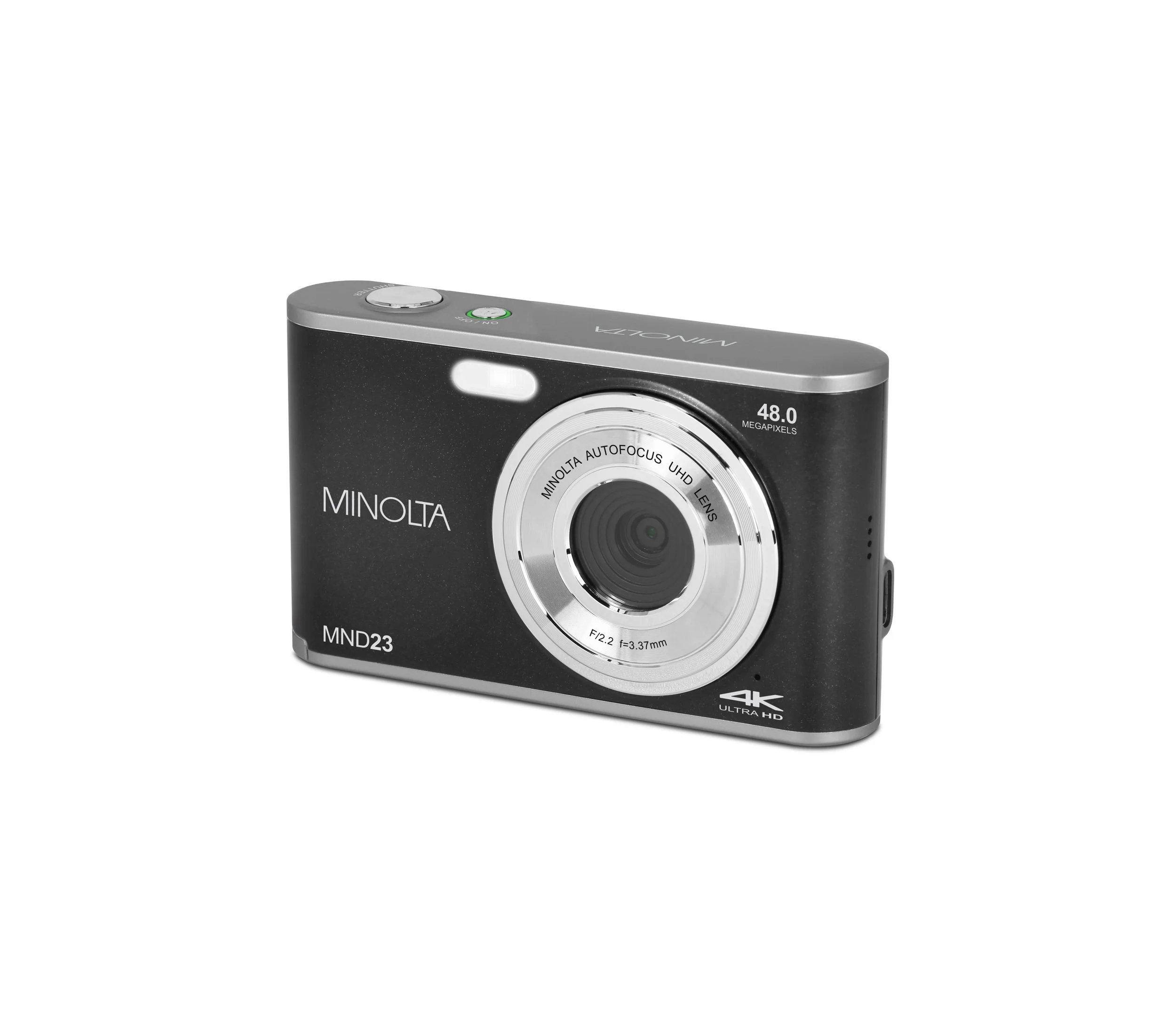
Minolta MND23: a basic selfie compact, not a phone upgrade
The MND23 is built around convenience: front and rear cameras, autofocus, a flip-up screen, and a small body. Its specification sheet lists 13MP native sensors but a 48MP still-image output. Those larger files are interpolated. They do not contain the fine detail captured by a native 48MP sensor.
The advertised 4K mode is also limited to 10fps, which is too choppy for ordinary moving video. There is no optical zoom, only digital enlargement. The MND23 can still suit a child, a casual user who wants a separate camera, or someone who values the flip screen more than image quality, but most recent US smartphones are the safer everyday imaging tool.
Buy it if: you specifically want a very simple standalone selfie camera.
Skip it if: “48MP” or “4K” is the reason you are considering it.
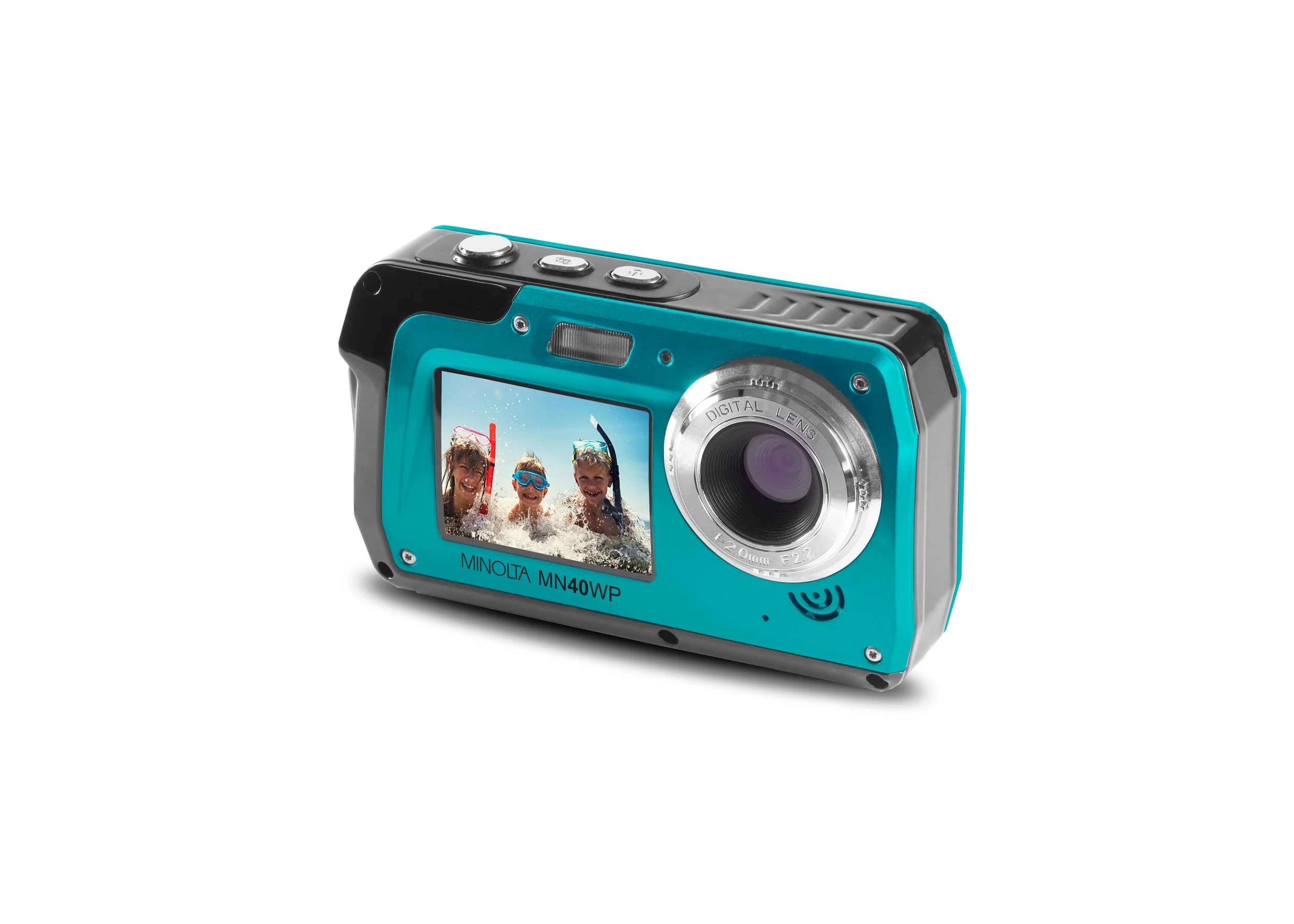
Minolta MN40WP: best only for inexpensive waterproof use
The MN40WP is useful because it can go where an unprotected phone should not. It is rated waterproof to 10 feet and has both rear and front screens, which helps with pool, beach, and family selfies. It records up to 2.7K/30 video and, like the MND23, creates 48MP output from a native 13MP sensor.
The limitations are substantial: the lens is fixed-focus, zoom is digital rather than optical, and its small sensor is least comfortable in dim underwater light. Treat it as an inexpensive splash-and-shallow-water camera, not a dive camera or a premium rugged compact. Check the battery/card-door seal carefully before every use and follow the manual’s care instructions after salt water.
Buy it if: low-cost waterproofing matters more than image quality.
Skip it if: you need depth, reliable close focus, or serious underwater results. Compare it with the purpose-built options in our underwater camera guide.

What about the newer Minolta MN68Z?
The MN68Z specification sheet is more ambitious: Minolta lists a 68x optical zoom, 20MP native sensor, optical stabilization, 4K/30 recording, RAW support, an electronic viewfinder, and a vari-angle screen. Those are meaningful upgrades over the MN67Z.
However, availability and reliable retail history are still too thin for us to make it the default recommendation or attach an unverified Amazon product. It is one to watch, not a reason to ignore a better-established alternative. We will add a full product recommendation when an exact US listing and enough independent evidence are available.
Best vintage Minolta film cameras
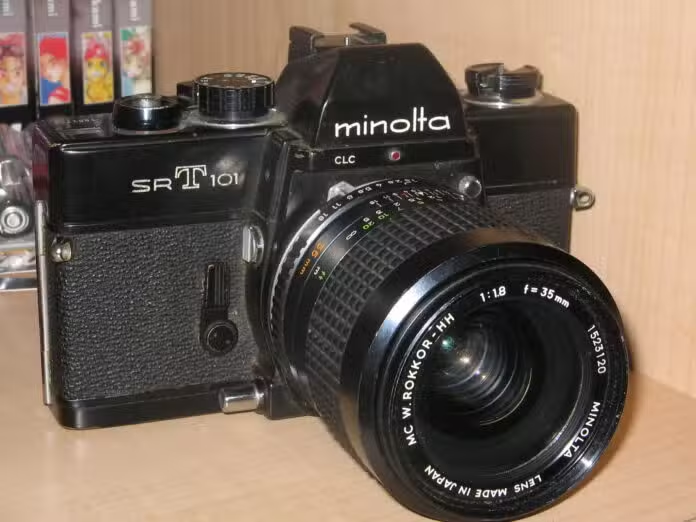
Minolta SR-T 101: best for learning the fundamentals
The SR-T 101 is the strongest starting point for someone who wants a traditional, tactile 35mm SLR. Its shutter is mechanical, so the camera can operate without a battery; the battery powers the meter. It accepts Minolta SR-mount manual-focus lenses, including the many MC and MD Rokkor lenses buyers commonly see online.
Its strengths are simplicity, direct controls, a broad lens supply, and repair familiarity. Its drawbacks are weight and age. The original meter was designed around a discontinued mercury battery, so verify that the meter has been serviced, calibrated for a modern replacement, or use an external meter. Do not assume an inaccurate meter means the mechanical camera is unusable.
Best for: students, deliberate manual shooting, and buyers who want fewer electronics.
Check before buying: shutter behavior at every speed, meter response, light seals, film transport, lens fungus, and aperture operation.
Minolta X-700: best for convenient classic shooting
The X-700 is popular because it can grow with the photographer. It offers Program mode, aperture-priority, and manual exposure in a smaller, lighter body than an SR-T. Program operation is best paired with compatible MD lenses, while the wider SR-mount family remains useful in other modes.
It is not a mechanical, all-metal tank. The shutter is electronically controlled and requires batteries, and failed capacitors are a familiar age-related fault. A tested body with proof of service is worth more than a cosmetically perfect, untested example.
Best for: beginners who want automation without losing manual control.
Check before buying: whether the shutter fires consistently, LEDs respond correctly, meter readings are plausible, and the advance/rewind mechanisms feel smooth.
Minolta XD-11: best refined manual-focus body
Known as the XD in some markets, the US-market XD-11 combines a compact body with aperture-priority, shutter-priority, and manual modes. It feels more sophisticated than the SR-T series and is an appealing home for quality Rokkor glass.
The XD-11 relies on electronics, so condition matters more than reputation: verify the meter, shutter timing, mode changes, seals, and battery compartment. For someone who wants maximum repair simplicity, the SR-T remains safer.
Minolta Maxxum 7000: best entry to autofocus Minolta
The Maxxum 7000 is historically important as an early successful autofocus SLR with an integrated AF system. It uses Minolta A-mount lenses rather than the older manual-focus SR/MC/MD mount. It can be an inexpensive route into autofocus film photography.
Its 1980s autofocus is slow beside a modern camera, and electronics, LCD condition, battery contacts, and grip deterioration deserve close inspection. Some later Sony A-mount bodies can use Minolta AF lenses, but current Sony E-mount mirrorless cameras need a compatible adapter; autofocus support varies by lens, body, and adapter. See our Sony DSLR lens guide before building a mixed Minolta/Sony kit.
Minolta CLE: a specialist choice, not the default
The CLE is a compact M-mount rangefinder associated with the excellent M-Rokkor lenses. It is attractive for travel and street photography, but it belongs to a different lens system from Minolta SLRs and commands collector interest. Battery-dependent electronics, rangefinder alignment, and limited service options make it a poor impulse buy. Choose it only if you specifically want the CLE experience and can verify its condition.
Are old Minolta digital cameras worth buying?
The Konica Minolta Maxxum 7D and 5D, and cameras such as the DiMAGE A2, can be enjoyable pieces of early-digital history. The 7D is especially notable for its controls, in-body stabilization, and A-mount compatibility. None is a practical substitute for a current camera for most readers.
Expect limited resolution, older autofocus, weaker high-ISO output, legacy cards or batteries, and uncertain repair support. Buy one for its handling, rendering, collection value, or an existing lens kit. An old flagship badge does not guarantee current performance.
Minolta lens mounts explained
| Mount/system | Typical cameras | What fits | Important compatibility note |
|---|---|---|---|
| SR mount (often described as MC/MD) | SR-T 101, X-700, XD-11 | Manual-focus Minolta SR lenses | MC and MD describe generations/couplings, not three unrelated mounts |
| A-mount / Maxxum | Maxxum 7000, Maxxum 7D | Minolta AF and compatible Sony A-mount lenses | Sony E-mount bodies require an adapter; features vary |
| M-mount | Minolta CLE | M-Rokkor and compatible M-mount lenses | Separate from both SR and A-mount systems |
| Current MN-series | MN67Z, MND23, MN40WP | Fixed lens | No compatibility with vintage Minolta lenses |
Vintage Minolta SR lenses can be attractive on mirrorless cameras because simple adapters preserve infinity focus, but they remain manual-focus lenses and usually need manual aperture control. An adapter does not turn them into native autofocus lenses.
How to buy a used Minolta without regret
- Choose the system first. SR-mount, A-mount, and M-mount are not interchangeable.
- Prioritize a tested camera. “Untested” normally means the buyer accepts the risk, not that the camera probably works.
- Test every shutter speed. Listen for obvious irregularities and check that the shutter does not hang.
- Inspect the film path. Check advance, rewind, pressure plate, take-up spool, counter, and light seals.
- Inspect lenses with a light. Look for haze, fungus, separation, scratches, oil on aperture blades, and stiff focus.
- Check all electronics. Meter, display, battery contacts, autofocus, stabilization, and mode controls can turn a bargain into a repair project.
- Value service evidence. A credible recent service receipt is more useful than vague claims such as “mint” or “works great.”
- Use buyer protection. A return window matters when remote testing is impossible.
Final verdict
Minolta remains a good name to explore, but not one recommendation. For classic film photography, the SR-T 101 and X-700 are the most sensible entry points, with the XD-11 offering a more refined experience and the Maxxum 7000 covering autofocus. Buy all of them by condition.
Among current licensed cameras, the MN67Z has the clearest purpose because its 67x optical zoom offers genuine reach. The MND23 is a basic selfie compact, while the MN40WP is a low-cost waterproof tool. Neither should be bought merely because its output specification says “48MP.”
Frequently asked questions
Is Minolta a good camera brand?
Original Minolta film cameras and lenses earned a strong reputation, and good examples remain rewarding. Current licensed Minolta digital cameras vary by model and should be judged on their actual specifications, not the vintage brand reputation.
Which Minolta film camera is best for beginners?
Choose the SR-T 101 to learn fully manual exposure with a mechanical shutter, or the X-700 if you want Program and aperture-priority modes. In either case, condition matters more than a small difference in model prestige.
Can Minolta lenses fit Sony cameras?
Minolta A-mount autofocus lenses fit Sony A-mount bodies. Sony E-mount mirrorless bodies require a suitable adapter, and autofocus compatibility varies. Older manual-focus SR/MC/MD lenses need a different simple adapter.
Are current Minolta digital cameras made by the original Minolta company?
No. Konica Minolta left the camera business in 2006. Current Minolta Digital cameras are made and sold under a licensed trademark arrangement.
Why are some Minolta cameras advertised as 48MP?
On models such as the MND23 and MN40WP, 48MP refers to the output file while the published native sensor resolution is 13MP. Interpolation increases file dimensions but cannot create the same captured detail as a native 48MP sensor.