

If you are shopping for the best digital camera under $100 in 2026, the most useful answer is not a long list of pretend bargains. It is this: under $100 is now a difficult camera budget, and you have to buy with your eyes open.
I still think this page matters. Not because a $70 compact camera is going to beat a modern phone, and not because the affiliate commission is exciting. It matters because a lot of people searching this topic are trying to solve a real problem: they want a simple camera with optical zoom, physical buttons, no phone plan, no apps, and no $600 mistake.
I have taught beginners who learned composition on cameras cheaper than a dinner for two. I have also seen people waste money on fake-spec Amazon cameras that promise 4K, 64MP, and “professional” results for $59. The goal of this guide is to keep you on the right side of that line.
Quick Answer: What Is the Best Digital Camera Under $100?
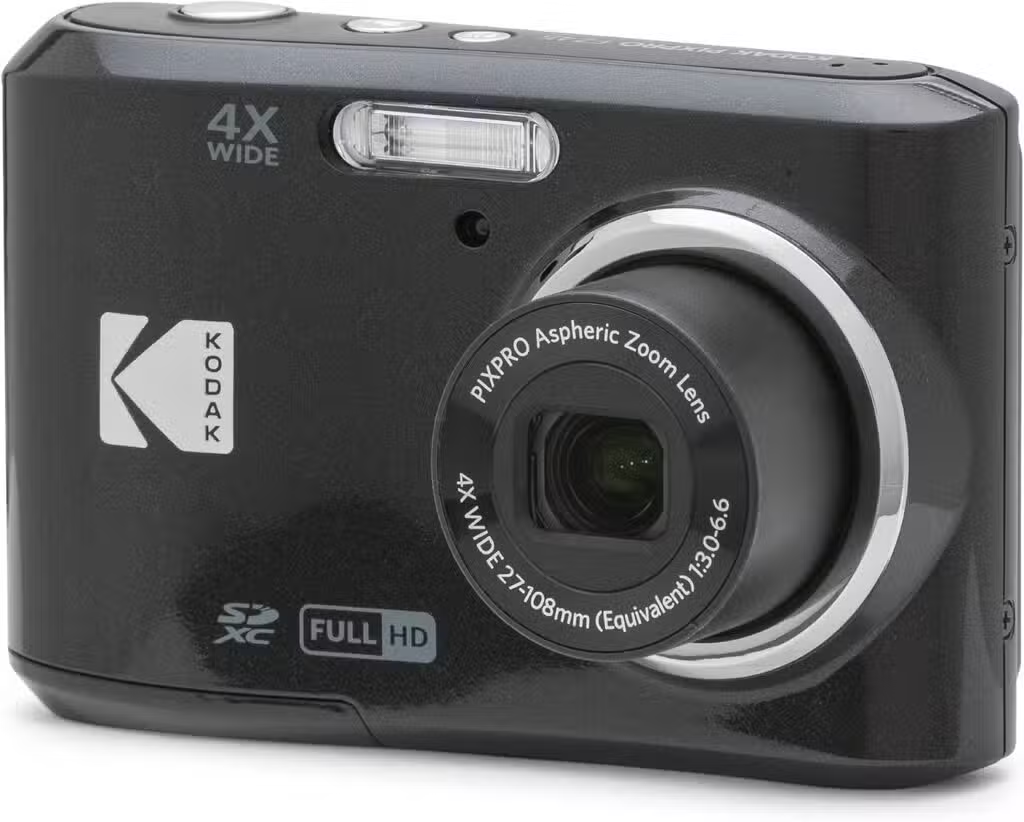
For most people, the safest answer is the Kodak Pixpro FZ45 if you can find it at or near $100. It is basic, but it is a real point-and-shoot camera from a recognizable camera line, with 4x optical zoom, 1080p video, a simple interface, and AA battery power.
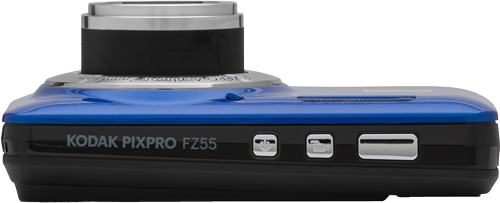
If the Kodak Pixpro FZ55 drops close to your budget, I prefer it for most adults because it is slimmer, uses a rechargeable lithium-ion battery, and has a slightly longer 5x zoom. The catch is price: in 2026, the FZ55 often sells above a strict $100 limit, especially during the renewed compact-camera trend.
The Sony Cyber-shot DSC-W800 is the compact used/refurbished option I would still consider, mainly because it is pocketable, has a 5x optical zoom, and benefits from Sony’s competent JPEG processing. But do not overpay for it. It is an old small-sensor compact, not a hidden professional camera.
My practical rule: if the Kodak FZ45, Kodak FZ55, or Sony W800 is not available at a sensible price, do not panic-buy a no-name “4K” camera. Either buy used from a reputable seller or stretch to the under-$200 camera range, where the choices become less compromised.
Best New and Used Picks Under $100
Prices move constantly, so treat the affiliate boxes below as current-price checks, not promises that every model will always sit below $100. If the price is too high, wait, buy used/refurbished, or move up one budget tier.
What $100 Actually Buys You in 2026
A $100 camera budget usually means one of three things:
- A very simple new compact from Kodak’s Pixpro line.
- An older used or refurbished compact from Sony, Canon, Nikon, or Panasonic.
- A no-name Amazon camera with inflated specifications and disappointing image quality.
The third category is where most people get burned. A camera can claim 48MP or 64MP and still produce worse files than an old 12MP compact if the lens, sensor, processing, and autofocus are poor.
At this price, I care much more about these things:
- Real optical zoom: 4x or 5x optical zoom is more useful than a fake 16x digital zoom claim.
- Known camera brand: Kodak Pixpro, Sony, Canon, Nikon, Panasonic, or Fujifilm used/refurbished.
- Simple controls: The best budget camera is the one a beginner can use without fighting menus.
- Return window: Budget cameras have more quality variation. You need time to test it.
- Battery practicality: AA batteries are convenient for travel; lithium batteries are cleaner for daily use.
Do not buy a sub-$100 camera expecting clean indoor images, fast sports autofocus, cinematic video, or big prints. Buy one because you want a simple dedicated camera with optical zoom and low financial risk.
1. Kodak Pixpro FZ45: Best Strict-Budget Pick
The Kodak Pixpro FZ45 is the first camera I would check if your budget is truly close to $100 and you want a new camera rather than used gear. It is not fancy. That is part of the appeal.
The FZ45 gives you a 16MP small sensor, 4x optical zoom, a 27mm wide-angle starting point, 1080p video, face detection, a 2.7-inch screen, and AA battery power. The AA batteries are not glamorous, but they are practical. If this camera is for a child, a grandparent, a school trip, or a travel backup, being able to buy batteries almost anywhere is a real advantage.
The FZ45 makes the most sense in good light: family days out, parks, vacations, school projects, garden photos, casual travel, and simple documentary shooting. In bright conditions, the photos are perfectly usable for sharing, small prints, and memories.
Where it struggles is predictable: dim rooms, fast-moving kids indoors, night scenes, and anything where you expect modern smartphone-style processing. The autofocus is basic, the screen is basic, and image stabilization is limited. If you accept those limits, it can be a genuinely useful cheap camera.
Buy the FZ45 if: your budget is strict, you want a simple new camera, AA batteries are a plus, and you mainly shoot outdoors.
Skip it if: you want strong video, low-light performance, Wi-Fi, or a camera that feels premium.
For more detail, see the dedicated Kodak Pixpro FZ45 review.
2. Kodak Pixpro FZ55: Best If You Can Stretch or Find a Sale
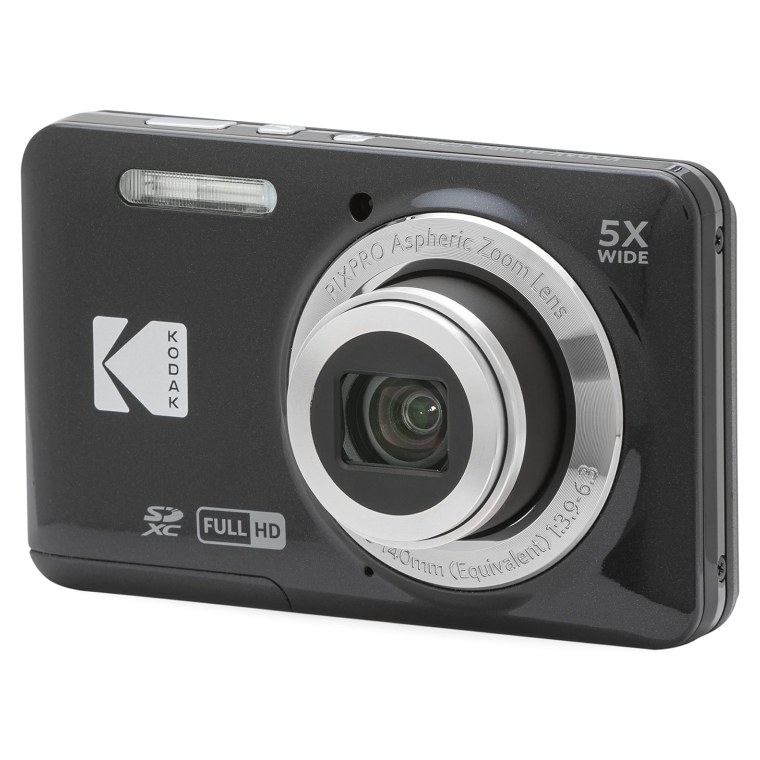
The Kodak Pixpro FZ55 is the camera I would rather hand to most adults if the price is close enough. It is slimmer than the FZ45, uses a rechargeable lithium-ion battery, and gives you a 5x optical zoom instead of 4x. It still uses a small 16MP sensor, but the overall package feels more like a proper pocket compact.
The reason I am careful about recommending it on an under-$100 page is price. The FZ55 has become popular again with people chasing the compact digital camera look, and that demand can push it well above the old budget-camera range. When it is overpriced, I would not call it a bargain. When it is near $100, it is one of the easiest compact cameras to recommend.
The FZ55 is best for daylight travel, casual portraits, family snapshots, and anyone who wants a pocketable camera that feels less toy-like than the cheapest options. Its 28-140mm equivalent range is useful for everyday shooting: wide enough for travel scenes, long enough for tighter portraits and details.
Like the FZ45, it is not a low-light camera. It is also not a vlogging camera in the modern sense. The 1080p video is fine for short clips, but there is no flip screen, no mic input, and no serious stabilization.
Buy the FZ55 if: you find it close to $100, you prefer rechargeable batteries, and you want the more polished Kodak compact.
Skip it if: it is priced like a better used camera. At that point, move up to a stronger used compact or mirrorless body.
For a direct breakdown, read the Kodak Pixpro FZ55 review or the Kodak FZ45 vs FZ55 comparison.
3. Sony Cyber-shot DSC-W800: Best Used Pocket Option
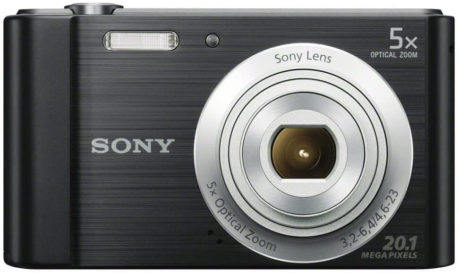
The Sony Cyber-shot DSC-W800 is old, but it still has a place in this guide if you find it used, refurbished, or discounted at a sensible price. Sony lists it with a 20.1MP Super HAD CCD sensor, a 5x optical zoom lens, and a 26-130mm equivalent zoom range. That is a useful little travel range for a camera that can disappear into a pocket.
The best reason to consider the W800 is not the 20.1MP number. On a tiny sensor, megapixels are not magic. The better reason is that Sony’s basic image processing and autofocus behavior are usually more predictable than the random no-name cameras flooding budget search results.
In daylight, the W800 can produce clean enough files for family photos, travel snapshots, eBay listings, and social sharing. The 5x optical zoom gives you a real advantage over phone digital zoom when photographing signs, distant details, kids at a playground, or travel scenes where you cannot physically move closer.
The limitations are obvious: 720p video, an old screen, old battery system, limited low-light quality, and no modern connectivity. I would not pay collector-style prices for it. But if you find a clean unit with a return window, it is still a safer buy than many anonymous budget cameras.
Buy the Sony W800 if: you want the smallest serious option here and you can find it used or refurbished from a reputable seller.
Skip it if: the price climbs above what a basic old compact deserves.
4. Used Canon, Nikon, Panasonic, and Fujifilm Compacts: Best Treasure-Hunt Option
If I had $100 cash and time to shop carefully, I would also look at used compact cameras from Canon, Nikon, Panasonic, and Fujifilm. This is where you can occasionally beat the new budget cameras.
Older Canon PowerShot ELPH models, Nikon Coolpix A-series and S-series cameras, Panasonic Lumix FH/SZ/ZS models, and Fujifilm FinePix compacts can be excellent cheap buys if they are clean, working, and sold with a battery and charger.
The risk is condition. A used compact camera can have dust inside the lens, a weak battery, a scratched screen, a sticky zoom mechanism, or a charger missing from the box. That is why I prefer sellers with return windows: Amazon Renewed, B&H Used, KEH, Adorama Used, or a local camera store that will let you test the camera.
If you buy used, test these things immediately:
- Zoom from wide to telephoto several times.
- Take photos at wide angle and full zoom.
- Check the corners of the photo for blur or dark spots.
- Record a short video clip.
- Test flash, battery charging, memory card writing, and playback.
- Make sure the lens retracts smoothly when powered off.
A good used compact can be the best digital camera under $100. A bad used compact is just someone else’s problem in your drawer.
5. Kids Cameras and Toy Cameras: Only for Very Young Children
Some people searching for a digital camera under $100 are really shopping for a child. If the child is five, six, or seven years old, a toy-style kids camera can make sense. They are built to be dropped, they are easy to hold, and the stakes are low.
For an older child who is genuinely interested in photography, I would rather buy the Kodak FZ45 or a used name-brand compact. A toy camera teaches button pressing. A real compact teaches framing, patience, zoom discipline, and timing.
The difference matters. A child who learns to wait for better light, hold the camera steady, and compose a cleaner frame is learning photography. A child who only uses novelty filters is mostly playing with a gadget. There is nothing wrong with that, but it is a different purchase.
Cameras I Would Avoid Under $100
The danger zone in this market is not the honest cheap camera. It is the overpromised cheap camera.
I would be very cautious with listings that lead with claims like:
- “64MP 4K digital camera” from a brand you have never heard of.
- Huge digital zoom numbers without real optical zoom.
- Hundreds of suspiciously similar five-star reviews.
- Product photos that show a DSLR-style camera but specs that describe a toy compact.
- No clear warranty, no real brand website, and no reliable support.
Some of these cameras are not scams in the legal sense. They do turn on. They do take pictures. But the image quality, autofocus, color, menus, and durability are often so poor that a used 10-year-old Canon or Sony would be a better photographic tool.
Also be careful with cheap action cameras if your real goal is still photos. Many sub-$100 action cameras use wide lenses, weak stabilization, poor audio, and mediocre still-photo quality. If you need an action camera, a used GoPro is usually a smarter target.
Budget Camera vs Smartphone: The Honest Comparison
Your phone probably wins in more situations than a $100 compact camera.
A recent iPhone, Pixel, or Samsung phone will usually give you better low-light images, better HDR, better video, faster sharing, better screen visibility, and smarter processing. That is not a moral failure of cheap cameras. It is just what computational photography has done.
The cheap camera still wins in a few specific situations:
- Optical zoom: a real 4x or 5x zoom beats phone digital zoom on many budget phones.
- Dedicated device: no notifications, apps, storage alerts, or phone distractions.
- Physical buttons: easier for some seniors, kids, and glove-wearing travelers.
- Lower risk: losing or damaging a cheap camera hurts less than damaging a flagship phone.
- Learning: a simple camera can make beginners think more about framing and timing.
If you already own a good modern phone and only shoot indoors, do not buy one of these cameras for better image quality. Buy one if you specifically want the camera experience, optical zoom, simplicity, or separation from your phone.
Best Uses for a Digital Camera Under $100
A cheap digital camera can still be the right tool when the job is realistic.
Travel backup camera
For bright daytime travel, a small compact can be useful when you do not want to drain your phone battery or risk your main camera. It is especially useful for kids on trips, grandparents, and anyone who likes a dedicated device.
Camera for seniors
Many seniors do not want cloud storage, camera apps, or phone gestures. They want a power button, a zoom lever, and a shutter button. For that audience, simplicity is not a weakness. It is the feature.
If that is your use case, also read the guide to digital cameras for seniors.
First camera for kids
For a child old enough to care about real photos, the FZ45 is more educational than a toy camera. The optical zoom teaches framing, and the limitations teach steady hands and good light.
School projects and documentation
A cheap dedicated camera can be useful for classrooms, clubs, workshops, scouting, inventory photos, craft documentation, and simple product photos where convenience matters more than artistic image quality.
Learning photography basics
You can learn composition, light direction, backgrounds, timing, and storytelling with almost any camera. You will not learn advanced manual exposure on most of these models, but you can absolutely learn how to see.
When You Should Spend More Than $100
Budget ladder: under $100 is useful for simple compacts, kids, and no-phone situations, but it is not the sweet spot for image quality. If you can stretch, look at the best cameras under $400 for stronger point-and-shoot options, or the best cameras under $700 if you want a real camera system instead of a disposable-feeling budget pick.
There are times when forcing the budget under $100 is false economy.
Spend more if you need:
- Good indoor image quality.
- Reliable sports or pet autofocus.
- 4K video that actually looks good.
- A flip screen for vlogging.
- Manual controls for learning exposure seriously.
- A camera you expect to use heavily for several years.
The jump from $100 to $200 is often bigger than the jump from $200 to $300 in practical value. If you can stretch, that next tier gives you more room to buy something that feels less compromised.
My Buying Checklist
Before buying any under-$100 camera, run through this checklist:
- Does it have real optical zoom, not just digital zoom?
- Is the brand recognizable or at least well documented?
- Can you return it if the lens, battery, or screen is defective?
- Does it include the correct battery, charger or cable, and memory card requirements?
- Are sample photos from real buyers acceptable in daylight?
- Are you buying it for the right reason: simplicity, zoom, low risk, or learning?
If the answer to those questions is yes, a cheap camera can be a perfectly reasonable purchase. If you are hoping for phone-beating image quality, you are likely to be disappointed.
Frequently Asked Questions
What is the best digital camera under $100 in 2026?
The Kodak Pixpro FZ45 is the safest strict-budget pick when it is available near $100. The Kodak Pixpro FZ55 is better for many adults if you can find it close to that price, but it often sells above a strict $100 budget.
Is a $100 digital camera better than a phone?
Usually not for overall image quality. A modern phone will often win for low light, HDR, video, and sharing. A $100 camera can still be better for optical zoom, physical buttons, simplicity, and giving kids or seniors a dedicated device.
Should I buy a used camera under $100?
Yes, if you buy from a seller with a return window and test it immediately. Used Canon, Sony, Nikon, Panasonic, and Fujifilm compacts can be better than many new no-name cameras, but condition matters.
Are cheap 4K digital cameras on Amazon worth it?
Be careful. Many cheap cameras use inflated specifications and weak sensors, lenses, and processing. I would rather buy a simple Kodak Pixpro or a used Sony/Canon compact than a no-name camera making huge claims for a very low price.
What should I look for in a cheap digital camera?
Prioritize real optical zoom, a known brand, simple controls, a return window, and a battery system that fits how you will use the camera. Ignore huge digital zoom and megapixel claims.
Is the Kodak FZ45 or FZ55 better?
The FZ45 is better for strict budgets and AA battery convenience. The FZ55 is slimmer, has 5x zoom, and uses a rechargeable lithium-ion battery, so I prefer it when the price is close enough. See the dedicated FZ45 vs FZ55 comparison for more detail.
Can I use a camera under $100 for YouTube or vlogging?
I would not. The video quality, autofocus, stabilization, audio, and screen design are too limited. A phone or used creator-focused camera will be much better.
Can these cameras print good photos?
In good daylight, small prints such as 4×6 and 5×7 can look fine. Some 8×10 prints may be acceptable if the image is sharp and shot at low ISO. Do not expect large, detailed wall prints.
Final Verdict
The best digital camera under $100 is not the one with the biggest number on the box. It is the one that solves a specific problem without lying to you.
For a strict budget, start with the Kodak Pixpro FZ45. If the Kodak Pixpro FZ55 is close in price, I would usually take the FZ55 for adults and travel. If you are comfortable buying used, a clean Sony W800 or older Canon/Nikon/Panasonic compact can still make sense.
But the real win is avoiding the trap: do not buy a no-name camera because it promises impossible specs. Under $100, honesty matters more than hype. A modest camera that takes simple photos reliably is far better than a flashy listing that disappoints the first time you use it indoors.