
If you’ve invested in a Sony mirrorless camera, you’ve probably realized the lens selection can feel overwhelming. The sony e mount lenses list has expanded dramatically since the system launched, and navigating through hundreds of options requires more than just scrolling through spec sheets. I’ve spent years testing these lenses across different shooting scenarios, and understanding the landscape helps you make smarter choices whether you’re shooting landscapes, portraits, wildlife, or anything in between.
Contents
- Understanding the Sony E-mount ecosystem
- First-party Sony lenses worth considering
- Prime lenses in the E-mount catalog
- Zoom lenses across the focal range
- Third-party alternatives expanding your options
- Specialty lenses for creative control
- Building your lens kit strategically
- Autofocus performance across the lineup
- Image quality considerations beyond sharpness
- Weight and size trade-offs
- Weather sealing and build quality
- Adapting lenses from other systems
- Future-proofing your investment
- Making informed purchasing decisions
Understanding the Sony E-mount ecosystem
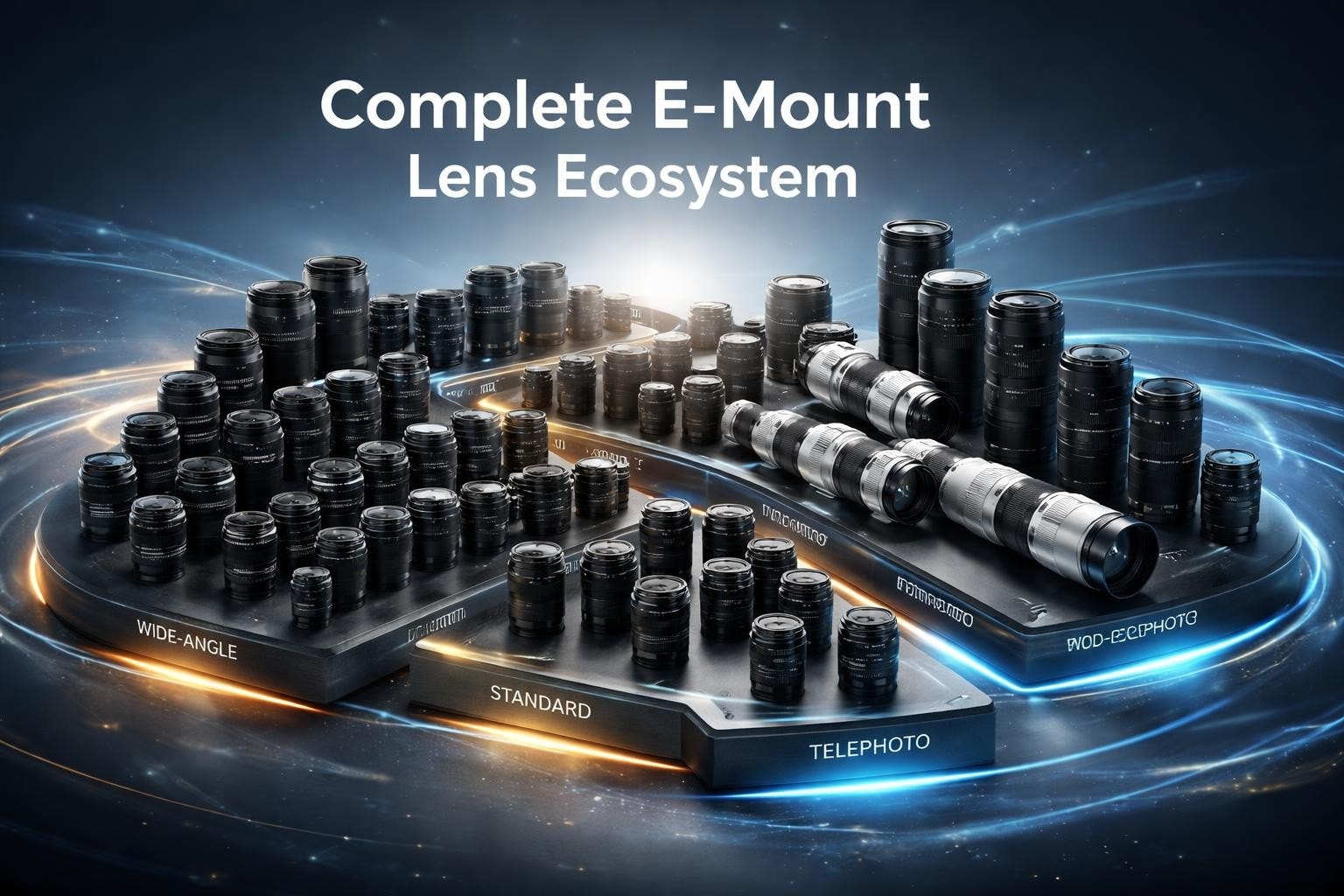
Sony created the E-mount system in 2010, and it has grown into one of the most versatile lens platforms available today. The mount serves both full-frame (FE) and APS-C (E) cameras, which means compatibility can get confusing if you don’t know the distinction.
Full-frame versus APS-C lenses
Full-frame FE lenses work on any E-mount camera, whether it’s a full-frame A7 series or an APS-C body like the A6700. APS-C E lenses, however, are designed for the smaller sensor and will trigger crop mode on full-frame cameras. This matters because you might save money on APS-C glass, but you’ll limit your future upgrade path.
The image circle difference explains this perfectly. FE lenses project a larger circle to cover the full-frame sensor, while E lenses project just enough for the smaller APS-C sensor. When you mount an E lens on a full-frame body, the camera automatically crops down to avoid vignetting, essentially turning your 24-megapixel sensor into a 10-megapixel one.
Key differences to remember:
- FE lenses work universally across the E-mount system
- E lenses are typically smaller and lighter
- E lenses cost less but limit full-frame use
- Third-party manufacturers often specify compatibility clearly
First-party Sony lenses worth considering
Sony divides their sony e mount lenses list into distinct quality tiers that reflect both price and performance. Understanding these categories helps you match your budget to your needs without overspending or compromising too much.
G Master series: Professional performance
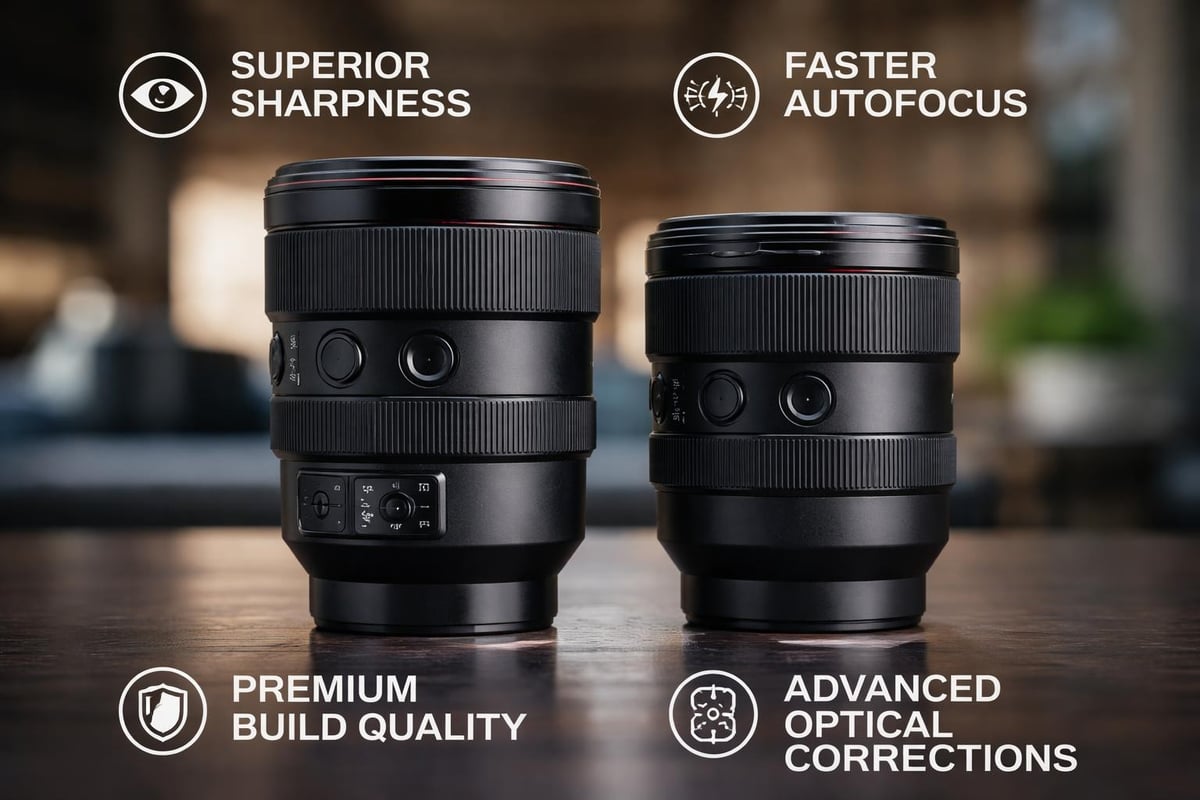
The GM lineup represents Sony’s flagship glass. These lenses deliver exceptional sharpness, fast autofocus, and premium build quality. The Sony FE 24-70mm F2.8 GM exemplifies this tier, offering weather sealing, near-perfect optical performance, and reliable construction that withstands professional use.
I’ve used the 85mm f/1.4 GM extensively for portrait work, and the bokeh quality genuinely separates it from cheaper alternatives. That said, you’re paying a premium for these advantages, often double or triple the cost of G-series equivalents.
G series lenses: Balancing quality and value
The G designation sits between GM and consumer-grade options. These lenses sacrifice some ultimate sharpness and build robustness but maintain excellent optical quality for most photographers. The Sony FE 200-600mm F5.6-6.3 G OSS proves this point perfectly, delivering professional-level wildlife performance at roughly half the cost of exotic super-telephoto primes.
| Lens Category | Typical Price Range | Build Quality | Optical Performance | Best For |
|---|---|---|---|---|
| G Master | $1,800 – $3,000+ | Exceptional | Outstanding | Professionals, demanding enthusiasts |
| G Series | $800 – $1,800 | Very Good | Excellent | Advanced hobbyists, semi-pros |
| Standard | $300 – $800 | Good | Good to Very Good | Beginners, budget-conscious shooters |
Standard Sony lenses for everyday shooting
Sony’s entry-level lenses don’t carry letter designations but still deliver solid performance. The Sony E 35mm F1.8 OSS has been a staple for APS-C shooters since its release, offering excellent sharpness and optical stabilization in a compact package.
These lenses work perfectly for photographers building their first kit or those prioritizing portability over ultimate performance. The compromises typically show up in slower autofocus, more plastic construction, and slightly softer corners rather than catastrophic image quality issues.
Prime lenses in the E-mount catalog
Prime lenses form the backbone of many photographers’ kits because they offer superior image quality and faster apertures compared to zooms. The sony e mount lenses list includes dozens of prime options across every focal length you might need.
Wide-angle primes for landscapes and architecture
Popular wide-angle choices:
- Sony FE 20mm f/1.8 G: Compact, sharp, perfect for astrophotography
- Sony FE 24mm f/1.4 GM: Premium option with exceptional corner sharpness
- Sigma 14-24mm f/2.8 DG DN Art: Actually a zoom, but worth mentioning for its performance
- Samyang 14mm f/2.8: Budget-friendly manual focus option
I’ve found wide-angle primes particularly valuable for real estate and landscape work where distortion control matters. The Sony 20mm f/1.8 G handles coma better than most alternatives, keeping stars sharp across the frame during night sky photography.
Standard and portrait primes
The 35mm, 50mm, and 85mm focal lengths dominate this category. These lenses suit everything from street photography to environmental portraits to documentary work. The Sony 50mm f/1.8 serves as the default recommendation for photographers wanting a fast, affordable normal lens, though it lacks optical stabilization.
For portrait specialists, the 85mm f/1.8 and 85mm f/1.4 GM represent two paths to beautiful subject isolation. The f/1.8 version costs about $600 and delivers 90% of the performance, while the GM version runs nearly $1,800 but offers that extra refinement in bokeh rendering and edge sharpness.
Telephoto primes for specialized work
Long prime lenses typically serve wildlife, sports, and specialized portrait photographers. Sony’s 400mm f/2.8 GM OSS costs over $12,000, positioning it firmly in the professional category. More accessible options include the 135mm f/1.8 GM, which creates stunning compression and background separation for headshots and detail work.
Zoom lenses across the focal range
Zooms sacrifice maximum aperture and slight optical performance compared to primes, but the convenience factor often outweighs these compromises. The sony e mount lenses list contains numerous zoom options from ultra-wide to super-telephoto.
Standard zoom lenses
Essential standard zooms:
- Sony FE 24-70mm f/2.8 GM: Professional workhorse
- Tamron 28-75mm f/2.8 Di III RXD: Budget-friendly alternative
- Sony FE 24-105mm f/4 G OSS: Extended range versatility
- Sigma 24-70mm f/2.8 DG DN Art: Third-party quality option
The 24-70mm focal range handles approximately 70% of general photography situations. I keep a 24-70mm mounted on one camera body during events because it eliminates constant lens swapping. The recent Samyang/Rokinon AF 24-60mm f/2.8 FE offers an interesting middle ground, sacrificing just 10mm of reach for significant size and weight reduction.

Telephoto zoom options
Telephoto zooms extend your reach for wildlife, sports, and distant subjects. The best 70-200mm telephoto zoom lenses category remains competitive in 2026, with options from Sony, Sigma, and Tamron all delivering excellent results.
| Lens | Aperture | Weight | Approximate Price | Best Feature |
|---|---|---|---|---|
| Sony FE 70-200mm f/2.8 GM II | f/2.8 | 1,045g | $2,800 | Ultimate sharpness |
| Tamron 70-180mm f/2.8 Di III VXD | f/2.8 | 810g | $1,200 | Compact size |
| Sony FE 70-200mm f/4 G OSS | f/4 | 840g | $1,500 | Lighter alternative |
| Sigma 100-400mm f/5-6.3 DG DN OS | f/5-6.3 | 1,135g | $950 | Extended reach |
Ultra-wide and superzoom versatility
Ultra-wide zooms like the Sony FE 12-24mm f/2.8 GM serve specialized needs in architectural and interior photography. These lenses manage distortion remarkably well considering their extreme field of view, though you’ll pay premium prices for this capability.
Superzoom lenses sacrifice image quality for convenience. The Sony E 18-200mm F3.5-6.3 OSS covers everything from moderate wide-angle to telephoto on APS-C cameras, making it ideal for travel when carrying multiple lenses isn’t practical. Just don’t expect GM-level sharpness, especially at the long end.
Third-party alternatives expanding your options
The sony e mount lenses list extends far beyond Sony’s own offerings. Third-party manufacturers have embraced the mount enthusiastically, producing excellent alternatives that often undercut Sony’s pricing significantly.
Sigma Art series lenses
Sigma’s Contemporary and Art lines have won significant market share from photographers seeking quality at reasonable prices. Their 35mm f/1.4 DG DN Art rivals the Sony GM version optically while saving you about $600. The build quality feels solid, autofocus performs reliably on modern Sony bodies, and the optical performance justifies the investment.
The Sigma 14-24mm f/2.8 DG DN Art deserves special mention because Sony doesn’t offer a direct equivalent with the same combination of speed and range. Landscape photographers particularly appreciate the versatility.
Tamron’s value proposition
Tamron has built a reputation for delivering 80-90% of GM performance at 40-50% of the cost. Their 28-75mm f/2.8 Di III RXD became an instant hit when released, offering weather sealing and fast aperture for under $900. The compromises appear in slightly slower autofocus and modestly reduced sharpness at extreme corners, details most photographers won’t notice in real-world shooting.
Standout Tamron options:
- 17-28mm f/2.8 Di III RXD: Compact ultra-wide zoom
- 28-75mm f/2.8 Di III VXD G2: Updated standard zoom
- 35-150mm f/2-2.8 Di III VXD: Unique focal range
- 50-400mm f/4.5-6.3 Di III VC VXD: Budget super-telephoto
Samyang and Viltrox budget options
Samyang (marketed as Rokinon in North America) produces both autofocus and manual focus lenses across the price spectrum. Their autofocus models have improved dramatically in recent years, with the 75mm f/1.8 FE delivering remarkably sharp results for around $400. The recent price reduction on the Samyang 24-70mm f/2.8 FE lens makes it an attractive option for budget-conscious photographers.
Viltrox has emerged as another budget player worth considering, particularly for prime lenses. Their 85mm f/1.8 and 75mm f/1.2 offer impressive sharpness and beautiful bokeh at prices that seem almost too good. The trade-offs typically involve slower autofocus and less refined weather sealing rather than optical compromises.
Specialty lenses for creative control
Beyond standard focal lengths, the sony e mount lenses list includes specialized options that solve specific creative challenges or enable unique perspectives.
Macro lenses for close-up work
Macro photography demands lenses capable of 1:1 magnification and excellent close-focusing performance. Sony’s FE 90mm f/2.8 Macro G OSS remains the gold standard, combining tack-sharp optics with optical stabilization that helps handholding at high magnifications.
The newer Sony FE 50mm f/2.8 Macro offers a more affordable entry point with shorter working distance. Third-party options from Laowa include the 100mm f/2.8 2x Ultra Macro, which extends beyond 1:1 to 2x magnification for extreme close-ups.
Tilt-shift and manual focus options
Architectural photographers and those seeking creative control appreciate tilt-shift capabilities. While Sony doesn’t manufacture native tilt-shift lenses, adapters allow using Canon or Nikon versions. Manual focus options from Voigtlander, like the recently announced Voigtlander Septon 40mm F2 Aspherical, appeal to photographers who value optical quality and tactile focusing over autofocus speed.

Building your lens kit strategically
Creating a comprehensive sony e mount lenses list for your specific needs requires strategic thinking about focal lengths, priorities, and budget allocation. I’ve watched too many photographers accumulate lenses randomly rather than building a coherent system.
The essential three-lens kit
Most versatile starting point:
- Wide-angle zoom (16-35mm or 17-28mm): Landscapes and interiors
- Standard zoom (24-70mm or 28-75mm): General purpose photography
- Telephoto zoom (70-200mm): Portraits and distant subjects
This combination covers 90% of photographic situations while minimizing gaps in focal length coverage. You might substitute a fast prime like a 35mm f/1.8 or 50mm f/1.8 for the standard zoom if you prioritize low-light performance and subject separation over versatility.
Budget-conscious building strategies
Start with one quality lens rather than multiple mediocre ones. If you’re working within constraints, consider exploring cameras and lenses that balance performance with affordability. A single excellent 35mm or 50mm prime teaches composition skills while delivering beautiful image quality for under $500.
Third-party manufacturers deserve serious consideration when budget matters. The performance gap between Sony GM lenses and quality third-party alternatives has narrowed considerably, making it harder to justify the price premium unless you absolutely need the last 10% of performance.
Professional kit considerations
Professional work demands reliability and comprehensive coverage. Most working photographers I know carry two camera bodies and at least four lenses to events. Redundancy matters because equipment failures happen at the worst possible times.
Consider these professional priorities:
- Weather sealing for outdoor and unpredictable conditions
- Fast autofocus for moving subjects and challenging situations
- Consistent aperture across zoom ranges for exposure stability
- Duplicate focal lengths on different bodies for quick shooting
Autofocus performance across the lineup
Autofocus capability varies significantly across the sony e mount lenses list, impacting your success rate with moving subjects and challenging conditions. Modern Sony bodies feature excellent autofocus systems, but lens performance influences the final results.
Linear motor technology advantages
Sony’s newer lenses incorporate linear motor technology for faster, quieter autofocus. The difference becomes obvious when shooting video or tracking unpredictable subjects. Older lenses using traditional motor designs still focus accurately but often hunt more and create audible noise during operation.
The GM II series represents Sony’s latest autofocus advancements, with the 70-200mm f/2.8 GM II focusing noticeably faster than its predecessor. Third-party manufacturers have also embraced linear motors, with Tamron’s VXD and Sigma’s linear motor implementations performing admirably.
Subject tracking and eye autofocus compatibility
All native E-mount lenses support Sony’s advanced subject tracking and eye autofocus features, though responsiveness varies. Newer lenses communicate faster with camera bodies, enabling more precise tracking and quicker adjustments as subjects move.
Manual focus lenses obviously bypass these systems entirely, requiring traditional focusing techniques. Some photographers prefer this control for landscape work and deliberate composition, though it limits spontaneous shooting opportunities.
Image quality considerations beyond sharpness
When evaluating lenses from the sony e mount lenses list, sharpness dominates most discussions. However, other optical characteristics significantly impact your final images and creative possibilities.
Bokeh rendering and background separation
The quality of out-of-focus areas varies dramatically between lenses, even at similar apertures. Sony’s GM lenses typically feature rounded aperture blades that create smooth, circular bokeh highlights. Budget lenses often use fewer blades, resulting in polygonal shapes that appear less pleasing in backgrounds.
The 85mm focal length demonstrates these differences clearly. Compare the Sony 85mm f/1.8 against the 85mm f/1.4 GM side-by-side, and the GM version produces noticeably creamier backgrounds despite only one stop of difference in maximum aperture.
Chromatic aberration and color fringing
Lower-quality lenses struggle with chromatic aberration, creating purple or green fringing around high-contrast edges. This appears most obviously in backlit situations and along branches against bright skies. Better lenses incorporate specialized glass elements that minimize these aberrations, reducing post-processing work.
Modern Sony cameras offer in-camera corrections for many lenses, automatically removing chromatic aberration and distortion during JPG processing. RAW shooters must handle these corrections in editing software, though programs like Lightroom include lens profiles for automatic compensation.
Distortion patterns and corrections
Wide-angle lenses inevitably introduce some distortion, either barrel (edges bow outward) or pincushion (edges curve inward). The comprehensive list of Sony E-mount lenses demonstrates how Sony and third-party manufacturers handle these optical challenges differently.
Premium lenses minimize distortion through optical design, while budget options often rely heavily on digital correction. This matters less for static subjects but can impact video shooters who notice correction shifts during movement.
Weight and size trade-offs
Carrying your gear influences what you actually shoot, making weight considerations important when selecting from the sony e mount lenses list. The most capable lens delivers nothing if it stays home because it’s too heavy.
Weight comparison of common lenses:
| Lens Type | Example | Weight | Practical Impact |
|---|---|---|---|
| Compact Prime | Sony FE 35mm f/1.8 | 280g | All-day comfort |
| Standard Zoom | Tamron 28-75mm f/2.8 | 550g | Manageable for most users |
| Pro Zoom | Sony FE 24-70mm f/2.8 GM | 886g | Noticeable fatigue after hours |
| Telephoto Zoom | Sony FE 70-200mm f/2.8 GM II | 1,045g | Requires committed carrying |
| Super-Tele Zoom | Sony FE 200-600mm f/5.6-6.3 G | 2,115g | Demands support system |
I’ve learned to balance image quality needs against practical carrying reality. A lighter lens you actually bring produces better results than a heavier, sharper lens left behind. For casual shooting and travel, compact options like the Tamron 28-75mm or Sony 35mm f/1.8 make more sense than professional zooms.
Weather sealing and build quality
Environmental protection varies across the sony e mount lenses list, from basic moisture resistance to comprehensive weatherproofing suitable for harsh conditions. This consideration matters most for outdoor photographers facing unpredictable weather.
Professional weather sealing standards
GM and G-series lenses typically include rubber gaskets at the mount and switches, protecting internal elements from dust and moisture. I’ve shot in light rain with sealed lenses and experienced no issues, though I wouldn’t recommend submersion or heavy downpours without additional protection.
Budget lenses often lack comprehensive sealing, making them vulnerable to humidity, dust, and accidental splashes. This doesn’t mean they’ll immediately fail in challenging conditions, but the risk increases compared to properly sealed alternatives.
Construction materials and durability
Premium lenses incorporate metal construction for mounting points and barrel components, improving long-term durability under professional use. Plastic construction dominates budget options, reducing weight but potentially compromising longevity during heavy use or accidental impacts.
The distinction matters most for photographers who regularly change lenses in challenging environments or handle their gear roughly during events and travel. Hobbyists shooting occasionally may never stress their equipment enough for construction quality to matter significantly.
Adapting lenses from other systems
The sony e mount lenses list expands dramatically when considering adapted lenses from Canon, Nikon, and other manufacturers. Modern electronic adapters enable autofocus and aperture control, though performance varies compared to native options.
Adapter types and capabilities
Basic adapters simply provide mechanical mounting, maintaining focus to infinity while sacrificing electronic communication. Smart adapters from Sigma, Metabones, and others preserve autofocus and aperture control, though performance typically lags behind native lenses.
I’ve used adapted Canon EF lenses on Sony bodies with mixed results. Autofocus speed drops noticeably compared to native E-mount glass, and tracking reliability suffers. For static subjects and manual focus work, adapters unlock extensive lens libraries at bargain prices.
When adaptation makes sense
Photographers transitioning from other systems can continue using existing lenses during the switch to Sony. This reduces initial investment while you gradually build a native lens collection. Specialized lenses unavailable in E-mount, like certain tilt-shift or exotic focal lengths, also justify adaptation.
The trade-offs involve reduced autofocus performance, potential reliability issues, added weight from the adapter, and loss of in-camera correction profiles. For critical professional work, native lenses eliminate these variables and deliver more predictable results.
Future-proofing your investment
Technology advances quickly in camera systems, but quality lenses maintain value and usefulness far longer than camera bodies. Choosing wisely from the sony e mount lenses list protects your investment and ensures compatibility with future cameras.
Full-frame versus APS-C investment strategy
Buying FE lenses even for APS-C cameras makes sense if you anticipate upgrading to full-frame eventually. The lenses work perfectly on crop sensors while maintaining compatibility when you eventually upgrade. The additional cost and weight compared to APS-C-specific lenses represents insurance against future limitations.
Conversely, if you’re committed to APS-C for size and budget reasons, optimized E lenses deliver better value and performance for your specific sensor. Just understand you’re limiting future flexibility.
Lens value retention
Premium lenses from Sony, particularly GM series, hold value remarkably well. A three-year-old GM lens might sell for 70-80% of its original price if maintained properly. Budget third-party lenses depreciate faster, sometimes losing 50% of their value within two years.
This matters when calculating total cost of ownership. A $2,000 GM lens that sells for $1,600 later effectively costs $400 in depreciation, while a $600 third-party lens selling for $300 costs $300 in depreciation, a higher percentage loss.
Making informed purchasing decisions
With hundreds of options in the sony e mount lenses list, making smart choices requires research, testing, and honest assessment of your actual needs versus aspirational wants. I’ve bought lenses I rarely used and wished I’d invested differently.
Renting before buying
Rental services like LensRentals and BorrowLenses enable testing expensive glass before committing thousands of dollars. Spending $50-100 to rent a lens for a weekend reveals whether it suits your shooting style better than spec sheets and reviews ever could.
Pay attention to weight, handling, autofocus behavior, and image quality during your actual photography. A lens that looks perfect on paper might feel awkward in your hands or produce results that don’t match your aesthetic preferences.
Reading between review lines
Professional reviews provide valuable technical information but often test lenses under ideal conditions that don’t reflect real-world shooting. Expert recommendations on the best Sony lenses offer helpful starting points, though your specific needs might differ from reviewers’ priorities.
Look for user reviews from photographers shooting similar subjects in comparable conditions. A lens perfect for controlled studio portraits might disappoint for chaotic event photography, even if technical reviews praise its performance.
Balancing budget and capability
The best lens is the one you can afford that meets your actual requirements. Stretching beyond your budget for premium glass makes sense if you’ll use it extensively and professionally, but hobbyists often achieve excellent results with mid-tier options.
For photographers just starting their Sony journey and working within budget constraints, exploring best cameras under 700$ alongside lens choices ensures balanced investment across your entire system rather than skewing too heavily toward the camera or glass.
Building a complete sony e mount lenses list understanding requires balancing technical specifications, practical considerations, and personal shooting priorities. The E-mount ecosystem offers exceptional variety from budget-friendly options to professional-grade glass that meets virtually any photographic need. Whether you’re exploring camera brands or building your first comprehensive lens collection, Lens and Shutter provides the detailed reviews and expert guidance you need to make informed decisions that match your photography goals and budget realities.