

Contents
- What the Panasonic Lumix L10 is and why it still matters
- Design, build quality, and handling in daily use
- Image quality and color performance
- Autofocus, speed, and overall shooting experience
- Lens compatibility and the value of the kit lens
- Battery life, storage, and practical ownership in 2026
- Who should buy it and who should skip it
- Frequently asked questions
- Key takeaways
What the Panasonic Lumix L10 is and why it still matters
A quick look at the L10’s place in Four Thirds history
For anyone searching for a Panasonic Lumix L10 review in 2026, it’s important to understand where this camera fits in digital photography’s timeline. The Panasonic L10 arrived in late 2007, right as the DSLR market was heating up and before mirrorless cameras took over. It was Panasonic’s second Four Thirds DSLR, following the L1, and it stood out for a few bold design choices that still feel unique today.
The Four Thirds system itself was an early attempt at standardizing lens mounts and sensor sizes for digital cameras. Olympus and Panasonic partnered on the format, aiming to deliver smaller, lighter DSLRs with high optical performance. The L10, in particular, targeted enthusiasts and advanced beginners who wanted a DSLR that felt approachable but didn’t compromise on advanced features.
What makes the Panasonic L10 still matter in 2026 is not just nostalgia. Compact digital cameras are experiencing a resurgence, and the L10’s combination of size, classic controls, and lens options make it appealing for photographers who want something different from the typical smartphone or modern mirrorless camera. Its fully articulated LCD, Live View implementation, and Leica-branded kit lens were ahead of their time, and these features still attract curious shooters who value experience and character over technical perfection.
In short, the Panasonic L10 is more than a quirky relic. It’s a bridge between film-era ergonomics and early digital innovation, and for certain types of photography, it still feels purposeful today.
Design, build quality, and handling in daily use
Grip, controls, and the fully articulated screen
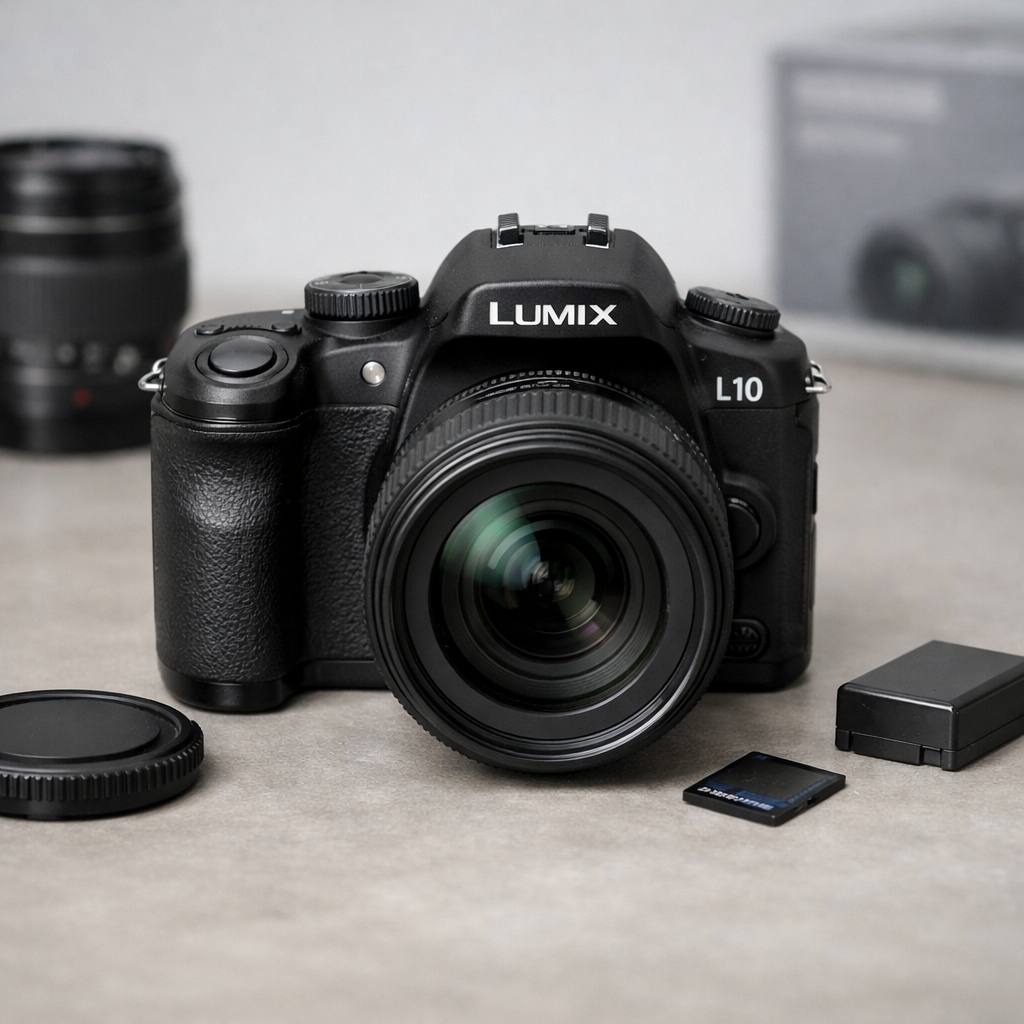
When you first pick up the Panasonic L10, it immediately feels different from many other DSLRs of its era. The body is compact, with a slightly retro silhouette that is comfortable for most hand sizes. The grip is deep enough for stability but doesn’t feel bulky, which is ideal for long walks or street photography sessions. The camera’s weight hits a sweet spot: light enough for all-day shooting, but heavy enough to feel substantial.
Build quality is impressive, especially considering its age. The chassis combines durable plastics with metal elements where it matters. My own well-used L10 has survived several years of urban shooting, travel, and even a couple of unexpected rain showers with only minor cosmetic wear. Buttons and dials remain tactile, and the main mode dial clicks with reassuring precision.
One area where the L10 still feels modern is its fully articulated 2.5-inch LCD screen. This feature was genuinely rare for DSLRs at the time, and even today, it makes the camera extremely versatile. Whether you’re composing at waist level, shooting over crowds, or framing awkward angles, the flip-out screen is a game-changer for creative composition. The screen’s resolution is modest by today’s standards, but it’s bright and color-accurate enough for confident shooting in most conditions.
The menu system feels a bit dated, with chunky icons and a basic structure, but it’s logical and quick once you get used to it. Physical controls are well-placed, and the dedicated ISO, white balance, and drive mode buttons make it easy to adjust settings without diving into menus. The only real ergonomic drawback is the relatively small viewfinder, which can feel cramped – especially if you’re used to larger APS-C or full-frame DSLRs.
Overall, the Panasonic Lumix L10 handling makes it an enjoyable camera for thoughtful, deliberate photography. It encourages you to slow down, consider your composition, and engage with the process, which is a refreshing change from the high-speed, automation-driven experience of most modern cameras.
Image quality and color performance
JPEG output, RAW flexibility, and ISO limits
Despite being nearly two decades old, the Panasonic Lumix L10 image quality still holds up surprisingly well in good light. The camera’s 10-megapixel Live MOS sensor, which was developed in partnership with Olympus, produces pleasing colors and respectable dynamic range for its class. JPEGs straight out of the camera have a distinct Panasonic color palette – natural, slightly warm, and well-suited for portraits and landscapes. Skin tones look lifelike, and there’s enough contrast to create images with a sense of depth without aggressive digital sharpening.
The L10’s RAW files provide a decent amount of flexibility for post-processing. If you’re willing to shoot in RAW and process your images in software like Adobe Lightroom or RawTherapee, you can recover highlight detail and push shadows more than you might expect from a sensor of this era. That said, the files are limited compared to modern sensors, especially in terms of noise performance at higher ISOs.
Speaking of ISO, the Lumix L10 ISO performance is probably its biggest limitation by 2026 standards. ISO 100 and 200 are clean and detailed, with minimal noise. At ISO 400, detail starts to soften, and by ISO 800, you’ll notice visible grain and a drop in color accuracy. Anything above ISO 800 is strictly for emergencies, unless you’re intentionally going for a gritty, film-like look. This means the L10 shines in daylight or controlled lighting situations but struggles indoors or at night without flash or a tripod.
For those who enjoy the look of older digital images, the L10’s files have a certain character that newer, ultra-clean sensors lack. There’s a slight grain and texture that recalls early digital photography, and that can be a creative asset if you embrace it. Just set your expectations around the camera’s strengths: rich daylight color, pleasing skin tones, and a unique rendering that stands out among today’s clinical digital output.
Autofocus, speed, and overall shooting experience
Viewfinder shooting versus Live View performance
When evaluating Panasonic Lumix L10 autofocus today, it’s important to remember the context of its release. The camera uses a traditional contrast-detect AF system, which was quite advanced for its time but feels slow compared to modern phase-detect systems. Through the optical viewfinder, AF is reasonably fast and accurate in good light. It’s more than sufficient for portraits, travel, and everyday scenes, but it’s not designed for fast-moving subjects or sports.
The L10 was one of the first DSLRs to offer proper Live View with autofocus, thanks to its articulated screen. In Live View mode, autofocus speed drops dramatically, as the camera has to perform a “mirror flip” to check focus, making it far slower than using the viewfinder. This is best reserved for static subjects or when you really need the flexibility of composing from an unusual angle. In practice, I use Live View mostly for macro, product, or tripod work where speed isn’t critical.
As for Lumix L10 shooting speed, the camera tops out at 3 frames per second, which is modest even by 2007 standards. The buffer fills quickly if you shoot RAW, so this is not the camera for action photography. However, for most everyday subjects – street photography, landscapes, environmental portraits – the speed is perfectly sufficient. The shutter sound is soft but distinct, adding to the tactile pleasure of shooting with the L10.
Overall, shooting with the Panasonic L10 is a deliberate, thoughtful process. It rewards patience, careful focusing, and a slower pace. While the autofocus and speed may feel dated compared to modern mirrorless cameras, these limitations can actually enhance the creative experience by encouraging you to engage more deeply with your subject and surroundings.
If you are considering a used L10 in 2026, keep in mind that it’s best for genres where precision matters more than speed. For those who appreciate the process as much as the final image, this camera offers a unique blend of nostalgia and practicality – a rare combination in the current market dominated by compact digital cameras and smartphones.
Lens compatibility and the value of the kit lens
Using Four Thirds lenses on the L10 today
When considering the Panasonic Lumix L10 in 2026, lens compatibility becomes a central topic. The camera uses the original Four Thirds lens mount, which was designed before the popular Micro Four Thirds system. This means you cannot directly use Micro Four Thirds lenses without an adapter, and even then, autofocus is often slow or unavailable. However, if you can find Panasonic Lumix L10 lenses or Olympus Four Thirds lenses, the camera becomes much more interesting.
The standout lens for many photographers is the Leica D Vario-Elmar 14-50mm f/3.8-5.6, often bundled as the kit lens with the L10. This lens has a reputation for better-than-average sharpness, rich color, and a pleasant rendering that Leica fans appreciate. It also features optical image stabilization, something not every Four Thirds lens offered at the time. In real-world use, this kit lens is a clear step above many basic DSLR kit zooms from the same era, both in build quality and optical performance.
If you are lucky enough to find the L10 with its original Leica-branded zoom, you are getting a lens that still holds up for general photography, street shooting, and travel. The zoom range is versatile, covering wide angle to short telephoto, and the lens feels balanced on the L10’s body. Manual focus is smooth, and the lens includes a physical switch for stabilization, a small detail that helps when working on a tripod.
For photographers willing to invest some time searching, other Four Thirds lenses can be found on the used market. Notably, the Olympus Zuiko Digital primes, like the 25mm f/2.8 or the 50mm f/2 Macro, are sharp and compact. Autofocus with these lenses on the L10 is not fast by modern standards, but it is accurate and reliable for slower-paced photography. The Panasonic 14-150mm and Olympus 14-54mm are strong all-in-one options for those who want to travel light.
The main limitation in 2026 is simply availability. Four Thirds lenses are getting harder to find, and prices can be unpredictable. If you already own some, or are able to grab a complete L10 kit, you can enjoy a small but high-quality selection of glass. If not, adapting lenses from other systems is possible using adapters, but with mixed results for autofocus and image quality.
In summary, the value of the Panasonic Lumix L10 kit lens, especially the Leica D Vario-Elmar 14-50mm, remains high in 2026. For most users, this lens alone makes the camera worth considering as a characterful walkaround or backup body, especially if you are nostalgic for the Four Thirds era.
Battery life, storage, and practical ownership in 2026
Owning a Panasonic Lumix L10 in 2026 means adapting to some quirks of older digital cameras. Battery life, for instance, is not on the level of today’s mirrorless or even newer DSLRs. In my experience, a fully charged DMW-BLB13 battery will get you about 300-350 shots per charge, depending on how much you use the LCD and how often you review images. Using live view drains the battery noticeably faster, so it pays to be mindful on long outings.
Replacement batteries are still available from third-party suppliers, but original Panasonic batteries are rare. I recommend carrying at least one spare, as older batteries tend to hold less charge after years of use. The charger is proprietary, so make sure any used kit you buy includes it. If not, third-party chargers are available online, though quality varies.
When it comes to storage, the Lumix L10 uses standard SD cards. There is no support for SDHC or SDXC, so the maximum recognized card size is 2GB. In practical terms, this means you will need several small cards if you shoot a lot, or be ready to swap cards and back up often. Cards of this size are inexpensive and easy to find used, but you may want to check their condition before relying on them for important shoots.
Shooting RAW files is fully supported, but the file sizes are small by modern standards (around 10-12MB per RAW). This makes the L10 surprisingly efficient with storage, but also limits the flexibility you get in post-processing compared to modern sensors.
Other ownership considerations include the camera’s menu system, which is logical but dated. Navigation is slower than on current models, and there are fewer customization options. The articulated LCD is still a highlight for creative angles, but it is small and not especially bright by 2026 standards.
If you are buying a used Panasonic L10, check for common issues such as dead pixels on the sensor, sticky buttons, and battery door wear. The camera is robust, but time takes its toll. The shutter is rated for around 50,000 actuations, so ask the seller about its history if possible.
In a world where compact digital cameras are seeing a resurgence, the L10 sits in an unusual place. It is not as pocketable as retro compacts, but it offers a more tactile shooting experience and lens versatility. For those willing to accept its quirks, the L10 can still be a rewarding camera to own and shoot with.
Who should buy it and who should skip it
Pros and cons after real-world use
After spending time with the Panasonic Lumix L10, I can say it is not a camera for everyone. Its appeal lies in a specific mix of nostalgia, simplicity, and the tactile satisfaction of shooting with a classic digital SLR.
Who should consider the L10?
- Photographers who enjoy older digital cameras and want a real Four Thirds shooting experience
- Collectors or those who already own compatible lenses and accessories
- Fans of the Leica D Vario-Elmar 14-50mm kit lens seeking distinctive color and rendering
- Enthusiasts looking for an affordable, rugged body for casual shooting in good light
Who should skip it?
- Anyone needing fast autofocus or reliable continuous shooting for action or wildlife
- Photographers who want modern connectivity (Wi-Fi, Bluetooth, USB-C) or easy file transfer
- Those who require high ISO performance or advanced video features
- Anyone expecting a large, current lens selection without hunting the used market
In terms of value, a used Panasonic L10 kit with the Leica lens can be a bargain, but only if you appreciate its unique strengths and accept its limits. The camera is not an all-rounder in 2026, but it brings a satisfying, almost analog-inspired experience to digital shooting. If that sounds appealing, and if you like the idea of a less common DSLR with a touch of Leica heritage, the L10 is still worth a look.
If your needs are more practical or you want to build a modern system, there are better options. However, for those who want to explore the history of digital photography with a camera that feels different from the crowd, the Panasonic Lumix L10 still has a place.
Frequently asked questions
- Is the Panasonic Lumix L10 still worth buying today?
For photographers who value the Four Thirds shooting experience, distinctive rendering from the Leica kit lens, and classic DSLR handling, the L10 remains a fun and affordable choice. However, it is not ideal for fast action or low-light work in 2026. - Does the Panasonic Lumix L10 shoot RAW files?
Yes, the L10 supports RAW capture, offering 10-megapixel files for more flexibility in editing. RAW files are small by today’s standards, making them easy to store and process. - What lenses work best with the Panasonic Lumix L10?
Native Four Thirds lenses from Panasonic and Olympus perform best. The Leica D Vario-Elmar 14-50mm kit lens offers excellent everyday performance. Other Zuiko Digital primes and zooms are also good choices if you can find them. - How good is the Panasonic Lumix L10 for beginners?
The camera is straightforward to use, with clear menus and simple controls. While autofocus and high ISO performance are dated, beginners interested in learning photography basics will find it a friendly introduction, especially if paired with the original kit lens.
Key takeaways
- The Panasonic Lumix L10 is an older DSLR, but it still offers enjoyable handling and solid image quality in good light.
- Its articulated screen and Leica-branded kit lens remain standout features for photographers who appreciate thoughtful design.
- Autofocus speed, high ISO performance, and system age are the main reasons to choose it carefully in today’s used market.