
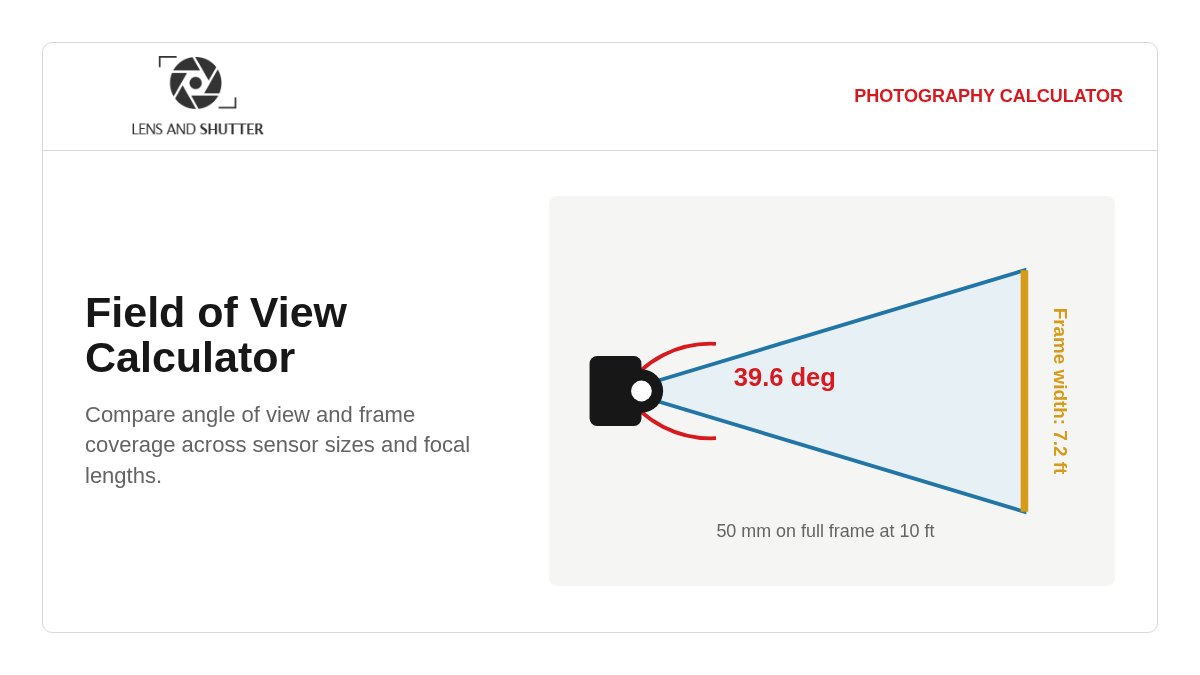
Use the calculator from either side of the shot
Coverage returns the angle of view and the physical width and height recorded at a known distance. Lens finds the focal length needed to fit a specified width from the available camera position. Distance finds the camera position required for a known lens and frame width.
The frame-width input follows the camera's displayed horizontal axis. Switch to portrait orientation when the short sensor dimension runs across the composition.
Full-frame angle of view by focal length
This quick reference uses a 36 x 24mm full-frame sensor and rectilinear lenses focused away from macro distances. Use the calculator above for another sensor size or an exact focal length.
| Focal length | Horizontal | Vertical | Diagonal |
|---|---|---|---|
| 14mm | 104.3° | 81.2° | 114.2° |
| 24mm | 73.7° | 53.1° | 84.1° |
| 35mm | 54.4° | 37.8° | 63.4° |
| 50mm | 39.6° | 27.0° | 46.8° |
| 85mm | 23.9° | 16.1° | 28.6° |
| 135mm | 15.2° | 10.2° | 18.2° |
| 200mm | 10.3° | 6.9° | 12.3° |
| 300mm | 6.9° | 4.6° | 8.2° |
What the results mean
Angle of view
Horizontal, vertical and diagonal angle of view describe angular coverage and do not change with subject distance. Sensor dimensions and physical focal length determine those angles.
Frame coverage
Frame width and height describe the real subject-plane area covered at the entered distance. Double the distance and each linear dimension approximately doubles.
Equivalent focal length
The 35mm-equivalent value matches diagonal angle of view on a 36 x 24mm sensor. It does not change the physical focal length, aperture or optical behavior of the lens.
Portrait orientation
Rotating the camera swaps horizontal and vertical sensor dimensions. Diagonal angle and diagonal crop factor remain unchanged.
Field of view formulas
For a rectilinear lens, angle of view along one sensor dimension is 2 × arctan(sensor dimension / (2 × focal length)). Approximate frame size at the subject plane is distance × sensor dimension / focal length, using consistent units.
The inverse calculations rearrange the same geometry. Required focal length is sensor width multiplied by distance and divided by required frame width. Required distance is frame width multiplied by focal length and divided by sensor width.
Where the model stops being exact
This calculator uses nominal sensor dimensions and stated focal length. Real framing can differ because manufacturers round focal lengths, lenses breathe while focusing, and distortion changes edge mapping. Internal focusing designs can also change effective focal length at short distances.
For macro, copy work, stitched panoramas or shots where edge placement is critical, use the result for planning and verify through the actual camera. Measure distance consistently; the entrance pupil is a better geometric reference than the front filter ring, but its position is rarely marked.
Field of view calculator FAQ
How do you calculate a camera's field of view?
Use the physical sensor dimension and physical focal length in the angle-of-view formula. Calculate horizontal, vertical and diagonal values separately. Subject distance is only needed when converting those angles into real frame coverage.
What is the difference between field of view and angle of view?
Angle of view is an angle measured in degrees. Field of view often means the physical width and height visible at a particular distance, although camera documentation frequently uses the terms interchangeably.
Does crop factor change focal length?
No. A 50mm lens remains a 50mm lens. Crop factor expresses how its angle of view compares with a lens on the 35mm full-frame reference format.
Why does my real lens show a different field of view?
Nominal focal length and sensor sizes may be rounded. Focus breathing, close-focus extension, distortion correction and cropped video modes can all change the recorded frame. Check the camera's active recording area and test critical setups.