
Using the depth of field calculator in the field
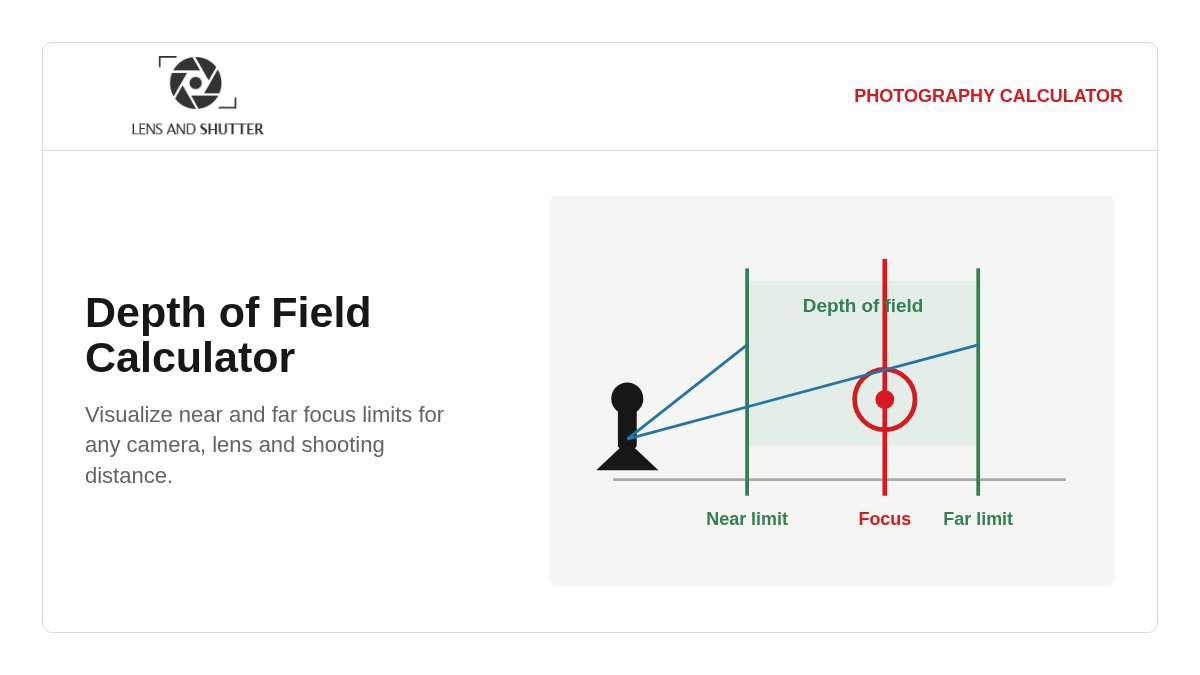
Select the sensor format, then enter the actual focal length marked on the lens, the working aperture and the distance from the sensor plane to the subject. The near and far limits mark where defocus reaches the selected circle of confusion, not where sharpness begins or ends abruptly.
Use Standard mode for a quick field calculation. Advanced mode exposes the sensor dimensions, CoC, field of view and framing results. For measured setups, take focus distance from the sensor-plane mark on the camera body rather than from the front of the lens.
Depth of field examples for common shots
These full-frame examples use a conventional 0.029mm circle of confusion. They show why subject distance and focal length often change depth of field more dramatically than a small aperture adjustment.
| Typical setup | Focus distance | Near to far limit | Total DOF |
|---|---|---|---|
| 24mm at f/8 | 10 ft | 4.5 ft to infinity | Extends to infinity |
| 35mm at f/5.6 | 15 ft | 9.4 to 37.4 ft | 28 ft |
| 50mm at f/2 | 8 ft | 7.6 to 8.5 ft | 0.9 ft |
| 85mm at f/2 | 8 ft | 7.9 to 8.2 ft | 0.3 ft |
| 200mm at f/4 | 30 ft | 29.2 to 30.8 ft | 1.6 ft |
They are planning references, not universal sharpness limits. Enter your actual sensor, lens, aperture and measured distance above for a result that fits the shot.
Calculation assumptions
Circle of confusion
The sensor presets use conventional CoC values close to the sensor diagonal divided by 1,500. They describe typical enlargement and viewing conditions, not a universal sharpness standard.
Distance and focal length
Enter the physical focal length, without applying crop factor, and measure subject distance from the sensor plane. Equivalent-framing comparisons also require changes in focal length or camera position.
Thin-lens model
The calculation assumes a paraxial thin lens. It does not model field curvature, aberrations, focus breathing, diffraction, camera movement or subject movement.
Acceptable sharpness
Only the plane of focus is geometrically exact. Near and far limits are threshold crossings whose practical relevance depends on enlargement, cropping, viewing distance and visual acuity.
Using hyperfocal distance critically
At the calculated hyperfocal distance, the far limit reaches infinity and the near limit lies at approximately half that distance. Infinity is not at best focus: it sits exactly at the selected acceptable-sharpness threshold.
If distant detail has priority, focus beyond the calculated hyperfocal distance or select a smaller CoC in Advanced mode. Large prints, close viewing and substantial crops usually justify a stricter value. Confirm critical work at the intended output size rather than treating the calculated boundary as absolute.
Formula and practical limits
Hyperfocal distance is calculated as H = f2 / (N c) + f, where f is focal length, N is f-number and c is the selected CoC. The near and far limits are then derived from H and focus distance. When focus distance reaches or exceeds H, the far limit is reported as infinity.
Stopping down increases geometric depth of field but does not guarantee more resolved detail because diffraction also increases. At high macro magnification, effective aperture and pupil magnification become significant; use a macro-specific model or field testing when those factors matter.
Depth of field calculator FAQ
Why do depth of field calculators give different results?
Calculators may use different CoC values, exact sensor dimensions, rounding rules or lens equations. Compare the assumptions before comparing the output. Two calculators using the same focal length, aperture, focus distance and CoC should produce closely matching results.
Which circle of confusion should I use?
The presets are suitable for conventional viewing assumptions. Choose a smaller CoC for large prints, close inspection, heavy cropping or a more conservative focus tolerance. The correct value depends on the final presentation, not sensor size alone.
Is infinity perfectly sharp at the hyperfocal distance?
No. Infinity is exactly at the selected acceptable-sharpness limit. If the horizon or distant texture is more important than the nearest foreground, focus farther than H or use a stricter CoC.
Can I use this calculator for macro photography?
Use it only as an approximation at high magnification. Macro depth of field can depend on effective aperture and pupil magnification, which this thin-lens calculation does not include. Critical macro work should be tested directly or planned with a macro-specific focus-stacking calculation.