



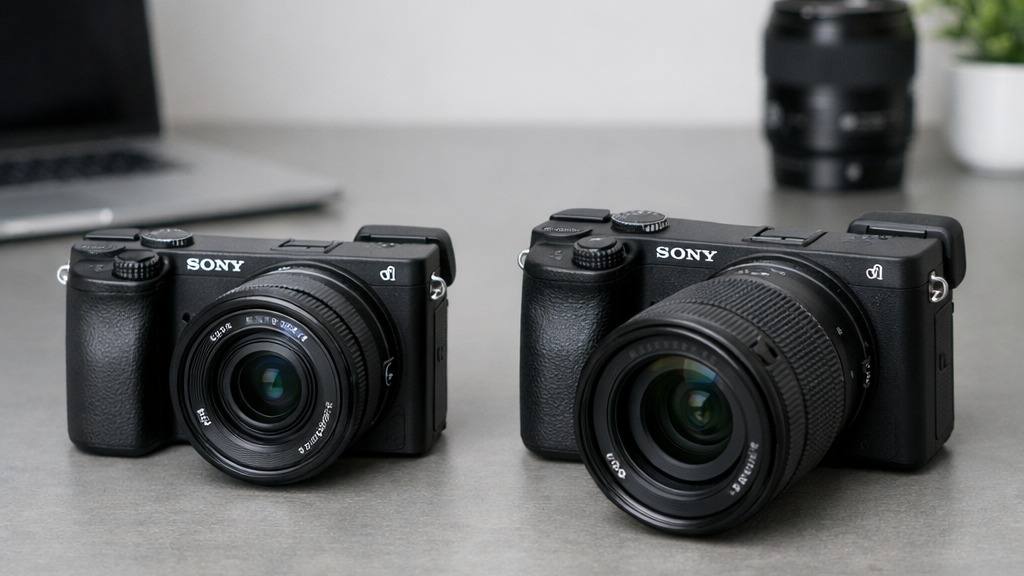
Quick verdict: choose the Sony a6100 if you want the cheaper, lighter entry point into Sony APS-C with very similar image quality. Choose the Sony a6400 if you care about the better viewfinder, tougher-feeling body, advanced video profiles, longer recording sessions, and a camera that feels more serious as your skills grow.
I would not overthink the sensor. The Sony a6100 and a6400 are close enough in image quality that most buyers will not see a meaningful difference in the final files. The real decision is about handling, video, durability, and how long you expect to keep the camera.


Contents
- Sony a6100 vs a6400: the short answer
- What the Sony a6100 and a6400 have in common
- The key differences that affect real-world shooting
- How they compare for video, vlogging, and content creation
- Who should buy the Sony a6100?
- Who should buy the Sony a6400?
- My verdict on value and long-term ownership
- Frequently asked questions
- Key takeaways
Sony a6100 vs a6400: the short answer
The a6100 is the better value camera for beginners, travel, family photography, and casual video. It gives you the same 24.2MP APS-C class, strong Sony autofocus, 4K recording, a flip-up screen, and E-mount lens compatibility without paying extra for features you may not use.
The a6400 is the better long-term camera if you already know you enjoy photography or video. Its higher-resolution viewfinder, stronger build, more advanced video tools, and lack of the old 30-minute recording limit make it the body I would rather own if the price difference is modest.
If you want the broader context before deciding, the Sony A6000 series guide explains where these bodies sit in the larger Sony APS-C lineup. For individual deep dives, see the Sony a6100 review and Sony a6400 review.
For the official baseline specs, Sony lists the a6100 specifications and a6400 specifications in its support documentation.
| Feature | Sony a6100 | Sony a6400 |
|---|---|---|
| Best for | Beginners, travel, family, budget buyers | Enthusiasts, video creators, tougher use |
| Sensor | 24.2MP APS-C | 24.2MP APS-C |
| Autofocus | 425 phase-detect / 425 contrast-detect points | 425 phase-detect / 425 contrast-detect points |
| Viewfinder | 1.44M-dot EVF | 2.36M-dot EVF |
| Video | 4K, mic input, no picture profiles | 4K, mic input, S-Log2/S-Log3/HLG |
| Stabilization | No in-body stabilization | No in-body stabilization |
| Battery | NP-FW50, roughly 380-420 CIPA stills | NP-FW50, roughly 360-410 CIPA stills |
What the Sony a6100 and a6400 have in common
If you pick up the Sony a6100 and a6400 side by side, the first thing to understand is how similar the image pipeline feels. Both use a 24.2MP APS-C sensor, both shoot RAW, both use Sony E-mount lenses, and both can produce very clean, detailed files when paired with good glass.
For still photography, that means the a6100 is not a weak camera just because it sits lower in the lineup. If you shoot portraits, travel scenes, city walks, family moments, product photos, or everyday stills, the a6100 and a6400 can look nearly identical in the final edit.
Autofocus is also strong on both. Sony lists 425 phase-detection and 425 contrast-detection AF points for the a6100, and the a6400 is built around the same modern Sony APS-C autofocus generation. In practice, both cameras are much easier to trust than older entry-level mirrorless bodies. Eye AF, face detection, and tracking make a real difference when photographing people, kids, pets, and casual action.
Both cameras also share the same basic compact rangefinder-style body shape. They fit easily into a small shoulder bag, work well with compact primes, and make sense as travel cameras. They both use the older NP-FW50 battery, so I would budget for a spare battery whichever body you buy.
The key differences that affect real-world shooting
Autofocus, burst speed, and tracking
On paper, the autofocus systems look very close, and for many casual shooters they feel close too. The a6100 is already good enough for family photos, travel, portraits, pets, and basic action. If you are upgrading from a phone, DSLR, or older mirrorless camera, it will feel fast.
The a6400 is the one I would choose when the scene gets more demanding. Its controls, viewfinder, and customization make it easier to stay locked in when shooting faster subjects or working in changing light. It is not a sports flagship, but it feels more confident as a camera you can grow into.
Both cameras can shoot up to 11fps, but the a6400 is the safer pick if bursts and tracking matter to you regularly. If you only photograph kids, travel, friends, and normal street scenes, the a6100 is already plenty.
Build quality, viewfinder, and handling
The a6400 feels more premium. Its magnesium-alloy construction and more rugged design give it a sturdier feel than the mostly entry-level a6100 body. I would still protect either camera from heavy rain, sand, or rough weather, but the a6400 is the one I would rather carry outdoors when conditions are less predictable.
The viewfinder difference is one of the biggest reasons to pay more. The a6100 uses a 1.44M-dot EVF, while the a6400 uses a sharper 2.36M-dot EVF. If you often shoot in bright sunlight, manually focus, review details through the finder, or simply prefer composing at eye level, the a6400 feels noticeably better.
Handling is similar, but the a6400 gives you a little more confidence when paired with better lenses. Neither body has in-body image stabilization, so lens choice matters. If you shoot handheld video or slower shutter speeds, stabilized OSS lenses can make a real difference.
How they compare for video, vlogging, and content creation
4K recording, profiles, and creator features
Both cameras can shoot sharp 4K video, and both have a microphone input. That makes either one usable for YouTube, travel clips, talking-head videos, and beginner creator work. The flip-up screen helps for solo framing, though a top-mounted microphone can block the screen unless you use a small side bracket.
The a6400 is the stronger video camera. It includes picture profiles such as S-Log2, S-Log3, and HLG, which are useful if you want more control over color grading. The a6100 skips those advanced profiles, which keeps the camera simpler but limits flexibility in post.
The a6400 also avoids the older 30-minute recording limit, which matters for interviews, long lessons, events, and streaming-style setups. The a6100 is fine for short clips and casual vlogging, but I would choose the a6400 if video is a serious part of the purchase.
- Sony a6100 video: strong 4K quality, reliable AF, microphone input, simpler profiles, better for casual clips.
- Sony a6400 video: adds S-Log, HLG, longer recording sessions, and better room to grow as a creator.
- Neither camera: has in-body stabilization or a headphone jack.
Who should buy the Sony a6100?
Buy the a6100 if this is your first interchangeable-lens camera or if you want the best value. It makes the most sense for beginners, travel photographers, parents, students, and anyone who wants better image quality than a phone without getting buried in extra features.
The a6100 is also a smart buy if you would rather spend the difference on a better lens. In the Sony APS-C system, a good prime or stabilized zoom can change your photos more than moving from the a6100 body to the a6400 body.
I would choose the a6100 if price is the deciding factor and your main use is still photography, short videos, family memories, travel, or learning photography.
Who should buy the Sony a6400?
Buy the a6400 if you already know you want to take photography or video seriously. It is the better choice for enthusiasts, outdoor shooters, hybrid creators, and anyone who expects to keep the camera for several years while building a lens kit.
The better EVF matters more than spec sheets suggest. So do the video profiles and the more robust feel. If you shoot often, those details make the camera more enjoyable and less limiting.
I would choose the a6400 if the price gap is small, if you care about video, if you use the viewfinder heavily, or if you want the safer long-term body. If your budget stretches further and you want newer autofocus, in-body stabilization, and a more modern APS-C flagship, the Sony a6700 review is also worth reading before you buy.
My verdict on value and long-term ownership
The Sony a6100 is the value pick. It gives you the core image quality and autofocus that make Sony APS-C attractive, and for many photographers that is enough. If your goal is to take better photos, learn manual settings, and travel light, the a6100 is easy to recommend.
The Sony a6400 is the camera I would rather own long term. It does not radically improve image quality, but it improves the experience: better viewfinder, tougher feel, better video options, and fewer reasons to upgrade quickly. That matters if you plan to shoot often.
My practical advice is simple: if the a6400 costs only a little more, buy the a6400. If the price difference is large, buy the a6100 and put the savings toward a better lens.
Frequently asked questions
Is the Sony a6400 worth the extra money over the a6100?
Yes, if you care about the better viewfinder, stronger build, advanced video profiles, and longer recording sessions. No, if you mostly shoot casual stills and want the lowest-cost path into Sony E-mount.
Do the Sony a6100 and a6400 use the same lenses?
Yes. Both cameras use Sony E-mount lenses. APS-C E-mount lenses are the most natural match, but full-frame FE lenses also work if you want lenses that can move to a full-frame Sony body later.
Which is better for beginners, the a6100 or the a6400?
The a6100 is better for most beginners because it is cheaper and produces very similar photos. The a6400 is better for beginners who already know they want to grow into video, manual shooting, or more frequent photography.
Is the Sony a6400 better for video than the a6100?
Yes. The a6400 is better for video because it adds picture profiles such as S-Log2, S-Log3, and HLG, and it avoids the older 30-minute recording limit. The a6100 is still good for short clips and casual vlogging.
Do either the a6100 or a6400 have in-body stabilization?
No. Neither body has in-body image stabilization. If stabilization matters, use stabilized OSS lenses or consider a different Sony APS-C body with IBIS.
Key takeaways
- The a6100 and a6400 share very similar image quality.
- The a6100 is the better budget and beginner choice.
- The a6400 has the better EVF, stronger body feel, and more serious video tools.
- Neither camera has IBIS, so lens choice matters.
- If the price gap is small, the a6400 is the better long-term buy.
Last update on 2026-06-15 / Affiliate links / Images from Amazon Product Advertising API


