



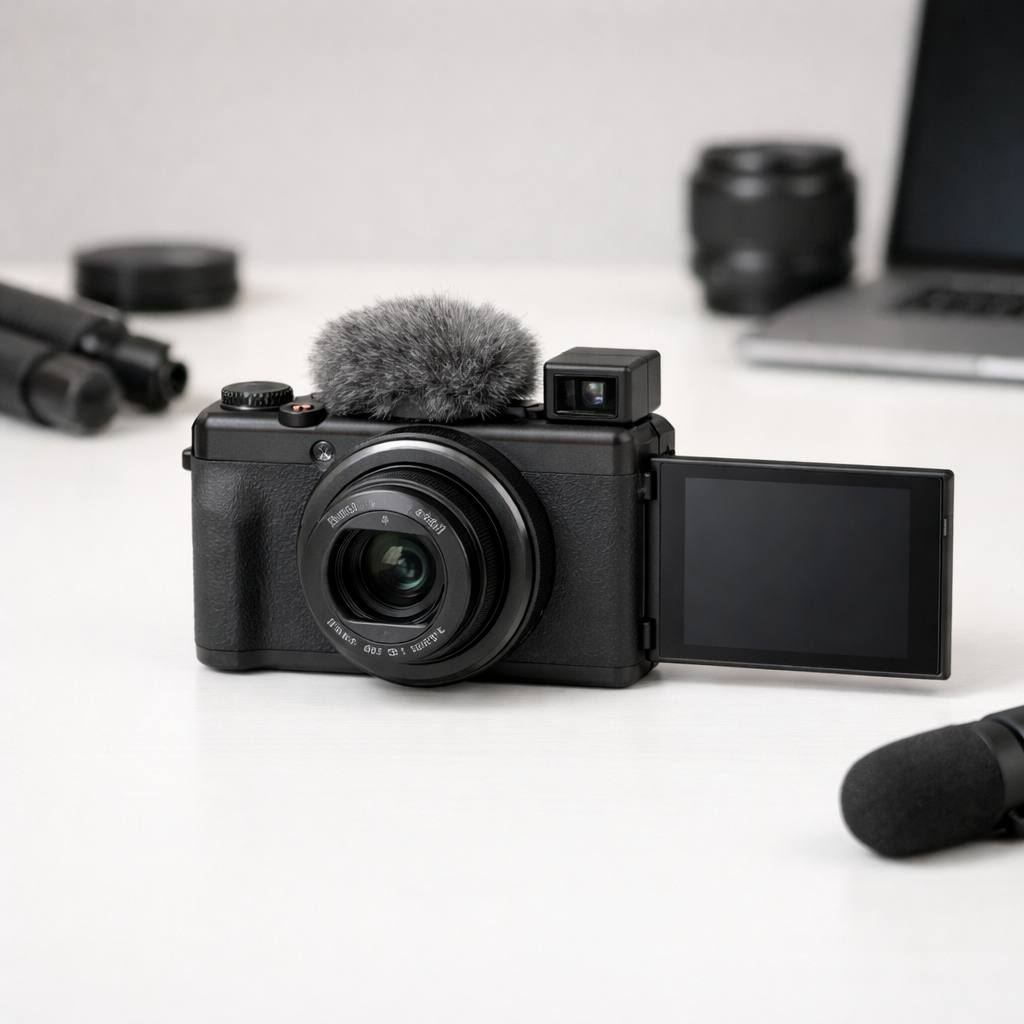
If you are here for a quick buying answer, this Canon PowerShot V1 review is simple: in 2026, the PowerShot V1 looks like one of the most sensible compact cameras for creators who want better image quality and control than a phone, but do not want to carry an interchangeable-lens kit everywhere.
Canon positions it as a creator-first compact in its V Series, and on paper that makes sense. The camera combines a newly designed 1.4-type sensor, an ultra-wide built-in zoom, Dual Pixel CMOS AF II for PowerShot, a fully articulated screen, USB streaming support, and even a built-in cooling fan for longer video recording. At launch, Canon listed it at $899.99 in the US.
As a photographer, I would look at the PowerShot V1 less as a tiny luxury point-and-shoot and more as a practical tool: a camera for travel days, walk-and-talk video, behind-the-scenes clips, family documentation, and everyday shooting when a larger body would stay at home. It will not replace a serious interchangeable-lens setup for specialist work, but that is not the point. The point is that you actually carry it.
Quick verdict for 2026 buyers: buy the PowerShot V1 if you want one compact camera for vlogging, travel, casual street shooting, and hybrid content. Skip it if you know you need interchangeable lenses, an EVF, or the best possible low-light performance for the money.
Contents
- Canon PowerShot V1 specs review 2026: key specs at a glance
- Who the Canon PowerShot V1 is really for
- What the PowerShot V1 is on paper, and why that matters
- Design, handling, and everyday carry appeal
- Image quality: what to expect from the 1.4-type sensor
- Lens range and why it suits travel so well
- Canon PowerShot V1 review for vlogging 2026: is it a good creator camera?
- Autofocus, creator workflow, and practical usability
- Battery life, heat, and long-recording practicality
- Canon PowerShot V1 vs EOS R50 V and Sony ZV-style alternatives
- Pros and cons
- Who should buy the Canon PowerShot V1 in 2026?
- FAQ: Canon PowerShot V1 review questions buyers ask
- Final verdict
Canon PowerShot V1 specs review 2026: key specs at a glance
| Feature | Canon PowerShot V1 | Why it matters |
|---|---|---|
| Camera type | Creator-focused compact camera in Canon’s PowerShot V Series | Built for travel, vlogging, and hybrid shooting rather than lens swapping |
| Sensor | Approx. 22.3MP newly designed 1.4-type sensor | Larger than many pocket vlog cameras, with more room for stills and video quality |
| Lens | Approx. 16-50mm equivalent F2.8-4.5 for stills | Useful range for landscapes, selfies, street, and everyday portraits |
| Video lens coverage | Approx. 17-52mm equivalent for video | Wide enough for handheld creator work without being a one-trick ultra-wide |
| Autofocus | Dual Pixel CMOS AF II for PowerShot | A major selling point for solo creators and family shooting |
| Screen | Vari-angle touchscreen | Essential for self-recording and awkward angles |
| Cooling | Built-in cooling fan | Helps with longer video recording sessions |
| Photo/video control | Dedicated still/movie switch | Useful if you regularly jump between photos and video clips |
| Streaming/webcam | USB video calls and livestreaming support | Good for creators, remote work, and simple desk setups |
| Connectivity | Canon Camera Connect support | Fast transfer and remote-control workflow matter more than many buyers admit |
| Launch price | $899.99 USD | Puts it above casual compacts but below many full creator kits |
Those are the safe headline specs from Canon’s official materials, and they already tell you what kind of camera this is. This is not a stripped-down travel compact. It is a compact camera designed around creator use.
Who the Canon PowerShot V1 is really for
The PowerShot V1 makes the most sense for three groups of buyers.
- Creators and vloggers who want a small all-in-one camera with reliable autofocus, a flip screen, and a wide built-in lens.
- Travelers who want better files and more control than a phone, but do not want to carry a body and multiple lenses.
- Photographers who already own a bigger system and want a compact second camera that is easy to bring everywhere.
As a photographer, I would also add a fourth group: people who are tired of the false choice between a phone and a full camera bag. The PowerShot V1 sits in that middle ground. It is more serious than a phone, less commitment than a mirrorless kit, and that alone will make it attractive in 2026.
Who should skip it? Anyone who already knows they want lens flexibility, a viewfinder, or the strongest value in pure image quality per dollar. If your main interest is wildlife, sports, long telephoto work, or shallow-depth portraiture, a compact fixed-lens camera is still a compromise.
What the PowerShot V1 is on paper, and why that matters
Canon’s official product page and launch announcement make the V1’s priorities very clear. It is part of Canon’s creator-focused V Series, with an ultra-wide zoom lens, a 22.3MP 1.4-type sensor, Dual Pixel CMOS AF II for PowerShot, a cooling fan, a still/movie switch, and USB streaming support. You can read Canon’s own overview on the Canon USA product page and the original positioning in Canon’s launch announcement.
That spec mix matters because it answers the usual compact-camera problem. Traditional compacts often feel compromised for video. Many vlogging cameras feel compromised for stills. The V1 appears designed to split the difference in a more useful way.
The lens range is especially important. Canon lists approximately 16-50mm equivalent at F2.8-4.5 for stills and approximately 17-52mm equivalent for video. That is a practical range, not a gimmick. It is wide enough for handheld self-recording and travel interiors, but not so wide that every shot looks exaggerated. At the long end, it gives you enough reach for tighter framing, food, details, and casual portraits.
Design, handling, and everyday carry appeal
Compact cameras live or die by one question: will you actually bring it with you? On that front, the PowerShot V1 has a strong argument.
It is small enough to fit into a light travel kit, a sling, or a jacket pocket depending on what you wear. That matters more than spec-sheet debates. A camera that stays home because it is annoying to carry is not helping you make better work.
The fully articulating screen is also a practical win. For creators, it is obvious why that matters. For photographers, it matters too. Waist-level street shooting, low-angle travel frames, overhead food shots, and quick tripod setups all get easier with a vari-angle display.
There is no built-in EVF, and that will be a deal-breaker for some buyers. As a photographer, I would miss a viewfinder more for bright midday stills than for video. If you are the kind of shooter who strongly prefers composing with your eye to the camera, that is a real compromise, not a minor footnote.
Still, the V1’s handling concept makes sense for its audience. This is a screen-first, creator-first compact. Canon is not pretending otherwise.
Image quality: what to expect from the 1.4-type sensor
The headline still-image spec is Canon’s approximately 22.3MP newly designed 1.4-type sensor. Without inventing test results that are not in the source material, the sensible expectation is this: it should sit comfortably above smartphone output in flexibility and natural rendering, while still falling short of larger APS-C and full-frame cameras in the toughest conditions.
That is not criticism. It is the honest place this camera occupies.
For travel and everyday photography, 22.3MP is plenty. It gives enough resolution for cropping, social use, web publishing, and respectable print sizes. For creators who need thumbnails, blog images, product shots, and behind-the-scenes stills from the same camera they use for video, it is a practical number.
Canon’s color science is also part of the appeal here. Even buyers who do not obsess over specs tend to notice when skin tones look right and when JPEGs need less work. As a photographer, I would expect the V1’s biggest stills advantage over a phone to be less about raw sharpness and more about cleaner rendering, more natural tonal transitions, and files that feel less aggressively processed.
Low light is where expectations need to stay realistic. A compact camera with a built-in zoom and a sensor smaller than APS-C is still a compromise after dark. It should be very usable for restaurants, city evenings, indoor family moments, and casual night scenes, but if low-light work is your top priority, a larger-sensor interchangeable-lens body still makes more sense.
Lens range and why it suits travel so well
The built-in lens is one of the strongest reasons to consider the PowerShot V1. Canon’s listed 16-50mm equivalent range for stills is exactly the kind of focal range that works in the real world.
- At the wide end, you can shoot city scenes, architecture, interiors, group photos, and handheld selfie framing.
- In the middle of the range, you get natural everyday framing for street scenes, family moments, and documentary-style travel images.
- At the longer end, you can isolate details, tighten compositions, and shoot casual portraits without stepping too close.
As a photographer, I would take this kind of moderate zoom over a more extreme range on a compact. Superzoom lenses often win the spec battle and lose the image-quality and usability battle. A restrained, useful range is usually the better choice.
The variable aperture of F2.8-4.5 is also sensible. It is bright enough at the wide end to help indoors and for subject separation, while staying realistic about the size limits of a compact body. No, it will not give you the same background blur as a fast APS-C prime. But for a carry-everywhere camera, it is a fair trade.
Canon PowerShot V1 review for vlogging 2026: is it a good creator camera?
This is the section many buyers actually care about, and rightly so. If your search is essentially canon powershot v1 review vlogging 2026, the short answer is yes: the V1 looks well judged for solo creator use.
Here is why.
Why the V1 makes sense for vlogging
- Wide built-in lens: Canon’s approximately 17-52mm equivalent video coverage is useful for handheld talking-head work and general B-roll.
- Vari-angle screen: You can frame yourself properly without accessories or guesswork.
- Dual Pixel CMOS AF II for PowerShot: Reliable face and eye tracking are exactly what solo creators need.
- Cooling fan: Longer recording is a real practical advantage, especially for indoor setups, interviews, and repeated takes.
- Still/movie switch: This sounds small, but it matters if you regularly bounce between thumbnails, social stills, and video clips.
- USB video calls and livestreaming: Useful for creators who also stream, teach, or work remotely.
As a photographer, I would say the V1’s biggest strength for vlogging is balance. Some creator cameras are excellent only when pointed at your own face. The V1 appears more flexible than that. It should be able to handle self-recording, travel B-roll, stills, and general everyday shooting without feeling like a one-purpose gadget.
Where vloggers may still want more
The obvious limitation is the fixed lens. If your content style depends on changing focal lengths dramatically, using specialty lenses, or building a more cinematic system over time, an interchangeable-lens body will age better.
There is also the usual compact-camera trade-off in low light. Night vlogging, dim restaurants, and event coverage are exactly where larger-sensor cameras start to pull away. The V1 may still be good enough for many creators, but it is not magic.
Best fit for creator types
The PowerShot V1 looks especially well suited to:
- travel vloggers
- lifestyle creators
- YouTubers who want a simple desk and walk-around setup
- small business owners making product and social content
- photographers who need a lightweight behind-the-scenes camera
If that sounds like your use case, the V1 is easier to justify than many spec-heavier cameras that are less pleasant to carry.
Autofocus, creator workflow, and practical usability
Canon’s inclusion of Dual Pixel CMOS AF II for PowerShot is one of the strongest reasons to take this camera seriously. Autofocus is not a glamorous spec anymore, but it is one of the biggest quality-of-life features for both stills and video.
For solo creators, dependable face and eye detection means less babysitting and fewer ruined clips. For travel and family photography, it means a higher hit rate with less menu diving. For casual street and documentary shooting, it means the camera should feel responsive rather than hesitant.
The workflow side also matters. Canon highlights support for Camera Connect, which is important for quick transfers and remote control. In 2026, a compact camera that is annoying to move files from is simply less useful. If your normal routine involves shooting, transferring to a phone, and posting quickly, this kind of connectivity is not a bonus feature. It is part of the buying decision.
USB video calls and livestreaming support also make the V1 more versatile than a pure travel compact. As a photographer, I would see that as a nice bonus if I wanted one camera to cover desk video, client calls, livestreams, and travel content without extra complexity.
Battery life, heat, and long-recording practicality
One of the more interesting official features is the built-in cooling fan. That tells you Canon expects buyers to use the V1 for meaningful video work, not just occasional clips.
Cooling does not automatically mean unlimited recording in every condition, but it is still a meaningful advantage. Compact cameras often become frustrating when they are marketed to creators yet struggle with sustained recording. Canon clearly wants the V1 to feel more dependable than that.
As a photographer, I would still budget for sensible creator accessories: at least one spare battery, a fast memory card, and USB-C power options if you plan to record for long stretches or stream from a desk. Compact convenience is great, but creator reliability usually comes from a small support kit around the camera.
Canon PowerShot V1 vs EOS R50 V and Sony ZV-style alternatives
This is where the buying decision gets more interesting. The PowerShot V1 does not exist in a vacuum. Most buyers will compare it with an entry-level creator mirrorless body like the EOS R50 V, or with Sony ZV-style compact cameras.
Canon PowerShot V1 vs EOS R50 V
The EOS R50 V route makes sense if you want room to grow. Interchangeable lenses give you more creative flexibility, better upgrade paths, and potentially stronger low-light or portrait performance depending on the lens you choose.
But there is a cost to that flexibility: size, lens decisions, and total system expense. Even a small mirrorless setup is still a setup.
Choose the PowerShot V1 if:
- you want an all-in-one camera with no lens decisions
- you care more about portability than system growth
- you want a compact travel and vlogging camera that is always ready
Choose the EOS R50 V if:
- you want interchangeable lenses
- you expect to build a more serious video or photo kit over time
- you are willing to carry more gear for more flexibility
As a photographer, I would say this: the R50 V is the smarter long-term system choice, but the PowerShot V1 may be the smarter real-life choice for people who value convenience enough to actually use the camera every day.
Canon PowerShot V1 vs Sony ZV-style compact cameras
Sony’s ZV-style compacts are the more direct comparison because they target the same creator audience: small body, flip screen, easy self-recording, and simple hybrid use.
The V1’s likely advantages are its balanced lens range, Canon color, and the fact that Canon seems to be pitching it as a more rounded hybrid compact rather than a narrowly optimized vlogging gadget. Sony’s alternatives remain strong because they are established, widely supported, and familiar to many creators.
If you are deciding between them, ask yourself one practical question: do you want the most creator-specific compact ecosystem, or do you want the camera that feels most balanced between stills, travel, and video? The PowerShot V1 appears aimed at the second buyer.
I would avoid overclaiming here. Sony still has deep experience in the creator compact category, and exact performance differences depend on the specific model you compare. But Canon has clearly built the V1 to be taken seriously in that space.
Simple comparison table
| Camera type | Best for | Main strength | Main compromise |
|---|---|---|---|
| Canon PowerShot V1 | Travel creators and hybrid shooters | All-in-one convenience with creator features | Fixed lens, no EVF |
| Canon EOS R50 V | Creators who want to grow into a system | Interchangeable lenses and more upgrade room | Larger kit, more expense over time |
| Sony ZV-style compact | Dedicated compact vlogging buyers | Strong creator focus and established category presence | Model-specific trade-offs in lens range, handling, and stills balance |
Pros and cons
What the Canon PowerShot V1 gets right
- Very sensible built-in zoom range for travel and creator work
- 22.3MP 1.4-type sensor should offer a meaningful step up from phone shooting
- Dual Pixel CMOS AF II for PowerShot is a major practical advantage
- Vari-angle screen, still/movie switch, and USB streaming support all fit real creator workflows
- Cooling fan suggests Canon took longer video recording seriously
- Compact all-in-one design is easier to carry than a mirrorless kit
Where the compromises are
- Fixed lens means less long-term flexibility than an EOS R body
- No built-in EVF will bother some photographers
- Low-light performance will still trail larger-sensor cameras
- Price is high enough that some buyers will be tempted by entry-level interchangeable-lens options
Who should buy the Canon PowerShot V1 in 2026?
Buy it if you want a compact camera that can realistically cover:
- travel photos and video
- vlogging and self-recorded content
- family and everyday documentation
- social media stills and clips
- a lightweight second camera alongside a larger system
As a photographer, I would recommend it most strongly to people who know they value portability. That sounds obvious, but it is the entire point. If you are the kind of buyer who keeps talking yourself into larger, more capable cameras and then leaves them at home, the PowerShot V1 is exactly the kind of correction that makes sense.
I would recommend it less strongly to buyers who are already thinking about future lenses, external rigs, and system expansion. If that is your mindset, start with an interchangeable-lens body instead.
FAQ: Canon PowerShot V1 review questions buyers ask
Is the Canon PowerShot V1 good for vlogging in 2026?
Yes, on paper it looks very well suited to vlogging in 2026 thanks to its wide built-in lens, vari-angle screen, Dual Pixel CMOS AF II for PowerShot, cooling fan, and USB streaming support. It makes the most sense for solo creators who want a compact all-in-one camera.
What are the Canon PowerShot V1 specs?
Canon lists a newly designed approximately 22.3MP 1.4-type sensor, approximately 16-50mm equivalent F2.8-4.5 lens for stills, approximately 17-52mm equivalent coverage for video, Dual Pixel CMOS AF II for PowerShot, a cooling fan, a still/movie switch, USB video call and livestreaming support, and Camera Connect compatibility.
Is the Canon PowerShot V1 better than the EOS R50 V?
Not universally. The PowerShot V1 is better if you want maximum convenience in a compact all-in-one camera. The EOS R50 V is better if you want interchangeable lenses and a system you can build over time.
Is the Canon PowerShot V1 better than Sony ZV-style compact cameras?
It depends on the exact Sony model and your priorities. The V1 looks especially appealing if you want a more balanced hybrid compact for both stills and video, rather than a camera aimed primarily at vlogging.
Does the Canon PowerShot V1 have a zoom lens?
Yes. Canon lists an ultra-wide built-in zoom lens with approximately 16-50mm equivalent coverage for stills and approximately 17-52mm equivalent coverage for video.
How much does the Canon PowerShot V1 cost?
Canon’s US launch announcement listed an estimated retail price of $899.99.
Final verdict
For the right buyer, the Canon PowerShot V1 is one of the more convincing compact-camera ideas of 2026. It is not trying to be everything. It is trying to be the camera you actually carry when you want better results than a phone and less hassle than a full kit.
That is a smart place to be.
As a photographer, I would see the PowerShot V1 as a practical, opinionated tool: wide enough for creator work, flexible enough for travel, simple enough for everyday use, and serious enough to earn a place beside larger cameras rather than beneath them. The fixed lens and compact format still impose limits, but Canon seems to have chosen the right limits for the audience.
If your search is for a canon powershot v1 camera specs review 2026 or a canon powershot v1 vlogging camera review 2026, the takeaway is the same. This looks like a strong option for creators and travelers who want a compact hybrid camera with fewer compromises than the average pocket vlogging model and less bulk than an entry-level mirrorless setup.
In short: if portability is part of your creative discipline, not just a nice extra, the Canon PowerShot V1 deserves a serious look.


