



Choosing your first DSLR camera can feel overwhelming when you’re standing in front of dozens of options, each promising professional results. I remember that exact moment myself, staring at spec sheets that might as well have been written in another language. The truth is, finding great DSLR cameras for beginners isn’t about buying the most expensive model or the one with the highest megapixel count. It’s about understanding what features actually matter when you’re learning the fundamentals of photography and which cameras will grow with you as your skills develop.
Contents
- What makes a DSLR suitable for beginners
- Top DSLR models for starting photographers
- Understanding sensor size and image quality
- Kit lenses versus investing in better glass
- Autofocus systems explained simply
- Memory cards and storage considerations
- Learning modes and shooting progression
- Viewfinder versus live view shooting
- Considering mirrorless alternatives
- Budget considerations and long-term value
- Building skills alongside equipment knowledge
- Where to find deals and save money
- The importance of learning resources
- Maintenance and care for longevity
- Making your final decision
What makes a DSLR suitable for beginners
The best beginner DSLR cameras share specific characteristics that make the learning process smoother rather than more frustrating. Intuitive controls rank at the top of this list because you need to adjust settings without taking your eye off the viewfinder or missing the moment entirely.
A proper guided mode or scene intelligent auto makes a difference during those early weeks when aperture, shutter speed, and ISO feel like abstract concepts. These features act as training wheels, letting you see how different settings affect your images in real time.
Build quality and ergonomics matter more than you think
Weight and grip design influence how often you’ll actually carry your camera. I’ve seen too many beginners buy heavy professional models that spend more time in the closet than around their necks. A camera that fits comfortably in your hands and doesn’t cause fatigue after an hour of shooting will teach you more than the best camera that stays at home.
Battery life deserves serious consideration too. Nothing kills learning momentum faster than a dead battery halfway through a practice session. The Nikon D3500, for example, delivers approximately 1,550 shots per charge, which means you can spend entire weekends shooting without worrying about power.
The viewfinder quality impacts your shooting experience significantly. Optical viewfinders in DSLRs show you the actual scene through the lens, with no lag or battery drain. This direct connection to your subject helps you understand composition and timing in ways that reviewing images on a screen simply cannot match.
Top DSLR models for starting photographers
Several models have proven themselves reliable companions for photographers taking their first steps beyond smartphone cameras. These aren’t just decent cameras; they represent different approaches to the beginner experience.
Canon EOS Rebel T7 / 2000D
The Canon Rebel T7 occupies an interesting position in the market as one of the most affordable entry points into DSLR photography. Its 24.1-megapixel APS-C sensor produces images with enough resolution for large prints and significant cropping flexibility.
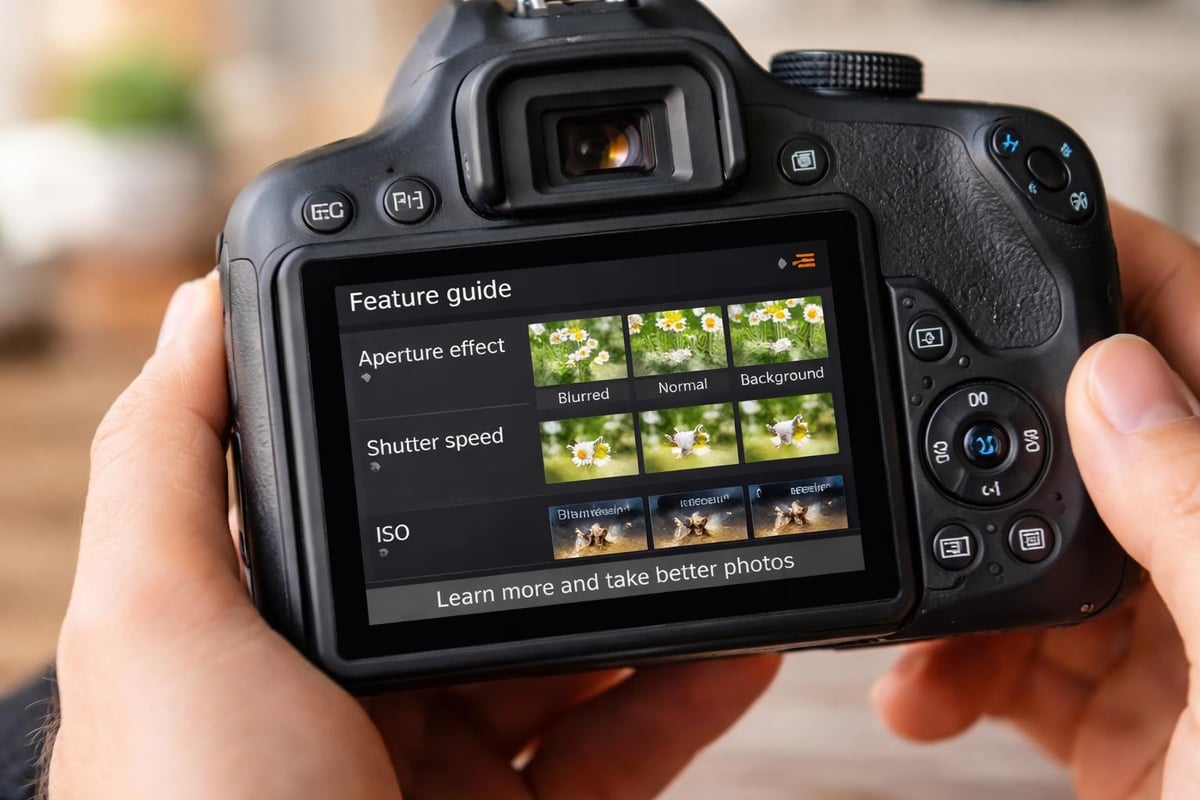
Canon built this camera with simplicity as the guiding principle. The Feature Guide walks you through settings with plain language explanations, turning cryptic camera terminology into understandable concepts. You can shoot while learning rather than studying manuals for weeks before pressing the shutter button.
The 9-point autofocus system seems basic compared to modern standards, but it teaches fundamental focus techniques without overwhelming you with too many options. You’ll learn to position your subject within the focus points and understand when to switch between autofocus modes.

| Feature | Specification | Beginner Benefit |
|---|---|---|
| Sensor | 24.1MP APS-C | Large prints, crop flexibility |
| ISO Range | 100-6400 (expandable to 12800) | Low-light capability for learning |
| Autofocus Points | 9 | Focused learning without complexity |
| Continuous Shooting | 3 fps | Action photography basics |
| Video | 1080p Full HD | Content creation options |
| Battery Life | 500 shots | Full day of casual shooting |
Nikon D3500
Nikon designed the D3500 specifically for people who’ve never held a DSLR before, and it shows in every aspect of the user experience. The Guide Mode transforms the camera into an interactive teacher, showing you exactly which settings to adjust for different scenarios.
Image quality from the 24.2-megapixel sensor rivals cameras costing twice as much. Nikon’s EXPEED 4 image processor handles noise reduction exceptionally well, producing clean images even when you’re shooting indoors without flash.
The body weighs just 365 grams, making it the lightest DSLR in its class. This seemingly small detail becomes significant when you’re carrying the camera all day or holding it steady for extended periods. Your arms won’t complain after a long shooting session.
According to Digital Trends’ comprehensive review, the D3500’s combination of user-friendly features and excellent image quality makes it a standout choice for newcomers to DSLR photography.
Battery performance deserves special mention. While most cameras in this price range struggle to reach 500 shots per charge, the D3500 delivers over 1,500 shots. You can travel for days without worrying about charging cables or spare batteries.
Canon EOS Rebel SL3 / 250D
The SL3 represents Canon’s attempt to create the smallest and lightest DSLR body possible without sacrificing essential features. At 449 grams with battery and card, it feels more like a compact camera than a traditional DSLR.
Canon equipped this model with Dual Pixel CMOS AF, their excellent autofocus technology that works in both viewfinder and Live View shooting. This dual functionality matters because it smooths the transition between traditional DSLR shooting and the screen-based approach many smartphone users prefer.
The 24.1-megapixel sensor produces sharp images with accurate colors straight out of the camera. Canon’s color science has always leaned toward pleasing skin tones, which proves helpful if you’re interested in portrait photography.
Video shooters will appreciate the 4K recording capability, though it comes with a significant crop factor. Still, having 4K available means the camera can handle both photography and video content creation as your interests evolve.
Nikon D5600
The D5600 sits one step up from the D3500 in Nikon’s lineup, offering additional features that intermediate photographers appreciate without overwhelming beginners. The 39-point autofocus system provides more coverage across the frame compared to entry-level models.
Connectivity features set this camera apart from cheaper alternatives. Built-in Wi-Fi and Bluetooth let you transfer images to your phone instantly, making it easy to share your work or back up files without a computer. The SnapBridge app maintains a constant connection, automatically transferring reduced-resolution copies of every image you capture.
The articulating touchscreen opens up creative shooting angles that fixed screens make difficult or impossible. You can hold the camera low to the ground for dramatic perspectives or shoot over crowds without awkward contortions.
As noted in Format’s overview of entry-level DSLRs, the D5600’s combination of features and performance makes it an excellent choice for beginners who plan to advance quickly beyond basic photography.
Battery life matches the impressive performance of the D3500, delivering around 970 shots per charge. Even heavy shooting days rarely require a battery swap.
Understanding sensor size and image quality
The sensor captures light and converts it into the digital image you see on screen. All the great DSLR cameras for beginners use APS-C sensors, which measure approximately 22.5 x 15mm. This size offers an excellent balance between image quality, lens size, and cost.
Full-frame sensors measure 36 x 24mm and appear in professional cameras. They gather more light and produce shallower depth of field, but the cameras and lenses cost significantly more. For beginners, APS-C provides everything you need to learn photography fundamentals.
Crop factor and lens selection
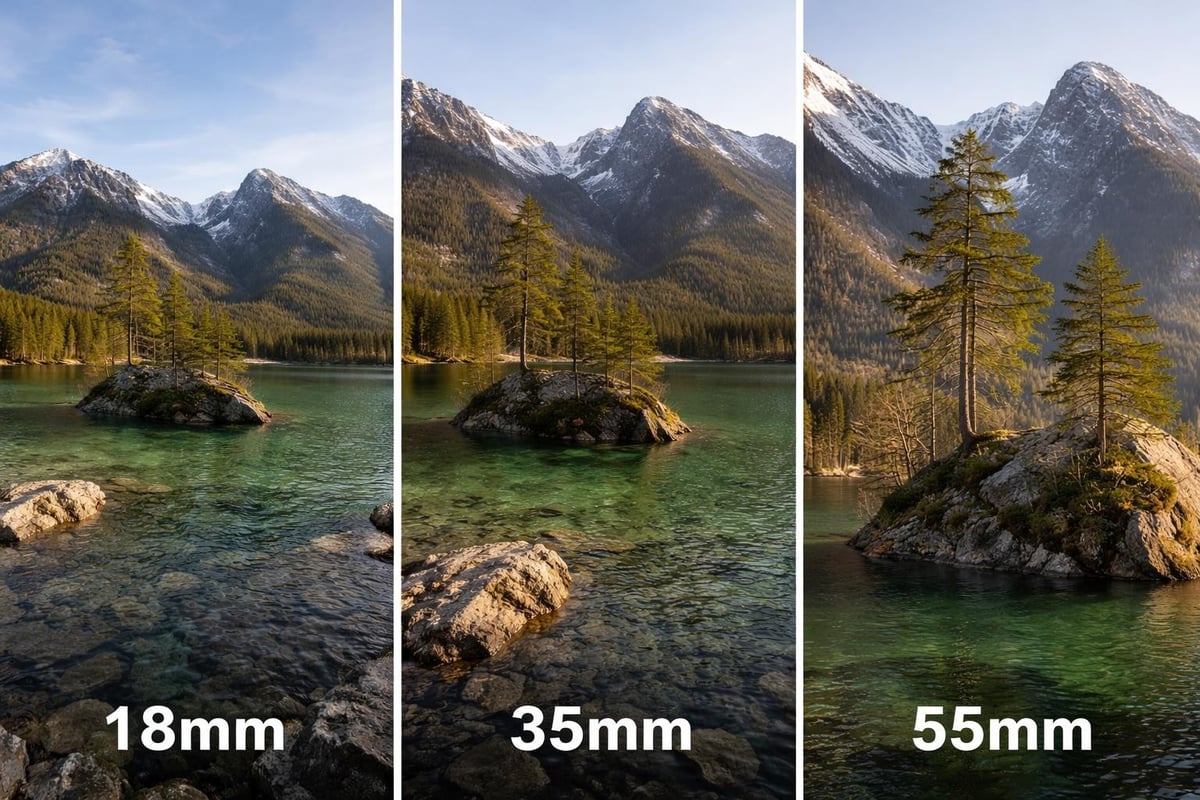
APS-C sensors have a crop factor of approximately 1.5x (Nikon) or 1.6x (Canon). This multiplier affects the effective focal length of lenses you attach to the camera. A 50mm lens on a Canon APS-C camera behaves like an 80mm lens on a full-frame body.
Understanding crop factor helps you choose appropriate lenses for different subjects:
- 35mm lens becomes roughly 50mm (ideal for street photography and environmental portraits)
- 50mm lens becomes roughly 80mm (perfect for traditional portraits)
- 18-55mm kit zoom becomes roughly 29-88mm (versatile everyday range)
This crop factor actually benefits beginners interested in wildlife or sports photography because telephoto lenses gain extra reach without additional cost.
Kit lenses versus investing in better glass
Every camera manufacturer bundles their entry-level DSLRs with an 18-55mm kit lens. These lenses receive criticism from photography communities, but they serve an important purpose for beginners.
The 18-55mm range covers wide-angle to short telephoto focal lengths, letting you photograph landscapes, portraits, and everything in between. Image quality from modern kit lenses exceeds what these lenses produced even five years ago. You can create sharp, professional-looking images if you understand the lens’s limitations.
Kit lenses typically have variable maximum apertures (f/3.5-5.6), which means they don’t gather as much light as more expensive lenses. This limitation becomes noticeable in low-light situations where you need faster shutter speeds or lower ISO values.
Should you buy the camera body only and invest in better lenses immediately? For most beginners, the answer is no. The kit lens lets you discover which focal lengths you use most often before spending money on specialized glass. You might think you need a wide-angle lens until you realize all your favorite images fall in the 50-85mm range.
When to upgrade your lens collection
Signs that you’ve outgrown your kit lens include:
- Consistently shooting at either the wide or telephoto end of the zoom range
- Frustration with low-light performance requiring high ISO values
- Desire for more background blur in portraits
- Needing faster autofocus for action photography
Your first lens upgrade often makes more difference to image quality than upgrading your camera body. A 50mm f/1.8 lens costs between 100 and 200 dollars but transforms your portrait and low-light photography capabilities. The wide f/1.8 aperture gathers far more light than your kit lens and creates beautiful background blur.
If you’re budget-conscious and want to explore your options further, check out our guide on the best cameras under 700 dollars which includes detailed comparisons of DSLRs and mirrorless alternatives at various price points.
Autofocus systems explained simply
Autofocus determines whether your images appear sharp or frustratingly blurry. DSLR cameras use phase-detection autofocus when you’re looking through the viewfinder, which works extremely quickly and accurately in good light.
Phase-detection systems use dedicated sensors below the mirror to calculate focus distance. The number of autofocus points indicates how many areas across the frame can achieve focus. Entry-level cameras typically offer between 9 and 45 points.
More autofocus points don’t automatically mean better performance. The coverage area and sensitivity of those points matter equally. A camera with 11 well-placed, sensitive autofocus points often outperforms one with 45 points clustered in the center of the frame.
Single-point versus area autofocus modes
Understanding autofocus modes helps you capture sharp images in different situations:
- Single-point AF gives you complete control over the focus location by selecting one specific autofocus point
- Dynamic-area AF tracks moving subjects by starting with your selected point and switching to nearby points if the subject moves
- Auto-area AF lets the camera choose which autofocus points to use based on what it thinks is the subject
Beginners often start with auto-area mode because it feels easier, but learning single-point AF early teaches better composition habits and gives you precise control over what appears sharp in your images.
Memory cards and storage considerations
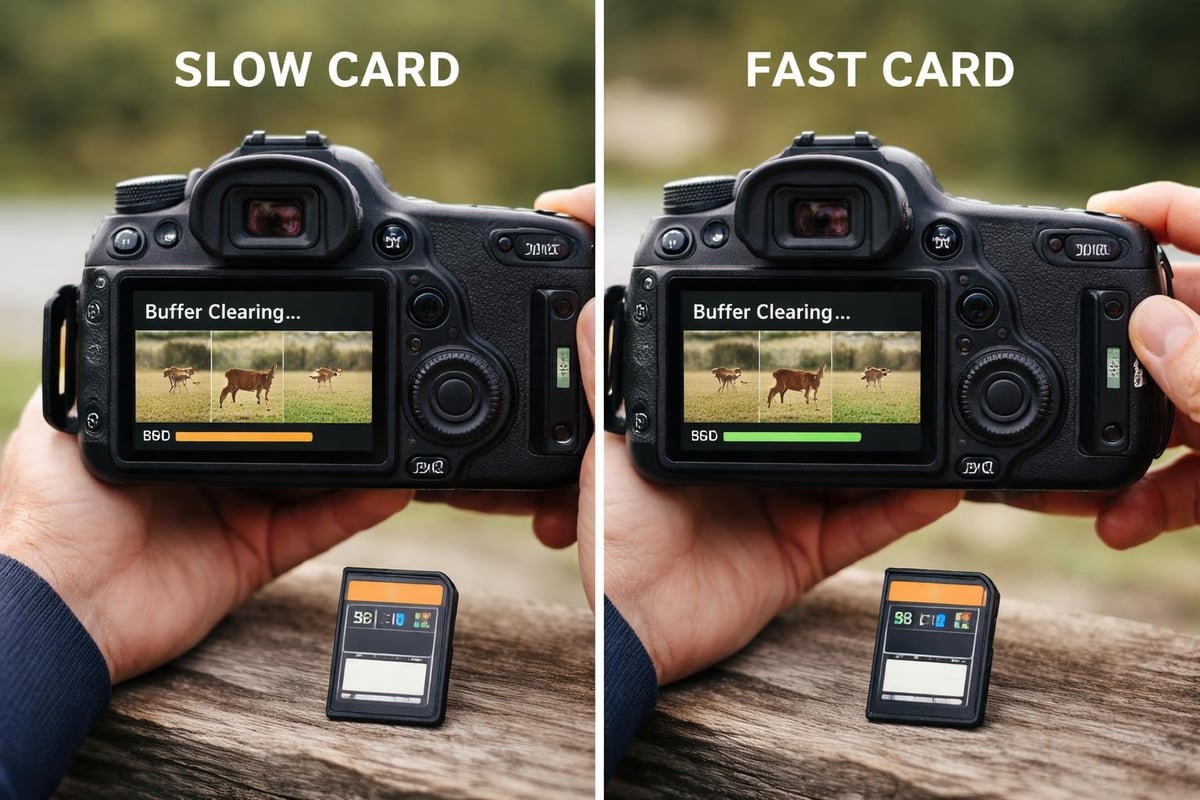
Memory card selection seems trivial until you miss important shots because your card can’t keep up with the camera. DSLR cameras for beginners use SD cards, but not all SD cards perform equally.
Speed class ratings indicate how fast data writes to the card. For photography, a Class 10 or UHS-I card with a speed rating of U1 handles continuous shooting adequately. Video recording, especially 4K, requires faster cards rated U3 or V30.
| Speed Class | Minimum Write Speed | Best For |
|---|---|---|
| Class 10 | 10 MB/s | Basic photography |
| UHS-I U1 | 10 MB/s | Standard photo shooting |
| UHS-I U3 | 30 MB/s | 4K video, continuous shooting |
| V30 | 30 MB/s | 4K video, high-speed bursts |
Card capacity depends on your shooting habits and workflow. A 32GB card holds approximately 1,000 RAW files or 5,000 JPEGs from a 24-megapixel camera. Starting with two 32GB cards costs less than one 64GB card and provides backup security if one card fails or gets lost.
Learning modes and shooting progression
Great DSLR cameras for beginners include shooting modes that gradually introduce manual controls without forcing you to understand everything immediately. The mode dial becomes your progression path from automatic to fully manual shooting.
Scene modes (portrait, landscape, sports, macro) configure all camera settings for specific situations. These modes teach you which combinations of aperture, shutter speed, and ISO work for different subjects, even if you don’t understand why yet.
Moving from auto to manual control
The typical progression follows this path:
- Start with Auto mode to understand basic camera operation and composition
- Move to Program mode (P) which selects exposure settings but lets you adjust them
- Graduate to Aperture Priority (A/Av) to control depth of field while the camera sets shutter speed
- Try Shutter Priority (S/Tv) when you need to control motion blur
- Eventually use Manual mode (M) for complete creative control
Rushing to manual mode doesn’t make you a better photographer faster. Understanding one variable at a time builds solid knowledge that sticks. You can create excellent images in aperture priority mode for years before needing full manual control.
According to insights from TechRadar’s beginner camera guide, cameras with excellent auto modes and gradual learning features help new photographers build confidence while developing technical skills.
Viewfinder versus live view shooting
DSLRs offer two ways to compose images: looking through the optical viewfinder or using the rear LCD screen in Live View mode. Each method has specific advantages depending on your subject and shooting style.
Optical viewfinders show you exactly what the lens sees with no processing delay. This direct view helps you track fast-moving subjects and react to changing moments instantly. The viewfinder also blocks ambient light, making it easier to see your composition in bright sunlight.
Live View mode displays a digital preview of your image on the LCD screen, showing exactly how exposure settings affect the final result before you press the shutter. This preview capability accelerates learning because you see the consequences of changing aperture or ISO immediately.
The tradeoff involves autofocus speed. Most entry-level DSLRs use slower contrast-detection autofocus in Live View compared to the phase-detection system active when using the viewfinder. Cameras like the Canon SL3 with Dual Pixel AF minimize this performance gap.
Considering mirrorless alternatives
While we’re focusing on great DSLR cameras for beginners, you should understand why mirrorless cameras have gained significant market share recently. The fundamental difference lies in the mirror mechanism.
DSLRs use a mirror to reflect light from the lens into the optical viewfinder. When you press the shutter, the mirror flips up, allowing light to reach the sensor. Mirrorless cameras eliminate this mechanism entirely, making them lighter and more compact while offering electronic viewfinders that preview your exposure in real time.
For beginners specifically, mirrorless cameras offer some learning advantages through features like focus peaking and zebra stripes that highlight exposure issues. However, DSLRs still excel in several areas:
- Longer battery life due to optical viewfinders that don’t drain power
- More affordable used lenses available in mature lens systems
- Optical viewfinders with no lag or battery-dependent display
- Generally lower prices for comparable image quality
The Canon EOS R100 has become increasingly affordable, making it a compelling mirrorless option worth considering against DSLR alternatives.
Budget considerations and long-term value
Determining your budget involves more than just the camera body price. A complete photography kit includes several essential items beyond the camera itself.
Complete starter kit costs
Your initial investment should account for:
- Camera body and kit lens: 400 to 700 dollars
- Memory cards: 30 to 60 dollars for two 32GB cards
- Extra battery: 30 to 50 dollars
- Camera bag: 40 to 100 dollars
- Basic cleaning kit: 20 to 30 dollars
- Screen protector: 10 to 15 dollars
Additional accessories like a tripod, external flash, or lens filters can wait until you understand your specific needs. Starting simple prevents wasting money on gear you might never use.
Used camera bodies and lenses offer excellent value if you buy from reputable sources. A two-year-old camera typically costs 40 to 60 percent less than new while delivering nearly identical image quality. Camera technology improves gradually, not dramatically, so older models remain perfectly capable.
Building skills alongside equipment knowledge
The best camera for beginners is the one you’ll actually use consistently. Regular practice develops your photographic eye faster than reading endless tutorials or watching hours of YouTube videos.
Start with daily photography challenges that force you to see ordinary subjects creatively. Photograph the same location at different times of day to understand how light transforms scenes. Limit yourself to a single focal length for a week to learn the perspective it creates.
Understanding exposure triangle fundamentals (aperture, shutter speed, ISO) matters more than memorizing every menu option. These three variables control how much light reaches your sensor and how that light gets captured. Everything else in photography builds on this foundation.
When you’re ready to expand your knowledge beyond the camera body, exploring different lens options helps you understand how glass affects image quality and creative possibilities.
Where to find deals and save money
Camera prices fluctuate throughout the year based on new model releases and retail seasons. Black Friday and Cyber Monday typically offer the deepest discounts, with savings of 20 to 40 percent on camera kits common during this period.
Camera manufacturers release new models on predictable schedules, usually every 18 to 24 months. When a newer version launches, the previous generation drops in price significantly while offering virtually identical image quality for beginners. The Nikon D3500 replaced the D3400, which suddenly became an incredible value despite being an excellent camera.
For those planning major purchases, our Black Friday camera deals guide tracks the best offers and helps you avoid overpriced bundles filled with low-quality accessories.
Retailer bundles sometimes include useful accessories, but examine each item carefully. Many packages pad the perceived value with cheap tripods, memory cards, and camera bags that you’ll replace quickly. A bundle with a quality camera bag and fast memory cards offers better value than one with ten mediocre items.
The importance of learning resources
Camera manuals contain valuable information but rarely explain concepts in beginner-friendly language. Fortunately, extensive learning resources exist online, many specifically created for your exact camera model.
YouTube channels dedicated to photography education demonstrate techniques visually, making complex concepts easier to grasp than text explanations alone. Channels focusing on beginner photography often use the same camera models you’re considering, showing exactly which buttons to press and settings to adjust.
Online photography courses provide structured learning paths that build skills progressively. Free resources from camera manufacturers themselves often get overlooked despite offering model-specific guidance that generic courses cannot match.
Local camera clubs and photography meetups connect you with experienced photographers willing to share knowledge and provide feedback on your work. Learning from someone who can examine your images and explain specific improvements accelerates your development significantly.
Maintenance and care for longevity
Proper camera care extends your equipment’s lifespan and maintains image quality over years of use. Simple habits prevent expensive repairs and frustrating performance issues.
Sensor cleaning seems intimidating but becomes necessary as dust spots appear in your images. Professional cleaning costs 50 to 100 dollars, while doing it yourself requires a 30-dollar cleaning kit and careful technique. Most beginners should have sensors professionally cleaned annually.
Lens cleaning deserves regular attention because fingerprints, dust, and moisture degrade image quality. Use a rocket blower to remove loose particles before wiping, and invest in proper microfiber cloths rather than using shirt tails or paper towels that scratch lens coatings.
Storage and environmental protection
Camera bodies and lenses tolerate reasonable environmental conditions but suffer from extremes:
- Store equipment in a dry environment with stable temperature
- Use silica gel packets in your camera bag to control moisture
- Avoid sudden temperature changes that cause condensation
- Remove batteries during long-term storage to prevent corrosion
- Keep cameras away from direct sunlight when not in use
Weather-sealing varies between models, with entry-level DSLRs generally lacking the protection found in professional bodies. A simple rain cover costs 15 to 30 dollars and protects your investment during light rain or dusty conditions.
Making your final decision
Choosing between great DSLR cameras for beginners ultimately depends on your specific priorities and which system feels right in your hands. Canon and Nikon dominate the DSLR market, both offering excellent entry-level options with mature lens ecosystems.
Visit a camera store if possible to handle different models before buying. The camera that feels comfortable and intuitive to you personally matters more than specifications that look impressive on paper. You’ll take more photographs with a camera you enjoy holding than one that technically outperforms competitors but feels awkward in your hands.
Consider your long-term interests when selecting a camera system. If you think you might develop serious interest in wildlife photography, Nikon’s extensive telephoto lens selection offers advantages. Portrait photographers might prefer Canon’s color rendering and wide selection of affordable prime lenses.
Resist the urge to delay starting photography until you can afford the perfect camera. The best camera is the one you have with you, and an entry-level DSLR in your hands today teaches you more than a professional model you’ll buy eventually. Start shooting now, learn the fundamentals thoroughly, and upgrade when you understand exactly what features you need.
The journey from beginner to skilled photographer depends far more on your dedication to learning and practicing than on which specific camera you choose. Any of the models discussed here will serve you well for years, growing alongside your developing skills and creative vision.
Finding great DSLR cameras for beginners means balancing features, budget, and long-term potential while focusing on models that make learning enjoyable rather than frustrating. The right camera empowers you to develop fundamental skills without overwhelming complexity or breaking your budget. At Lens and Shutter, our detailed reviews and expert guidance help you navigate camera choices with confidence, ensuring your investment supports your photography journey from those first uncertain shots to creating images you’re proud to share.


